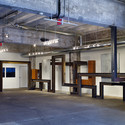
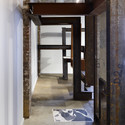
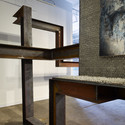
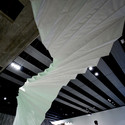
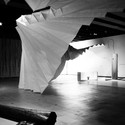
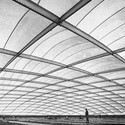
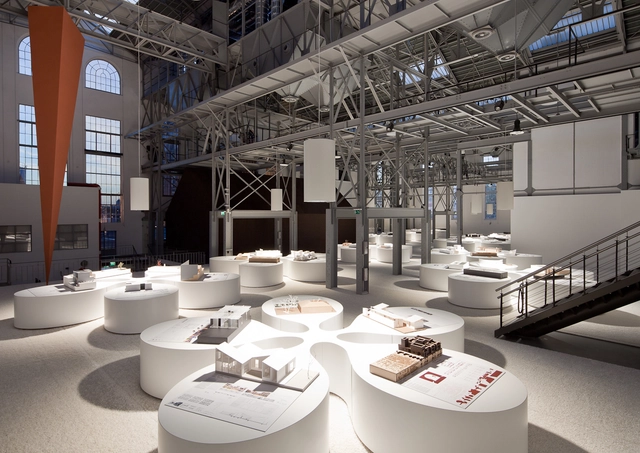
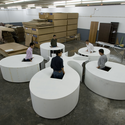
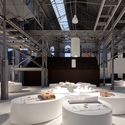
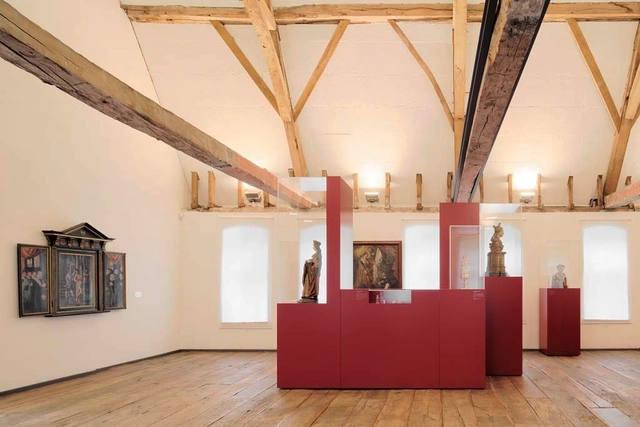
The Longview Gallery in Washington DC invited David Jameson Architect to design an installation that investigates the relationship of art and architecture. The gallery space is housed next to the DC Convention Center in the shell of a 1930’s auto repair garage. Conceived as a spatial armature, Stalling Detritus, as the installation is called, creates a gallery within the gallery by weaving steel beam scraps through space that react to the topography of the concrete structure.
Architects:David Jameson Architect, Inc. Location: 1234 9th St NW Washington, DC, USA Principal: David Jameson Project Architect: Ron Southwick Contractor: Rockville Iron Works Inc Project Year: 2010 Photographs: Alan Karchmer Photography
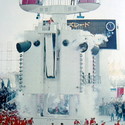
Taking inspiration from the behavior and volume of an idealized cloud, Dan Goods, Nik Hafermaas, and Aaron Koblin created eCloud an interactive sculpture for the San Jose International Airport. The dynamic liquid crystal scultpure hangs from the ceiling displaying weather data from the National Oceanic and Atmospheric Administration. eCloud is constructed from polycarbonate tiles appearing as transparent and opaque depending on the pattern which is in constant motion transforming every 20 seconds.
Recent graduates of the University of Western Australia shared with us their 5th year work studying Soviet Constructivism by researching, analyzing and reproducing various significant buildings from the movement. Additional images of the collection are available after the break.
Following a resounding success at Aedes Gallery in Berlin, international design practice Austin-Smith:Lord is bringing the Informal City of Century XXI and Measure of Man/Measure of Architecture exhibitions to London, England starting with an invitation only conference on January 19th followed by their public exhibition open from January 20th to the 25th. The event will take place at The German Gymnasium, 26 Pancras Road, London N1C 4TB More images and event description after the break.
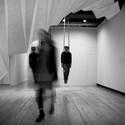
Salvaged Layers; a Collaborative Site Specific Performance project was an interdisciplinary collaboration between two groups of students from separate Universities. The studio challenged students to explore issues of craft, making and place through a series of full scale built interventions in a historic Indianapolis theatre which had been gutted in anticipation of a planned renovation. The raw state of the theatre’s interior gave students a rich and evocative palette to engage while simultaneously liberating them from the conventional notions of stage and audience.
Architects: Students of Ball State University Department of Architecture; Faculty Coordinator Timothy Gray, Gray Architecture Location: 5505 E Washington Street, Indianapolis, Indiana, USA Project Team: Mark Vanden Akker, Austin Lucari, Jay Weeks, Brad Wanek, Veronica Eulacivo, Eric Jenson, Michael Neizer, Paul Reynolds, Greg Hittler, Luke Haas, Ben Greenberg; (Butler University) Jacqueline Vouga, Jeff Irlbeck, Jill Harman, Amanda Lynn Meyer, Amanda Miller, Joe Esbenshade, Chris Ziegler, Jessica Conger, Steph Gray, and Butler University Faculty Coordinator Melli Hoppe Client: Dale Harkin, Irving Theatre Project Year: 2010 Photographs: Greg Hittler, Courtesy of Gray Architecture
We received the following exhibition by Chandler Ahrens and John Carpenter. It is located in Brooklyn, New York City, and it was inaugurated on the occasion of the conference ACADIA 2010 LIFE in:formation hosted by The Cooper Union. It examines concepts, tools and technologies that implement responsive and generative aspects of information in the design process.
The exhibition chairs are Chandler Ahrens, Michael W. Su and Axel Schmitzberger and conference chairs are Pablo Lorenzo-Eiroa, Aaron Sprecher and Shai Yeshauyahu.
The installation of Emergency Exit, the Polish Pavilion at the 2010 Venice Architecture Biennale, by artist Agnieszka Kurant and architect Aleksandra Wasilkowska, seeks to go beyond the logic of urban reality through the creation of ‘urban portable holes’: in-between spaces, places of uncertainty and doubt, of time-space discontinuity, such as abandoned or unfinished buildings, sites of catastrophe or accidents, illegal markets, rooftops and tunnels. The title refers ironically to the health and safety regulations in buildings and urban space that seek to plan, control risk and eliminate the accidental and unexpected. More images and architect’s description after the break.
STILLS shows the development of the oeuvre, shows the projects, expands upon the theoretical background and offers insight into the sources of inspiration and fascination of Wiel Arets himself. From his very early beginnings to his striking and unique personal vision on the future of urban development exemplified by the utopian ‘Zuidstad’ model.
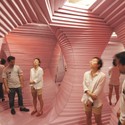
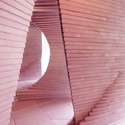
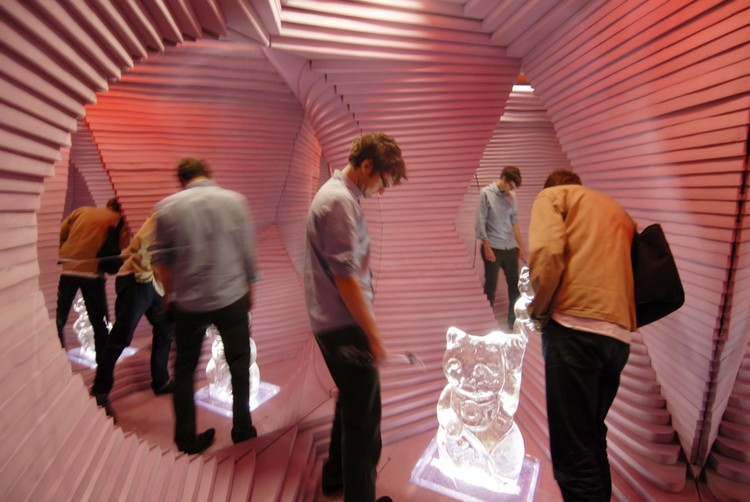
Architects Leong Leong recently shared their photographs from Turning Pink at W/ Project Space in New York’s Chinatown. Made from 3inch rigid insulation and mirrored acrylic this temporary and site-specific installation was part of a series that ‘explore the translation of a legible figure into a continuous visual field’.
More photographs and drawings about the Turning Pink installation following the break.
Architects: Leong Leong Architecture Location: New York City, New York, USA Principals-in-Charge: Dominic Leong and Chris Leong Project Team: Nathan Smith, Christina Galvez, Sarah Carpenter, Greg Bugel, Brittany Drapac, Naomi Szto Builder: Leong Leong Architects Sponsors: 3.1 Phillip Lim and Pabst Blue Ribbon Project Area: 60 sqf Project Year: 2010 Photographs: Courtesy of Leong Leong Architecture
Architects Ahmed Mito, Kamel Loqman, Hisham Alaa and artists Ayman Lotfy, Ahmed Refat, Niveen Farghaly, and Amer Abdelhakemrecently took part of the prestigious La Biennale di Venezia where they presented their work for the Egyptian Pavilion. Images and the architects description after the break.
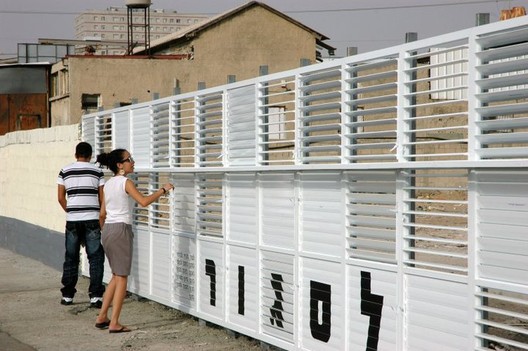
Check out this installation designed by Noa Biran and Roy Talmon for the Timing 2010 – Bat Yam Biennale of Landscape Urbanism. The Biennale is a reaction to existing municipal infrastructure projects, whose long periods of construction disrupt the communities while waiting for ‘a better future.’ The participants were asked to takes these disruptive events and transform them into opportunities for improvement. Biran and Talmon design a new type of fence that replaces the standard corrugated fence on construction sites. This new fence is comprised of different operable sections of recycled plastic shutters that can be open or closed to form an ever-changing façade.
This autumn, the London Design Museum is presenting a major exhibition on John Pawson. Often labelled a ‘minimalist’, he is known for his rigorous process of design. By reducing and editing he creates architecture and product designs of visual clarity, simplicity and grace.
Marco Zanta shared with us some photographs of the exhibition you can visit until January 30, 2011.