

- Year: 2011


As a follow up to last weeks coverage on the Rio Carnival 2012 kick-off in Oscar Niemeyer’s newly renovated Sambadrome, we would like to share with you this stunning tilt-shift video capturing the essence of Rio de Janeiro and the colorful parade of the Carnival. You will also catch a glimpse of famous mosaic sidewalks of the Copacabana Beach Boardwalk designed by the Brazilian landscape architect Roberto Burle Marx.
Creators: Keith Loutit and Jarbas Agnelli Music: Jarbas Agnelli Special Thanks: Rede Globo, Liesa and Jodele Larcher
*This video was filmed during Carnival of 2011.
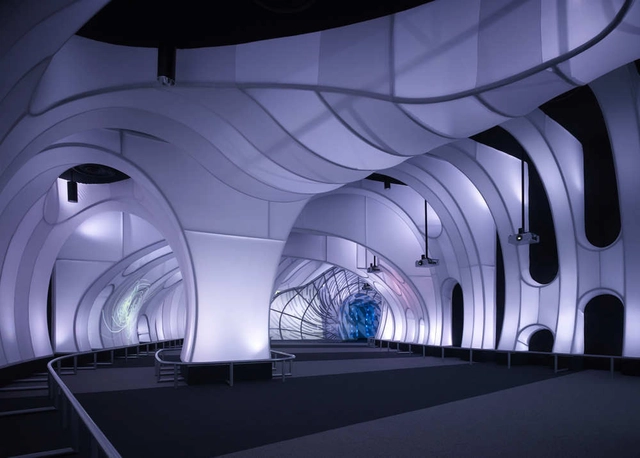

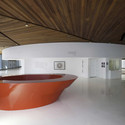
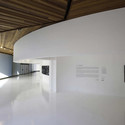
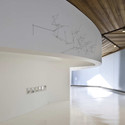
Danica Ocvirk Kus shared with us her photographic work for Oscar Niemeyer‘s Niemeyer Center in Aviles, Spain. Known her work across Europe, her talent is very eloquently represented through these images of this highly admired and appreciated institution for the city. A full gallery of images can be viewed after the break.

‘Calling of the Sea’, the proposal for the exhibition hall for Yantai Development Zone Blueprint by Origin Architect, will be not only a space to exhibit the blueprint of Yantai City, but also present an attitude itself and the possible future of the coastal city, as well as the visions experienced directly. The starting point for the entire design derives from cherishing and respect to unique land conditions. It makes an attempt for common development and symbiotic relationship of urban architectures and nature, protect and develop natural resources, and restore hangovers from the past. In the end, it can make the city’s single coastal environment thriving. More images and architects’ description after the break.


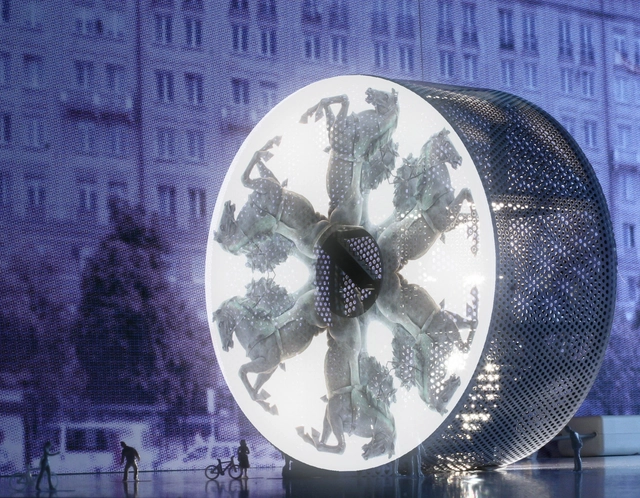
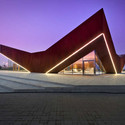
With its function and form changing based on its location and event, the Operalab is a bold statement in the cityscape and serves as an ad hoc embassy for the Polish National Opera’s cultural program. Designed by the collaborative team of Cezary Kępka, Bartłomiej Popiela, Małgorzata Piotrowska, and Jan Sukiennik, the pavilion can be installed in various configurations: vertically, horizontally, in intermediate settings as well as as stand-alone modules. More images and architects’ description after the break.

The project of the Shanxi opera house in Taiyuan, designed by Arte Charpentier Architectes, is at the heart of challenges such as the rapid development of the city and imposing reflections on its planning and scope. Situated in the new district of Changfeng, in the heart of a green island, it participates in the creation of a new centrality for the city. More images and project description after the break.
Nearly two years after OMA was announced the winner of a two-stage international competition, the construction of the new Taipei Performing Arts Center has commenced. This ambitious project, led by OMA partners Rem Koolhaas and David Gianotten, generated a lot of debate among architects when it was announced back in 2009 due to its particular form. Morphed by a series of programmatic operations, the form intersects three types of theater in order to accommodate a variety of performances.

The Proscenium Playhouse, which seats 800, is expressed on the exterior as a large sphere while the other two theaters, respectively capable of seating 1,500 and 800, are represented as peripheric cubes. All the stage accommodations are brought together within the central cube, allowing for more flexibility as theaters can be used independently or combined, thus expanding the possibilities for experimental performances – an art that is very strong in Taiwan. At the same time, and in a similar way as OMA’s CCTV building in Beijing, China, a “public loop” channels circulation through the building, exposing the spaces that make the TPAC work, areas typically are hidden from the public but are as revealing as the performances themselves.
In this aspect, the building is like a machine at work with its engine exposed, somehow reminding me of OMA’s Prada Transformer – a machine-like building (the anti-blob) that changed its configuration to host different types of events.
The 180 million dollar project is set to be completed in 2015. More details, including sections and updated renders, after the break:

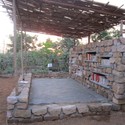
The proposed pavilion, designed by CLP Arquitectos, for the Archi competition, consisted of 20 m2 of floor space to be constructed in a protected natural area in Muttersholtz, Alsace. With a limited budget of 7000 Euros, the commission allowed them to seek for a precise and careful architecture. More images and architects’ description after the break.

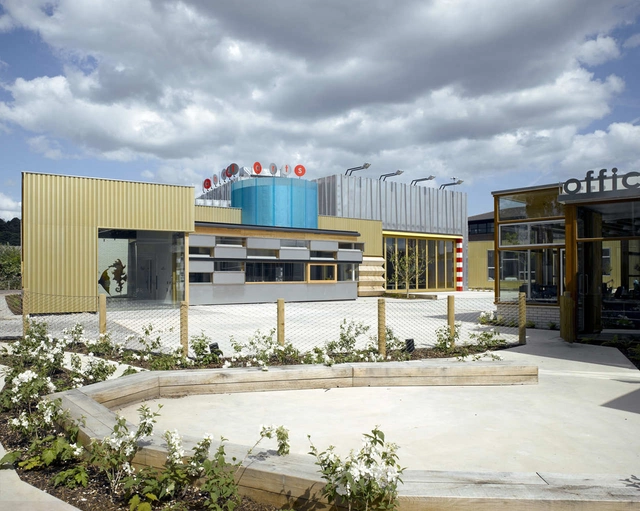

Since 2007, controversy has been stirring due to the rising costs and delayed schedule of Herzog & de Meuron’s Elbphilharmonie concert hall in Hamburg, Germany. Recent reports state the court has approved the city of Hamburg’s €40 million lawsuit against the primary contractor HochTief, who has stopped working in four areas of the €600 million project this past November. HochTief blames the architect due to differences in its plans.
Continue reading for more.