Arguing that the previous thirteen Biennales have, "more or less, tried to predict what is going to happen over the next five years," "Rem Koolhaas has changed the paradigm:" Rem's Biennale is about "the past of the present". Jencks, who describes Koolhaas as "the Corbusier of our time", suggests that his Biennale is about analysis rather than total synthesis. He has, however, "shown that research can be creative."
Dundee, Scotland, 2003 by Frank Gehry / Courtesy of Maggie's Centres. ImageThe third center was designed by Frank Gehry, a close friend of Maggie's. “Frank gave us so much publicity, and allowed us to raise the money,” Jencks says. Each center is self-financed through donations.
Maggie's Centres are the legacy of Margaret Keswick Jencks, a terminally ill woman who had the notion that cancer treatment environments and their results could be drastically improved through good design. Her vision was realized and continues to be realized today by numerous architects, including Frank Gehry, Zaha Hadid, and Snøhetta - just to name a few. Originally appearing in Metropolis Magazine as “Living with Cancer,” this article by Samuel Medina features images of Maggie's Centres around the world, taking a closer look at the organization's roots and its continued success through the aid of architects.
It was May 1993, and writer and designer Margaret Keswick Jencks sat in a windowless corridor of a small Scottish hospital, dreading what would come next. The prognosis was bad—her cancer had returned—but the waiting, and the waiting room, were draining. Over the next two years until her death, she returned several times for chemo drips. In such neglected, thoughtless spaces, she wrote, patients like herself were left to “wilt” under the desiccating glare of fluorescent lights.
Wouldn’t it be better to have a private, light-filled space in which to await the results of the next bout of tests, or from which to contemplate, in silence, the findings? If architecture could demoralize patients—could “contribute to extreme and mental enervation,” as Keswick Jencks observed—could it not also prove restorative?
In this book Michael Maltzan holds conversations with a photographer, architects, a landscape architect, a futurists, and a urban planner about Los Angeles’s recent past and its near and distant future. For Maltzan, Los Angeles is currently in a delicate moment of transformation “where past vocabularies of the city and of urbanism are no longer adequate, and at this moment, the very word no longer applies.” In order to guide this transformation in a positive direction Maltzan asserts that “architects, urban theorists, architects, designers, planners, and city leaders requires keen investigation to produce forms that represent this city and and its culture, as opposed to importing other urban models.” The conversations along with the photographs by Iwan Baan presented in this book are part of the keen investigation Maltzan advocates for. This makes for a very engaging book for anyone interested in Los Angeles and shaping the future of cities in general.
https://www.archdaily.com/136321/no-more-play-michael-maltzanChristopher Henry


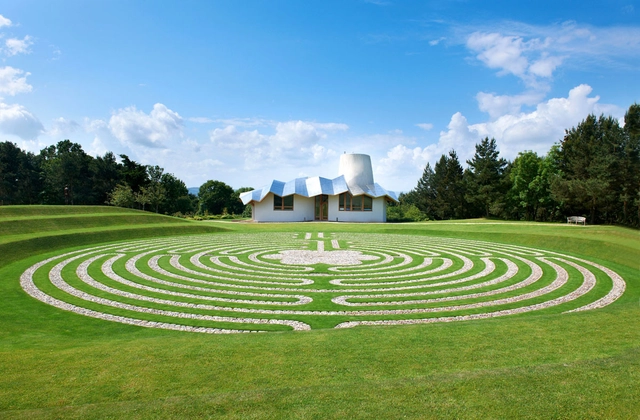

.jpg?1397700541 "Fife, Scotland, 2006 by Zaha Hadid Architects / © Werner Huthmacher. ImageAll sharp angles and painted a sinister black, Zaha Hadid's Fife center isn't the first thing you'd expect from a Maggie's Centre. The exterior invited comparisons to a bunker, despite the airy, humane spaces within. \"Zaha got a lot of criticism and her building is bloody good,\" Jencks says of his former student's design. The building was the architect's first in the UK.")