New York will be the recipient of another Steven Holl project – a new library at the Queens West Development at Hunters Point. Envisioned as a contemporary “urban forum”, the project will shape public space and create new connections across the Queens West Development, Hunter Points South, and the existing neighborhood of Hunters Point. Steven Holl states, “We are very pleased with this great commission for an addition to the growing community. We envision a building hovering and porous, open to the public park. A luminous form of opportunity for knowledge, standing on its own reflection in the east river.”
We’ve seen tons of glitzy and glamorous renderings that immediately attract our attention. You know the kind we mean – a picturesque snapshot where the weather is absolutely perfect, the sunlight is bursting through the glass facade magnificently, and people are laughing and strolling hand in hand. And, sometimes, the rendering style speaks louder than the actual architecture – convincing clients and jurors, or perhaps misleading them, to invest in the project. Of course, we love seeing the variety of presentation styles and how firms market their work, but we also enjoy seeing construction shots and finished photography to see if the realized project lives up to the idealized renderings.
So, if you had to choose between a pencil, a knife, or a hammer as the only tool you could ever own, which would you choose and why? – John Maeda, the President of the Rhode Island School of Design, and this week’s guest moderator for the Glass House Conversations, asks us. These conversations have a rich history rooted in Johnson’s New Canaan creation. Not only did the Glass House offer an elegant example of Modern Architecture, the residence also played hostess to some of the greatest creative thinkers of the twentieth century. Described as “the longest running salon in America,” the Glass House witnessed dozens of intense conversations about art, architecture and society between Philip Johnson and David Whitney and their invited guests, including Andy Warhol, Frank Stella and Robert A.M. Stern. The conversations, not doubt, spurred debate, yet the meetings were the perfect opportunity to share ideas and philosophies that ultimately impacted our culture.
Check out this great video we spotted over at The Architect’s Newspaper Blog by Urban Omnibus. The video’s subject, Mitch McEwan, speaks about Superfront, a space for architectural experimentation located on Atlantic Avenue in Brooklyn. Throughout the video, McEwan emphasizes that the collaboration between the architect and interdisciplinaries is the way for architecture to break out of its isolated shell and affect the broader public. As McEwan points out, architecture cannot become a contained subject that is purely debated and discussed by architects. After all, in order to create places that suit the public, a vital relationship must be fostered between the designer and the community. McEwan also calls to attention the fact that if we want to expand the influence of the architect, we have to, basically, make our “architecture not just about architecture all the time”. We have to create something real and meaningful; our architecture must speak to the site, the local culture, and most importantly, those who will be occupying the space. What do you think of the video and McEwan’s ideas?
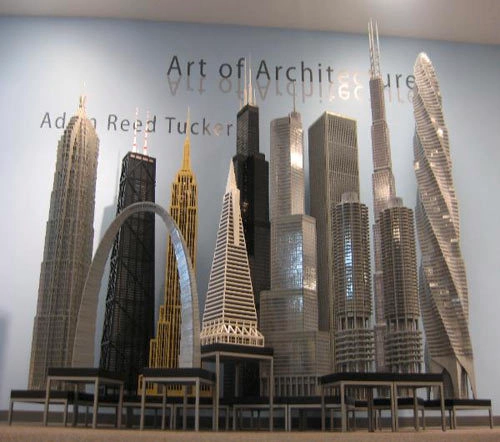
Growing up, LEGO were a staple of most children’s playtime activities to create anything from a house to an entire city for hours at a time. The blocks were so captivating that it seems that even as we outgrow our childhood years, we can never outgrow the toys. Previously, we’ve featured projects that have shown James May’s LEGO addiction…his actual house is built from LEGOs! Yet, May isn’t the only one to still show an interest in the children toys – architect Adam Reed Tuckerhas created 15 large scale buildings from around the world just using the blocks. The buildings are the focal point of the exhibition LEGO® Architecture: Towering Ambition at the National Building Museum in Washington, DC.
Brent Vander Werf’sCompliant Shading Enclosure creates a movable mechanism within the air-gap of a glass enclosure to regulate the amount of sun, shade and shadow permitted in a space. Powered by the energy from the sun, the mechanism passively expands or closes to make the opening the correct size to meet the desired comfort level.
Set for completion this October, NORD Architecture’s Shingle House will be part of the Living Architecture vacation houses, a project aimed to enhance the public’s appreciation of architecture. For their project, the young practice responded to the site’s strong winds and incorporated a modern take on the typical shingle homes that are scattered across the area.
More images and more about the home after the break.
During the post-WWII era, the surge in the housing market often resulted in “faceless” suburban communities that sprang up to relieve the immediate need for housing. The cities maintained their cultural identity and rather than the suburbs infusing their new communities with commercial or cultural entities, the suburbs constantly relied on the city’s proximity for such things. As this old model is highly unsustainable and car dependent, Christoph Vogl from Cheungvogl has studied Long Island’s suburbs, in particular Hempstead, that did not grow as independent communities. He has outlined a master plan of what can be done to give Long Island the social, cultural and economic context it needs.
“Very much representing these observations, the so-thought town centres of Long Island’s communities, placed around the major traffic intersections are not occupied by cultural, commercial and social institutions, as expected from the ratio of communal identity and urban context, but by parking lots. Not some, but hectares of paring lots. Not complaining about the non-existence of urban context and real community, these vacant areas around Long Island’s “Cross roads” offer the unique chance for master planning based reconsideration of the meaning of community,” added Vogl.
Check out the steps of the master plan after the break.
Residents are hopeful that Foreign Office Architects (FOA)’s first museum design (and the firm’s first major US building) will help Cleveland’s urban-revitalization project move forward. Farshid Moussaviof the FOA London has designed a geometric volume that dominates the Uptown area’s site, creating a bold icon for the new Museum of Contemporary Art. Prior to this, the MOCA rented a 23,000 square feet of space on the second floor of the Cleveland Play House complex, but with this 34,000 sqf new home, the museum will be able to showcase a bigger selection and accommodate more visitors.
More images, a cool video, and more about the project after the break.
When we spotted William Leddy’s (the founding principal of Leddy Maytum Stacy Architects in San Francisco) thoughts on Getting Past Green for the Architect’s Newspaper, we completely connected with his words. A few months ago, when we shared Frank Gehry’s comments about LEED, we received an overwhelming number of responses about your opinions of the rating system. Leddy exclaimed, “Let’s get past our paler notions of “green design” and stop fussing over arcane LEED points to get to the real business of fully integrating radical resource- efficiency within our concepts of design excellence. Only then can we whole-heartedly focus the transformative power of design on the greatest challenge of our generation: helping to lead our society to a prosperous, carbon-neutral future. We can afford to do nothing less.”
It is easy to take for granted the things you grow accustomed to, but ever since the initial idea of revitalizing the High Line began sprouting up, New Yorkers have been taking full advantage of the project and loving every second spent strolling, relaxing and gazing at the West Side’s newest addition. The project has truly piqued locals and tourists’ interests as the elevated promenade is enjoyed as much today as it was on opening day over a year ago.
With such success, it is no surprise, as Kate Taylor reported for the New York Times, that the small office of the Friends of the High Line has received countless calls asking how their cities can also enjoy the High Line effect.
Chaired by Paolo Baratta, the Board of the Biennale di Venezia has awarded the Golden Lion for Lifetime Achievement to Rem Koolhaas. The much deserving architect has produced dozens of thought-provoking and inspirational works that constantly push the limits of the current state of architecture. His strength lies in his buildings’ strong conceptual nature that is carried through to ideas about circulation, structure and programmatic organization. ”Rem Koolhaas has expanded the possibilities of architecture. He has focused on the exchanges between people in space. He creates buildings that bring people together and in this way forms ambitious goals for architecture. His influence on the world has come well beyond architecture. People from very diverse fields feel a great freedom from his work,” explained the board.
For the Young Architects Forum Atlanta’s 10UP! National Architectue Competition, participants were challenged to create a temporary installation for Atlanta. The winning 45 ft tower, Periscope, designed by Brandon Clifford and Wes Mcgee of Matter Design Studio, is an “inhabitable installation with iconic implications to advocate bold architecture for the Atlanta community and young designers across the globe.” The designers felt the tower would create a strong marker for the city, “Through vertical expansion via the omission of a vertical restriction, this tower will engage a broader audience, inviting them to the event similar to search lights in the night sky.”
More about the tower, including lots of images and a video, after the break.
If you quickly glance at this first image of Point Supreme Architects’ newest installation, you may being wondering what that blue volume is or even wondering what could happen in that small space. But, if you’re wondering what it is made of, well, that question yields the most interesting answer. The architects teamed with two visual artists, a musician and a performance artist/choreographer to design this installation and performance piece made 100% from blue foam insulation panels!
More information about this installation and more images of the amazing foam work after the break.
Although Peter Zumthor’s success is undisputed in the architecture world, it was interesting he would tackle a residence for Living Architecture as his past works have gracefully unfolded after years of development. For Zumthor’s project, entitled A Secular Retreat, the architect employs his signature strategy of using nature as a source of relaxation. The hill-top retreat is a quiet and passive design, truly taking the backseat to the surroundings. The home is designed to exploit the beauty of its location, capitalizing on views and providing perfect places for reflection. The home, Zumthor’s first project in the UK, is the perfect residence of the Living Architecture projects to visit for some peaceful downtime.
Jeffrey Pongonis’ blog, MSI Design – Beyond the Studio, is chock full of urban issues ranging from new green initiatives to schematic designs for new developments. What attracted our attention was the strategic plan for Columbus Ohio, an initiative to restore Downtown’s vitality by building upon the area’s success from the 2002 Strategic Business Plan for Downtown Columbus.
More about the plan and more images after the break.
A few days ago, we shared C. F. Møller Architects‘ winning entry for the Kristiansund Opera and Culture Center entitled Kulturkvartalet. This project shares its joint first place prize with Oslo based architecture and design office Space Group + London based Brisac Gonzalez. The team of Space Group and Brisac Gonzales have designed a 15, 000 m2 opera and cultural house with a 600-seat auditorium, library, cultural facilities, restaurants and a youth center. ”Our strategy is threefold: a full refurbishment of the building skin, an upgrading of the structure, and an extension of the top floor with roof terrace. The ground floor is conceived as a living room, with spaces for music, newspapers, studying, playing. The café opens graciously to Kongensplass – an urban garden,” explained the team.
More images and more about the winning proposal after the break.
With all the projects we feature, it becomes second nature to envision yourself occupying that space if not only to critique its success, but also to merely imagine what it would be like to live there. But, what if, instead of just daydreaming about living in a certain residence designed by your favorite architect, you could actually spend a week or two in a house designed by Peter Zumthor, or JVA, or even MVRDV? Living Architecture, a new not-for-profit organization, offers the chance to rent houses in different areas of Britain for a vacation starting at £20 per person per night. ”We are dedicated to introducing you to the best of contemporary architecture, as well as to curating unique and enjoyable holidays,” explained the organization.