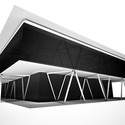
An exciting new structural system will be unveiled tomorrow at the Design Indaba conference in Cape Town, South Africa. QuaDror, invented and patented by Dror Benshetrit, is a space truss geometry system inspired by versatility and structural integrity of interlocking members.
Like a magician revealing the secrets behind his magic, Dror Benshetrit shows that the mechanism behind these structures is surprisingly simple but it is the complex interaction of the interlocking members that makes it so unique. From a simple block model to a bridge support system, the QuaDror system shows its abilities at all scales.
As we reported last week, Interboro Partners’ “Holding Pattern” was selected as the winner of the 2011 YAP organized by the MoMA and the MoMA P.S.1. As usual, and in order to extend the debate, we are presenting you the running entries.
We present you “Ghost House” by London-based firm IJP Corporation Architects, a light-weight installation with a counter-intuitive material structure exuding an aura of mystery and wonder. A representation of contemporary living, to be built almost entirely with tensed rope to enclose spaces that relate to how we live.
The American Institute of Architects (AIA) announced 104 members to be elevated to its prestigious College of Fellows (FAIA) at the 2011 National AIA Convention, held in New Orleans this May. The Fellowship program acknowledges those who have made a ‘significant contribution to architecture and society and who have achieved a standard of excellence in the profession’ a distinguished group of individuals fewer than 2,700 from over 80,000 members. Here is a complete list of the newly appointed 104 FAIA members.
Last week, as the NY Times reported, the interior of 510 Fifth Avenue received landmark protection by the Landmarks Preservation Commission. The building, designed by Gordon Bunshaft of Skidmore, Owings, and Merrill back in the 1950s, served as a branch of the former Manufacturers Trust Bank (later the Chase Bank Building) and is situated on a dense Manhattan block near the New York Public Library, Cook+Fox’s recent One Bryant Park, and the park itself.
More about the landmarked interior after the break.
The commission for a Green Tech City in Hanoi, Vietnam was recently awarded to Skidmore Owings & Merrill. SOM’s preliminary master plan focuses on reducing demand for non-renewable resources while integrating local traditions and utilizing the existing green urban character of Hanoi. At the heart of this new green district is a riverfront park. A series of landscaped green spaces, formed from existing agricultural water channels, would connect into this linear riverfront park creating a well connected network of public parks.
The Philips Livable Cities Award has announced a shortlist of eight initiatives, narrowed down from 450 ideas received from 29 countries around the world. The eight simple solutions all share a common thread, a reasonable approach to improving the health and well-being of people living in cities. Shortlisted designs include a smart grid athletic light for city recreation in NY, design your own park competition, a shade stand in Kampala, and a moveable street park in Buenos Aires. Cast your vote for your favorite Philips Livable City by March 24th. Design Your Own Park Competition in Binghamton, USAIn many cities, neglected urban spaces are seen as unsightly and unusable areas of land. David Sloan Wilson’s shortlisted ‘Design Your Own Park Competition’ idea would turn these areas into a space Binghamton residents can use and be proud of.Shade Stand in Kampala, Uganda James Kityo’s idea involves creating 45 ‘Shade Stands’ across Uganda’s capital, Kampala, providing shelter against both the hot sun and torrential rain, and displaying posters about health education topics. Plaza Movil Street Park in Buenos AiresManuel Rapoport’s ‘Plaza Movil Street Park’ idea would see Buenos Aires’ streets temporarily closed to traffic during weekends and public holidays, and portable playground equipment and benches used to convert them into recreational spaces.Smart Grid Athletic Light in New York City, USA Andrew Burdick’s ‘Smart Grid Athletic Light’ shortlisted idea involves modular solar or wind-powered streetlights connected to a ‘smart grid’, allowing children and sports teams to play later in the day in a well-lit and safer environment. Neighborhood Network Scheme in Abeokuta, NigeriaMichael Iyanro’s idea proposes the development of a ‘Neighborhood Network Scheme’ in Abeokuta, Nigeria, by providing access to a network of welfare services, designed to help elderly citizens live independently and more securely within their city.Rainwater Aggregation in Sana, Yemen In Sana’a, Yemen, water can quickly become scarce, posing a risk to vulnerable city residents. Sabrina Faber’s shortlisted idea of ‘Rainwater Aggregation’ addresses this problem by using existing flat rooftops to capture, filter and store water during rainy periods. iQare in Edinburgh, UKEve Hatton’s shortlisted idea, ‘iQare’, works by simplifying how elderly people in Edinburgh, UK, access the latest digital tools. Thus making it easier to remain independent, stay in touch with friends and family, and access service providers and retailers.Health Education Initiative for the Deaf in Embu, KenyaJacob Ireri has submitted an idea to address the significant challenges faced by deaf children in Embu, Kenya. His ‘Health Education Initiative for the Deaf’ aims to promote health-related information through the teaching of Kenyan Sign Language.
The 2011 edition of Indesem will focus on the theme ‘Losing ground’; the changing position of architect and architecture with respect to the digitalized network society and the necessary shifts in practice and thinking when designing in this changing paradigm. For more information on the theme, lectures and workshop you can go to the event’s official website.
The awkwardly shaped large site at West Side Highway and 57th Street is about to get a whole lot more attention. Bjarke Ingels and BIG will finally make their architectural debut in North America, with an unusual apartment building design in none other than New York City. The asymmetrical peak almost pyramid in shape is the result of blending the mismatched forms of a typical Manhattan tower podium and a low-rise apartment block European in style.
BIG’s reinvention of the ‘New York apartment building’ somehow is able to check all of the boxes, providing a connection to the waterfront and the Hudson River Park, acknowledging the surrounding context both in relationship to building size and neighbors’ views, and alleviating traffic noise. The leafy green courtyards that pop up within this new residential typology help to balance a steeply sloped facade, 450-feet at its peak. Designed for client Durst Fetner Residential, the building offers both a cultural and commercial program and will accommodate 600 residential units varying in size.
Follow the break for the architect’s description and more photographs.
Studio O+A, principals Verda Alexander and Primo Orpilla, were named this week by Contract magazine as the 2011 Designers of the Year. Known for designs such as the Facebook Offices in Palo Alto, the award is recognition of Studio O+A’s consistency of bringing creative quality design to start-ups and venture firms in Silicon Valley.
University of Toronto’s John H. Daniels Faculty of Architecture, Landscape and Design is putting on their Bulthaup Spring 2011 Lecture Series which will feature several well-renowned architects beginning at 6:30pm on February 3rd and ending on March 22nd. The lectures will be held at the University’s John H. Daniels Faculty of Architecture, Landscape and Design in room 103 at 230 College Street, Toronto ON M5T 1R2. Below are the dates of the lectures:
Immersive Kinematics, a new research group at the University of Pennsylvania, shared with us their newly launch website. The research agenda expands the roles of architecture and engineering focusing on integrating robotics, interaction, and embedded intelligence in our buildings, cities, and cultures.
Earlier today it was announced that OMA teamed with AMO have been commissioned to develop a new vision, Railway Vision 2020, for Hong Kong’s MTR, urban transit authority. Together they will produce new branding and identity, site analysis, sustainability research, and usage patterns studies. OMA will also be designing two prototype stations that will eventually span the entire transit network in Hong Kong. The prototype stations are expected to open before 2014.
The 20 collegiate teams chosen for the 2011 Solar Decathlon headed to Orlando, Florida last week for the International Builders’ Show where they met with media, exhibited scaled models of their current designs, and had their Design Drawings reviewed – the last stages of preparation, feedback, and red-flags prior to the September assembly at the National Mall in Washington DC.
In a strange turn of events, the National Park Service and Department of Energy decided to simultaneously announce last week that the Solar Decathlon would not be hosted at the National Mall. Contestants were blindsided by the announcement to relocate this years U.S. Department of Energy Solar Decathlon 2011 competition. The launching pad for the largest solar competition in the world, where contestants are educating the general public about sustainable living and further are held fiscally responsible under competition rules for maintaining and restoring their respective sites to their natural state following the exhibition, is apparently not good for sustainability.
In recognition of his contributions to architecture in both theory and practice Fumihiko Maki was recently named the 2011 AIA Gold Medal Winner. Maki, arguably one of Japan’s most distinguished living architects, will be honored with the award in New Orleans at the AIA National Convention.
Straight on the heels of being named the Best Architectural Monograph of 2010 by the DAM Museum, Taschen republishes YES IS MORE as the World’s 1st Architectural Monograph in an eBook edition tailored to the Apple iPad.
Today, the design for the Broad Museum has been released. Situated adjacent to Frank Gehry’s Walt Disney Concert Hall and Arata Isozaki’s Museum of Contemporary Art, the museum has become a key part of the Grand Avenue redevelopment project that has been losing steam.