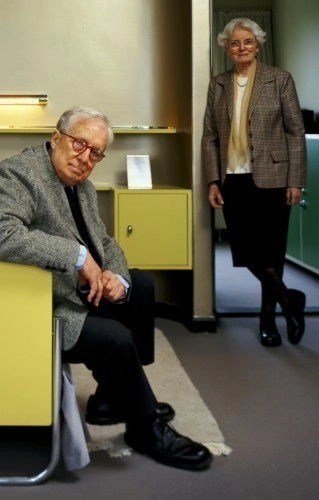
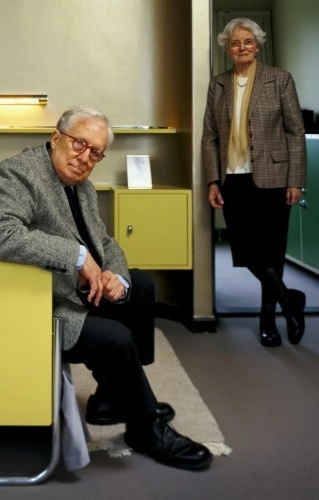
Robert Venturi, the architectural figurehead who fought the cause for postmodernism, turns 88 today. Venturi, whose 1966 book 'Complexity and Contradiction in Architecture' coined the term "less is a bore" - to contradict Mies van der Rohe's famous "less is more" - is possibly the most influential of the theorists who worked to steer architecture away from the modernist ethos in which it had become so entrenched.
Lord Palumbo, the Chair of The Pritzker Architecture Prize, has responded that this would be impossible due to the way that Pritzker Juries deliberate: "Pritzker juries, over time, are made up of different individuals, each of whom does his or her best to find the most highly qualified candidate. A later jury cannot re-open, or second guess the work of an earlier jury, and none has ever done so."
The letter goes on to suggest that Ms. Scott Brown is, however, still eligible for a Pritzker of her own; it also thanks Assouline-Lichten and James for "calling directly to our attention a more general problem, namely that of assuring women a fair and equal place within the profession. [...] one particular role that the Pritzker Jury must fulfill, in this respect, is that of keeping in mind the fact that certain recommendations or discussions relating to architectural creation are often a reflection of particular times or places, which may reflect cultural biases that underplay a woman’s role in the creative process. Where this occurs, we must, and we do, take such matters into account."
Courtesy of Phyllis Richman. Published June 6, 2013 on The Washington Post.
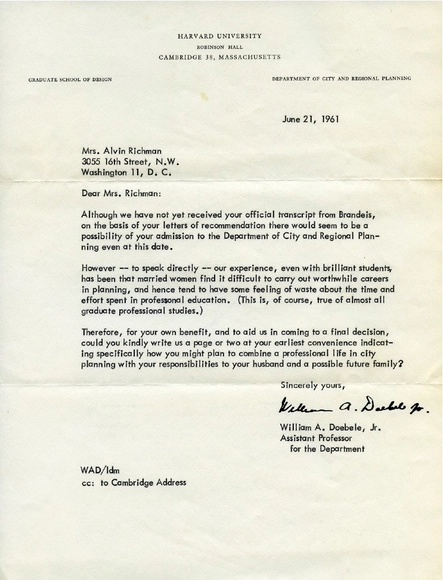
In 1961, Phyllis Richman, a student at Brandeis University, was considering applying to the Harvard Graduate School of Design's Department of City and Regional Planning. The response from Professor Doebele, which you can read above, was to question the validity/practicality of her desire to enter into higher education, being, as she would surely be, a future wife and mother.
While today it sounds almost quaint in its blatantly sexist assumptions, Ms. Richman's letter remains, unfortunately, all too relevant. In her article for The Washington Post, Richman says: "To the extent, Dr. Doebele, that your letter steered me away from city planning and opened my path to writing [a career Richman later describes as "remarkably well-suited to raising children"], one might consider that a stroke of luck. I’d say, though, that the choice of how to balance family and graduate school should have been mine."
She's absolutely right, of course; the decision was hers and hers alone to make. However, there's no avoiding that Richman eventually found success in a job that allowed her to live flexibly as a professional and parent. How many women, and for that matter men, can claim that of architecture? How many architects are convinced, just like Ms. Richman, to pursue success in other, more flexible careers?
More about Richman's letter, and where Denise Scott Brown comes in, after the break...
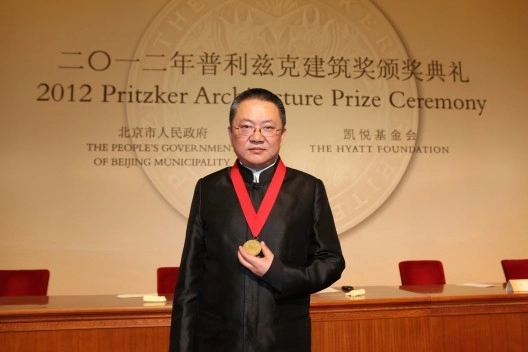
Wang Shu receiving his Pritzker Award in 2012. Oddly, his wife and co-partner, Lu Wenyu, was not acknowledged.
The Pritzker Prize had idealistic beginnings: recognising achievement within architecture, a profession that had long lost its status in public opinion. Pritzker 'seamed' this fragmentation, celebrated the architect and broadcast this stellar contribution to society, as a creative, a singular author whose uniqueness set him/her apart from a field of practitioners.
The Prize has since assumed a role of gatekeeper to the 'starchitect' it once helped define. While it is inspiring that architecture as a profession has reaffirmed its status and cultural significance, The Pritzker places itself on an archi-centric proscenium, running the risk of being consumed by a synthetic reality within the profession. If Pritzker and other similar models of recognition are to evolve, they must illuminate widespread transformations in practice and emphasise the changing of the guard within the profession.
Firstly, Denise Scott Brown should be recognised retrospectively. Opinion does not change facts.
Read more about the (d)evolution of the Pritzker Prize, after the break...
An intense gender debate has been making headlines after Denise Scott Brown called for Pritzker to “salute the notion of joint creativity” and retrospectively acknowledge her role in Robert Venturi’s 1991 Pritzker Prize during an AJ Women in Architecture luncheon in late March. Since, nearly 2,000 advocates have passionately rallied in Brown’s support by signing an online petition created by Harvard’s GSD Woman in Design Group. Among the signatures include architects Zaha Hadid, Farshid Moussavi and Hani Rashid, along with MoMA senior curator of architecture and design Paola Antonelli, architecture photographer Iwan Baan, Rice School of Architecture dean Sarah Whiting, and Berkeley College of Environmental Design dean Jennifer Wolch.
Responding to the outrage, Martha Thorne, executive director of Pritzker Prize, promised to “refer this important matter to the current jury at their next meeting”, respectfully pointing out that this presents an “unusual situation” considering each Laureate is chosen annually by a panel of independent jurors who change over the years.
During a speech at the AJ Women in Architecture luncheon in London last week, postmodern icon Denise Scott Brown requested to be acknowledged retrospectively for her role in Robert Venturi’s 1991 Pritzker Prize, describing Pritzker’s inability to acknowledge her involvement as “very sad”.
Although at the time of the award Brown had co-partnered their practice Venturi Scott Brown and Associates for over 22 years and played a critical role in the evolution of architectural theory and design alongside Venturi for the over 30 years, as well as co-authored the transformative 1970’s book Learning from Las Vegas, her role as “wife” seemed to have trumped her role as an equal partner when the Pritzker jury chose to only honor her husband, Venturi.
More information and an online petition after the break...