
【Final Call】
2019 Taipei International Design Award call for entries. Open until 18 July, 2019
We sincerely invite you to participate. Do not miss this opportunity.


【Final Call】
2019 Taipei International Design Award call for entries. Open until 18 July, 2019
We sincerely invite you to participate. Do not miss this opportunity.

1948-1970 were boom years for Victoria, not equalled until the most recent decade. The Province’s resource-based economy expanded rapidly, followed by investments in jobs and infrastructure.
Over this short period Victoria changed as its rural hinterland gave way to suburbia, Victorian and Edwardian neighbourhoods sprouted high-rise towers and multi-storey walk-ups, and plate-glass replaced terra-cotta. New high-rise densities in the urban core prompted a rethinking of urban space, the public and private realms, institutional and commercial uses. Built form drew on social psychology for innovative approaches to handling light and space.
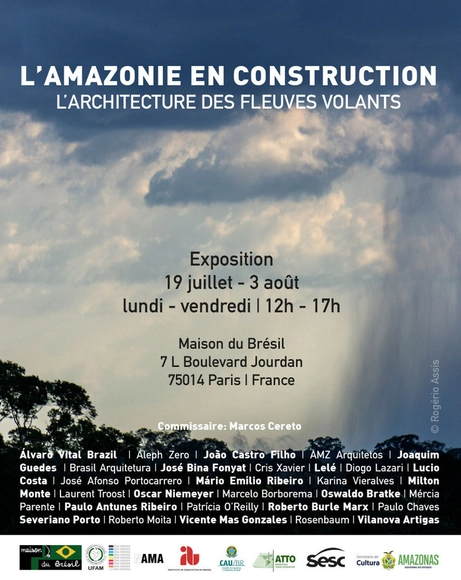
NAMA, Revista Amazônia Moderna and UFAM hold the exhibition L'Amazonie en construction: l'architecture des fleuves volants, from July 19 to August 3 at the Maison du Brésil in Paris, in commemoration of the 60th anniversary of this iconic building designed by Le Corbusier. This is the first time that the Brazilian Amazon will be exhibited in Europe from an architectural point of view. Admission is free.

Public space is under pressure – commercialized for economic interests, abused as a playground for event culture, and maneuvered into insignificance through private acts of self-staging. Is its original function as a forum for public life coming to an end? At the same time, there are ever more standards, regulations, and requirements designed to guarantee safety and functionality. Does this reduce the creative possibilities for new architecture to react to the specifics of the location? If so, how are buildings being affected by these processes?
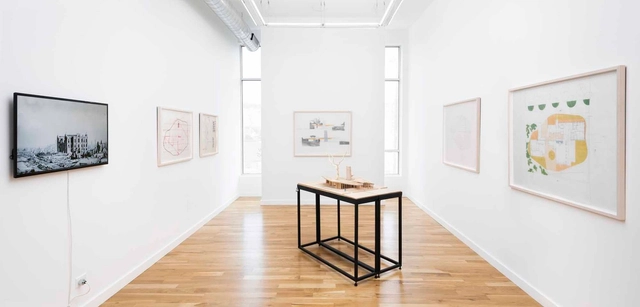
Western Exhibitions is thrilled to present its third solo show with Marshall Brown, Je est un autre, in Galleries 1 and 2. Featuring two new projects, Brown uses the historically disruptive properties of collage and montage to create new spaces, forms, and narratives that embody new relationships between the one and the many. Je est un autre translates roughly to “I is another,” a phrase borrowed from French poet Arthur Rimbaud, and speaks to Brown’s rejection of purist or reductionist worldviews through his hybrid works. The exhibition opens on June 7th with a free and public reception from 5 to 8pm and runs through July 27th.
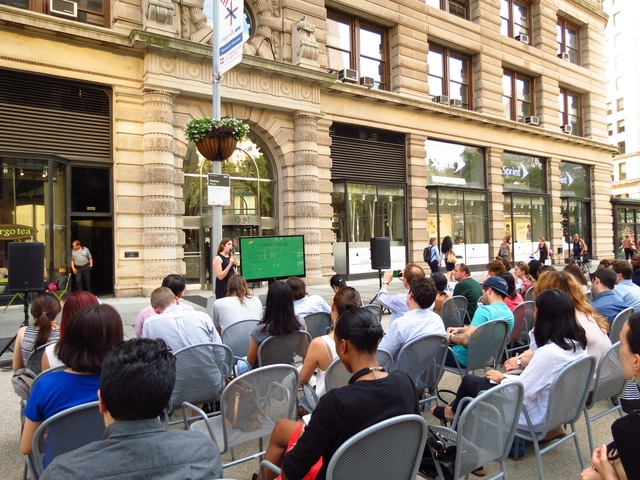
Start Time: 6:00pm
End Time: 7:00pm
The Flatiron/23rd Street Partnership Business Improvement District (BID), in collaboration with General Assembly and local institutions and businesses, presents eight weeks of free education classes on the Flatiron South Public Plaza.

Within the 2019/20 program, CANactions School travels to 4 metropoles in western, northern and central Europe and explores their innovative approaches for creating more livable neighborhoods. Based on the findings, we develop new strategies for locally specific and globally relevant questions, considering spatial, economic, social and political measures.

Join us for the release of Field Guide to Life in Urban Plazas.
The guide outlines a research effort focused on New York City, the primary location of urbanist William H. Whyte’s “Street Life Project,” which formed the basis for his seminal book and film The Social Life of Small Urban Spaces (1980). The new guide seeks to understand how different types of public spaces have changed some 40 years later. What’s changed about how people use the public realm, and what makes for successful spaces?

A monograph on one of the most influential visionary architects of the twentieth century, Claude Parent, whose buildings and theoretical work directly influenced leading architects Hadid, Libeskind, Nouvel and Gehry. The influence of the idealistic French architect Claude Parent (1923-2016) extends far beyond the legacy he left in iconic commercial and residential built works such as the Villa Drusch in Versailles (1963), the church of Sainte-Bernadette du Banlay in Nevers (1966), and GEM shopping center in Sens (1970). The movement was at the heart of Parent's vision, and is nowhere more evident than in his drawings, many of which are published in this book for the first time-- drawings which, according to Frank Gehry, are "extraordinary--beautiful fantasies, full of poetry," and which Edwin Eathcote, writing for the Financial Times, described as "breathtaking... in their ambition they not only presage Daniel Libeskind and Zaha Hadid, they arguably surpass them." Parent's work manifests the oblique function theory he developed with Paul Virilio in 1963, that dictates that buildings should feature slopes, be wall-free where possible and have a predominance of space over the surface. Featuring contributions by some of today's most renowned architects, this long-overdue publication is a must-have for students of architecture and architects alike. Including initial sketches for his best known buildings and never-before-seen drawings of unbuilt works, Claude Parent: Visionary Architect reveals the genius of a man who unquestionably changed the history of architecture.
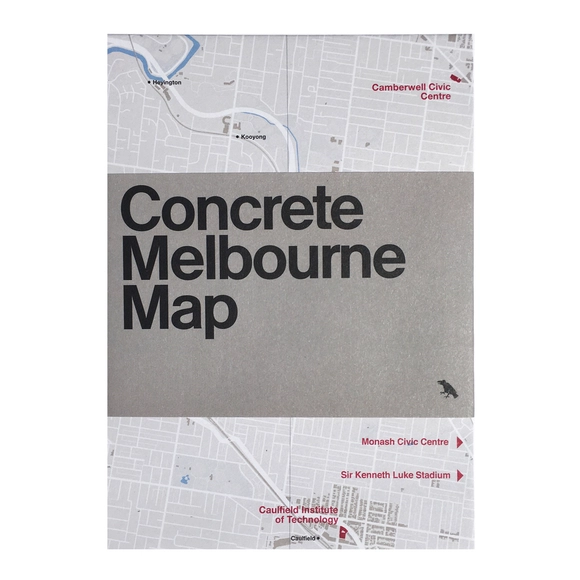
Description via Amazon. Two-sided guide featuring a map of Melbourne’s finest concrete and Brutalist buildings. The reverse includes details for fifty buildings, an introduction by Glenn Harper, the editor of Blue Crow Media's Brutalist Sydney Map, and original photography by Clinton Weaver.
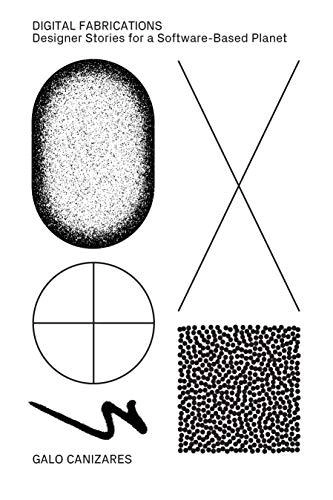
Description via Amazon. Digital Fabrications is a collection of essays and half-true stories about design software and hardware. Written from the perspective of architectural design, each piece expands on emerging trends, devices, foibles, and phenomena engendered by an increased reliance on interactions with interfaces in the discipline. The essays ask, how do we characterize our post-digital design labor? What are the politics of design software? How is architecture adapting to a world largely dependent on platforms and scripts? What are the spatial mechanisms of the internet and VR? Using storytelling techniques, this book accepts that software is everywhere, and narrows in on a few ways it has taken command of our cultural products.From the perspective of architectural design, a field traditionally associated with sketching and its own myths of creativity, computers are an essential workplace tool. Projects rely on a wide assortment of software packages and standalone applications, but rarely do architects reflect on the structure of those programs or how they have infiltrated our disciplinary conventions. PDFs and JPGs are as much a part of our vocabulary as plans, sections, and elevations. A drawing today might refer to a rendering, a CAD document, a proprietary BIM file, or anything that describes a project visually. While one way of examining this disciplinary shift might be to re-imagine what digital drawing can be, this collection of essays puts forth another way: to look at the behaviors, phenomena, collective trends, and oddities emerging as a result of global software proliferation. In other words, this book accepts that software is everywhere, and narrows in on a few ways it has taken command of our cultural products.
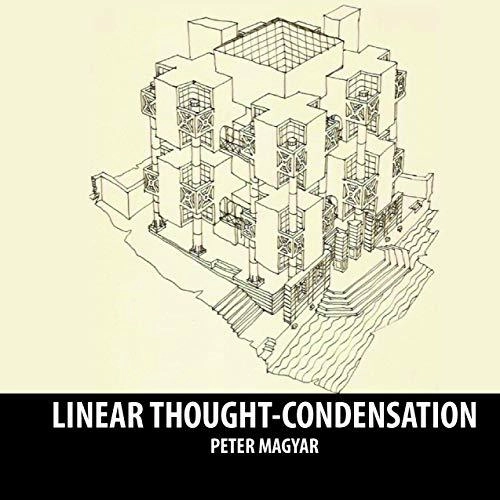
Description via Amazon. Unify knowing and feeling with drawing. Since this process is influenced by the racial memory of our body, the outcome could be unpredictable, mysterious and timeless. If the drawn investigation questions the fundamentals of knowledge, existence and truth, then the resulting architecture might embody a new branch of philosophy. It will affect simultaneously our cerebral, tactile, and spatial perceptions and appear as a circumstantial singularity.

Description via Amazon. LOOK UP! New York is the first volume of an exciting new series of architecture and design books inspiring architects of all ages. This book is an architecture book, an activity book, a history book and an art book all rolled into one--it explores the rich and fascinating world of building in New York City. It is designed to be an on-the-go, fun and informative architecture book. Use it to learn, explore, create and color. It is filled with great drawing and doodling activities for kids and teens as well as beautiful images, architecture detailing and fun historical facts that will inspire everyone. LOOK UP! New York provides a guide for exciting neighborhood walking tours; fun maps are included to enhance observation and learning. The carefully chosen neighborhoods and buildings identify the different types of architecture that evidence culture, life and character for that area of the city. This book will help kids identify architectural drawings, understand building design, develop drawing skills, and recognize architectural details. It will help readers consider architecture in its environment, its impact on our world and its place in history, and will also inspire all readers to sketch building ideas and details in a fun and creative process. New York City is home to some of the most beautiful and recognizable buildings in the world. LOOK UP! New York will include specialized tours of each neighborhood with 6-8 buildings encompassing a perfect walking tour. Currently, the neighborhoods include the Upper West Side, Upper East Side, Bryant Park, and Madison Square Park/Flatiron. Featured buildings include: UPPER WEST SIDE The Dakota Building San Remo Building Kenilworth Building Universalist Church New York Historical Society American Museum of Natural History Rose Center for Earth & Space UPPER EAST SIDE Arsenal Building 820 Fifth Avenue The Knickerbocker Club The Metropolitan Club The Sherry Netherland Hotel The Plaza Hotel The Apple Store BRYANT PARK The New York Public Library Building HSBC Bank Building/Knox Hat Building Bryant Park Hotel Bank of America The W. R. Grace Building FLATIRON WALK New York Life Insurance Building Appellate Division of the Supreme Court of the 54 40 State of New York Metropolitan Life North Building Met Life Tower One Madison Park The Flatiron Building
Description via Amazon. Urban Grids: Handbook for Regular City Design is the result of an eight-year research project undertaken at the Harvard University Graduate School of Design. The book emphasizes the value of the regular city as an open form for city design, and specifically insists that the grid has the unique capacity to absorb and channel urban transformation flexibly and productively. Research into existing cities and projects is revealing new emerging conditions for the urban grid, presented here as possible paradigms for the city of the future. The work is organized into six parts: 1. The Atlas of Grid Cities; 2. Grid Projects across History; 3. The Twentieth-Century Dilemma; 4. The Emergence of New Urban Grids; 5. Projective Design Tools; 6. The Good Grid City as Open Form.
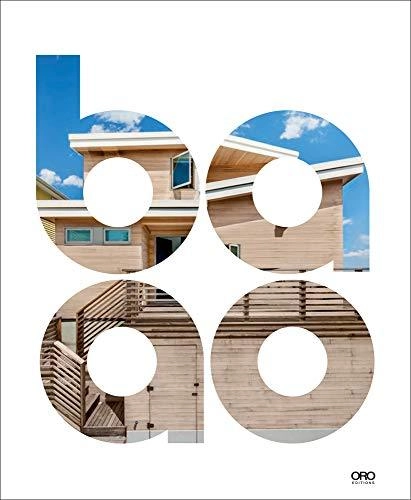
Description via Amazon. This publication charts the multidisciplinary practice of Brooklyn-based architecture and design firm BAAO. By delving into a cross section of projects from acclaimed single- and multi-family residencies in Brooklyn, to institutional and retail projects like the Maple Street School and the Body Factory Midtown, to propositions like Chromatic Energy Landscape that fuse engineered technologies with ecological processes like photosynthesis and algae production, this eponymous publication highlights the diversity and ingenuity of BAAO’s practice.Flowing through a thematic structure that is porous and intersectional, BAAO is not intended as a roundup of independent projects but instead presents itself as a selected outcome from a larger cluster of ongoing material and spatial research. This publication situates BAAO’s work in the context of topical discussions including ecology and the landscape, multigenerational architecture and design, and the role of fabrication technologies in producing new relationships to space and place.
PURPOSE OF THE COMPETITION
The subject of the competition is the architectural design of the building of the Faculty of Mechanical Engineering (UL FS) in the area marked EUP RD 358, within the framework of the University Center Brdo (OPPN 65). The area under consideration is located in the western part of the city of Ljubljana, at the northern foot of Rožnik hill, which ends on the west side of the Trail of Remembrance and Comradeship (PST). The building of the Faculty of Mechanical Engineering is placed in a narrower area determined on the basis of a preliminary urban competition for the building of the Faculty of Mechanical Engineering and the Faculty of Pharmacy. The subject of the competition is also the external arrangement of the wider competition area of the two faculties, which in certain parts exceeds the ownership boundaries.
PURPOSE OF THE COMPETITION
The subject of the competition is the architectural design of the building of the Faculty of Pharmacy (UL FFA) in the area marked EUP RD 358, within the framework of the University Center Brdo (OPPN 65). The area under consideration is located in the western part of the city of Ljubljana, at the northern foot of Rožnik hill, which ends on the west side of the Trail of Remembrance and Comradeship (PST). The building of the faculty is placed in a narrower area determined on the basis of preliminary urban competition for the building of the Faculty of Mechanical Engineering and the Faculty of Pharmacy. The subject of the competition is also the external arrangement of the wider competition area of the two faculties, which in certain parts exceeds the ownership boundaries.

OVERVIEW
The definition of crime is culturally subjective. This subjectivity used to help us define law and punishment in a more rational manner in the past. Today, this subjectivity placed against pacing time and increasing globalization is not easy to rationalize anymore.
We see this in many walks of life where assets like gold which used to be the driving force of an economy. Where trade and even countries were valued based on how much gold reserves they had in the past. In today’s context, trade depends on technology and the currency here is information. The millions of gigabytes of data that flow over the internet fuels the economy today. Where stealing gold is deemed a crime and is identified by everyone as a crime. But when it comes to information, all the applications, internet service providers, devices like Alexa and corporations are running on this data.