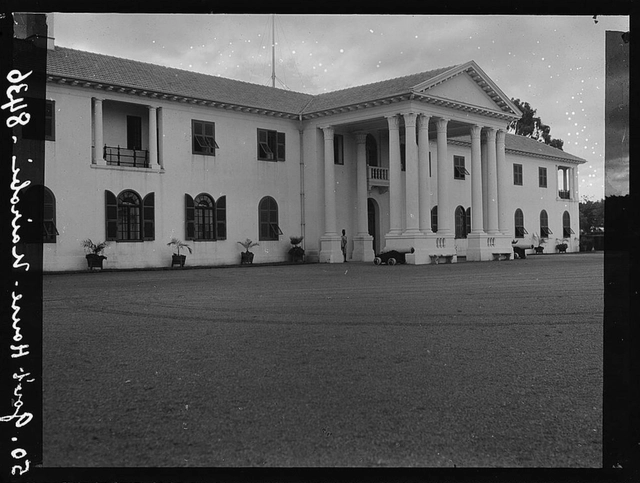
Known as the state house, the presidential palace, and an assortment of other terms — the building that hosts a country’s seat of government is usually quite architecturally striking. Frequently opulent, grand, and sometimes imposing, the state house is intended to function as a visually distinct marker of a nation — an extension of a state’s identity. In the African continent, a landmass that had seen a significant part of it colonized by European nations, this identity of statehood, in an architectural sense, is complex.
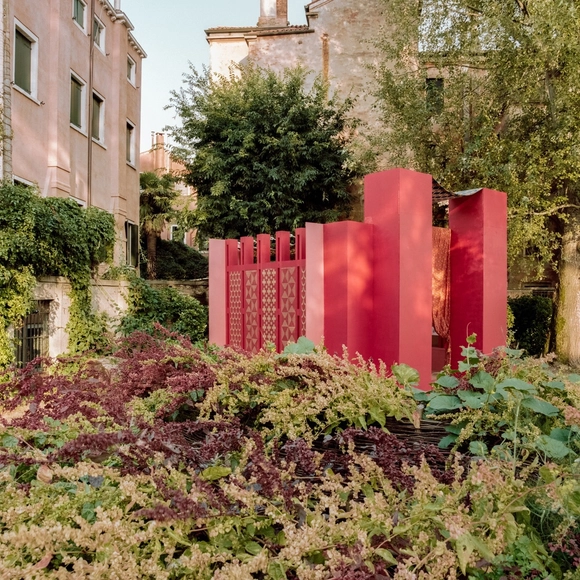
Studio NYALI / ArchiAfrika Pavilion at the 2021 Venice Biennale. Image Courtesy of Studio NYALI
From the Tbilisi Architecture Biennial to the Sharjah Architecture Triennial, architecture exhibitions are ever-increasing fixtures on cultural calendars around the contemporary world. New editions of architecture exhibitions rest on a foundation propagated by exhibitions of the past – and these historical expositions, to a great degree, have shaped the architectural discourse we have today. But as these exhibitions were born out of a western framework, African historical representations on the biennial and triennial architectural stage have often been reductive, with an assortment of cultures flattened into one, and distinct architectural styles meshed in an incoherent manner.
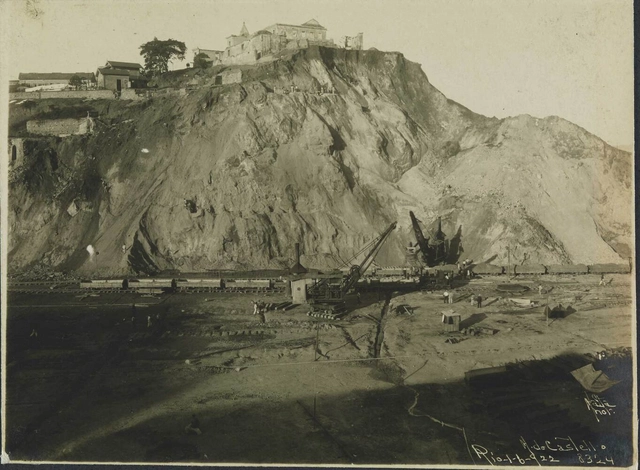
Augusto Malta, Demolition Morro do Castelo, Rio de Janeiro, RJ, June 1, 1922. . Image Courtesy of Biblioteca Nacional Digital Brasil, Fundação Biblioteca Nacional.
At the inauguration of the First Brazilian Congress of Eugenics in July of 1929, the physician and anthropologist Edgar Roquette-Pinto addressed an audience preoccupied with the question of how a country as vast as Brazil could best increase and improve its population. To accomplish this, Roquette-Pinto exalted “eugenia” as the new science that, together with medicine and hygiene, would guarantee the efficiency and perfection of the race. With the following words, the Brazilian scientist underscored a positivist agenda that brought architecture to the very core of the eugenics—the so-called science of race “improvement”—movement: “It is critical to emphasize that the influence [on our race] does not stem from the natural environment but rather from the artificial environment, created by man.” With these opening remarks to the Congress, Roquette-Pinto called attention to the crucial role that the man-made environment plays in the “amelioration” of what he called “the biological patrimony” of Brazil’s diverse population. In his invitation to social engineering, Roquette Pinto pointed to the environmental-genetic collusion that they hoped would bring with it the very possibility of progress.
In June 2020, the statue of 17th-century slave trader Edward Colston was toppled in the southwestern city of Bristol in England. Before this, the statue sat on a plinth in a prominent public park, before being hauled into Bristol Harbour by Black Lives Matter protestors. This act has led to a long-overdue reckoning in the UK and other Western nations, a reckoning that has necessitated a deeper analysis of monuments that line cities, and how deeply imperialism can be interlinked with parts of the built environment. The ever-green question is, what do we do with these buildings?
At the turn of the 19th century, a British publishing house would release a book written by an English urban planner – a book with an optimistic title. The title of this book was To-morrow: A Peaceful Path to Real Reform, later reprinted as Garden Cities of To-morrow. The English urban planner in question was Ebenezer Howard – and this book would lay the foundations for what would later become known as the Garden City Movement. This movement would go on to produce green suburbs praised for their lofty aims, but it would also produce satellite communities that only catered to a privileged few.
Compared to that of the West and East, awareness and knowledge of the architecture of sub-Saharan Africa—Africa south of the Sahara Desert—is scant. A new book intends to mitigate this oversight, and it’s a significant accomplishment. Architectural Guide Sub-Saharan Africa (DOM publishers, 2021), edited by Philipp Meuser, Adil Dalbai, and Livingstone Mukasa, was more than six years in the making. The seven-volume guide presents architecture in the continent’s 49 sub-Saharan nation-states, includes contributions by nearly 340 authors, 5,000 photos, more than 850 buildings, and 49 articles expressly devoted to theorizing African architecture in its social, economic, historical, and cultural context. I interviewed two of the editors—Adil Dalbai, an architectural researcher and practitioner specializing in sub-Saharan Africa, and Livingstone Mukasa, a native Ugandan architect interested in the intersections of architectural history and cultural anthropology—about the challenges of creating the guide, some of its revelations about the architecture of Africa, and its potential impact.
https://www.archdaily.com/979526/a-remarkably-comprehensive-new-guide-to-the-architecture-of-sub-saharan-africaMichael J. Crosbie
The early 20th century saw the birth of Modernist architecture. It brought with it a central architectural movement that in turn birthed off-shoots of its own. A figure often seen as the defining face of this movement is Le Corbusier, whose 1923 treatise Toward an Architecturewas influential to his Modernist contemporaries – a manifesto including the phrase “a house is a machine for living in” where good architecture would have to be intrinsically linked to function and the demands of industry.
The year 2021 has been a turbulent one –coronavirus rages on, and the design and construction industries have been forced to keep adapting two years into a global pandemic. As virtual methods of working and communicating continue to be tweaked and honed, a plethora of virtual events has meant that architectural discourse outside the western canon and Eurocentric gaze, in a small way, has been able to claim space front and center in the global architectural conversation.
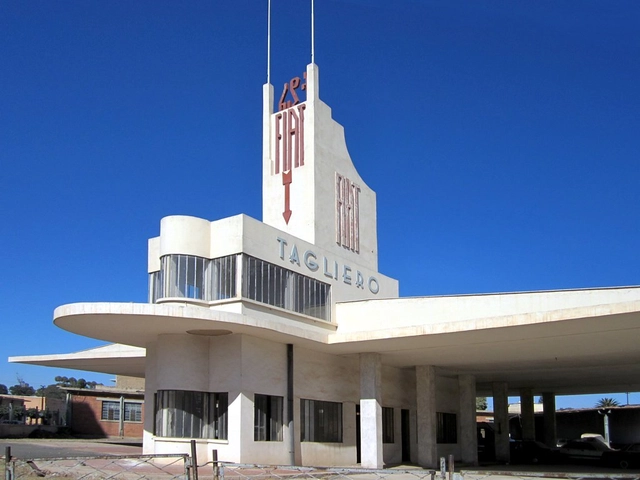
The built environment we all inhabit is part and parcel of global, interconnected processes and systems. When we appraise the historically significant architecture of our cities, the structural integrity and aesthetics of a building merits equal consideration with factors such as the labour conditions of its builders to the existing power structures of its time. Examples of ItalianModernism in Eritrea, for instance, might be worthy of aesthetic praise – but intertwined with the legacy of these buildings hailed as Modernist icons is the sobering fact that they were built to further an imperial project. In the complex fields of architectural conservation, preservation and cultural heritage, democratisation should always remain a key priority.





















.jpg?1637861666 "Casco Viejo - Panama City, Panama. Image © Wikimedia User David Broad under the Creative Commons Attribution 3.0 Unported license.")