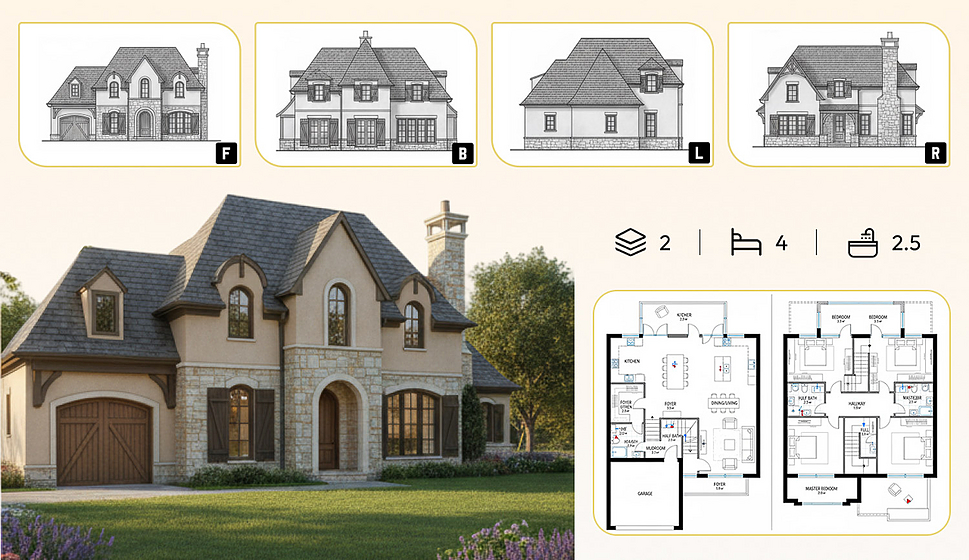
This guide covers a workflow that moves from project parameters to generated floor plans, 3D perspective views, exterior design exploration, and site context visualization, using AI tools in place of preliminary CAD and rendering work.
This guide covers a workflow that moves from project parameters to generated floor plans, 3D perspective views, exterior design exploration, and site context visualization, using AI tools in place of preliminary CAD and rendering work.

The psychology behind what we consider or value to be our homes presents some interesting concepts. While it is easy to answer the question “Where are you from?” when someone is asked “Where is home for you?” the resulting answer may be influenced by a variety of perceptions of what home really is. A recent article entitled The Psychology of Home: Why Where You Live Means So Much discusses such implications. Read more after the break.

The SmartPlayhouse children`s houses are authentic pieces of design work inspired by contemporary architecture. A modern and comfortable space that provides the children with their own private and safe place to play, developing their creativity and ability to share. Built with the highest quality materials and very resistant to rough weather conditions, they give children their own place to play, organize themselves and invite friends over. It`s a place where they can socialize, share with others, express their creativity, mature and have great experiences. It makes a great gift for the holiday season! Check them out here. More images of playhouses can be seen after the break.

MASS Design Group is encourage everyone to help, in any way, in their efforts to design, build, and advocate for buildings that improve health and strengthen communities. Architects have a unique ability to affect change by producing Well-Built Environments, those that are efficient, effective, and empowering. By applying architectural thinking to the full project delivery process we can engender social and political affects that help fight social inequity. For more information and to find out ways you can help, please visit their website here.

During these days we have received close to a thousand seasonal greetings from architects, photographers and editorials around the world. We are very grateful to have collaborated with an amazing group of professionals, who mixed creativity and humor on their e-cards.
Enjoy a selection of these e-cards, including this nice Ginger Bread Vitra Haus, along with Snøhetta, SOM, Richard Meier, BIG, CEBRA, and more!

We found this great image from The All Nighter – a tumblr dedicated to students who want to share and prospective students who would like to know about the architecture studio experience. The ArchDaily team would like to wish you a wonderful holiday season and a happy new year!

For those of you still in search for some last minute gift ideas, we present to you part three of the 2011 ArchDaily Holiday Gift Guide. We hope this provides you with that last bit of inspiration to finish your holiday shopping. In case you missed our previous guides, view Part One and Part Two for more gift ideas that is guaranteed to please any architect.


De Rotterdam is a unique multifunctional building on the shores of the river Maas on the Wilhelminapier in Rotterdam designed by Office for Metropolitan Architecture (OMA) of Rem Koolhaas. Its remarkable mix of functions makes this building a true vertical city.
By following the construction for 4 years (January 2010 – end of 2013), Ruud Sies presents a photographic report on a very special project in the development of Rotterdam, one that also forms a link to the Wilhelminapier as a historic spot. The full report can be viewed here. More images after the break.

What is the function of gossip in architecture? Let’s face it, architects don’t openly criticize or debate each other’s work in public; they prefer to gossip within their chosen networks, aiding social bonding through subtle passive aggression. Gossip has always been around in architecture as one of the oldest ways of sharing, maneuvering and convincing. But how does it manifest itself today within the instant culture of internet and social media?
These are the questions Conditions Magazine is hoping you will be able to answer through an abstract design for their new, upcoming issue. More information on the call for submissions after the break.

Highlighting fashion one more time this week (take a look at An Architect’s Dress Code) we wanted to share with you this Le Corbusier inspired design. Taking a nod from one of architecture’s greats the Corneliani man for Fall/Winter 2011 is an interpretation of the Swiss architect and designer Le Corbusier’s timeless elegance and the ‘talking jacket’. Setting a scene reminiscent of a 1940s movie set the Italian brand’s new collection is described as ‘a suit with peak lapels, a soft, enveloping, deconstructed overcoat, thick glasses and a bow tie symbolise with an eccentric touch a sophisticated and relaxed chic.’

What would the world’s landscape look like if it were concentrated into one megalopolis? This graphic analysis illustrates the amount of land required to accommodate all 6.9 billion people based on the densities of cities across the globe. The differences illuminate the adverse affects of suburban sprawl.

Architect: Sanders Pace Architecture Location: Manchester, Tennessee Project Team: Brandon Pace, Michael Davis, Michael Aktalay, Larry Davis, Matthew Davis, Carah Ferry, Will Spencer, Garrett Ferry, Ashley Pace, John Sanders, Stephanie Dowdy, David Scott, Shane Elliot, Leslie Smith Project Area: 900 SF (x2 pods) Project Year: Summer 2011 Photographs: Sanders Pace Architecture

Zaha Hadid Architects have launched a new interactive website that has a large archival library of the many works, built and un-built by the firm. Looking through this vast collection of projects, it becomes obvious how much of Zaha Hadid’s work is public architecture: between urban projects, museums and galleries, this architect’s project are made for masses. We are the real users of her architecture. The new website allows visitors to not only appreciate her work, but participate in an internet forum of sharing a common appreciation for the work. Each project can be “starred” and added to YourZHA, which becomes a log of her work that the visitor to the site can then refer back to.
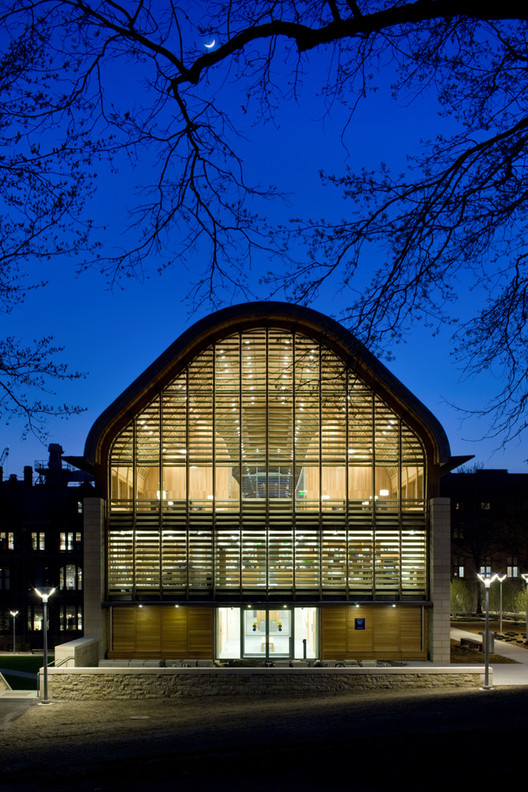
Tensions mounted between modernist and traditionalist camps earlier last month when Paul Finch, UK Chairman for the Commission for Architecture and the Build Environment, praised the fact that modernists had won bids to design buildings for the 2012 Olympics. In response, Robert Adam, member of the Traditional Architecture Group, and Michael Taylor, senior partner at Hopkins, the firm that designed the Olympic velodrome, met for a discussion on hegemony, timeliness, and pastiche moderated by Guardian staffer Lanre Bakare.

Sunland Park, N.M– Martin Resendiz, mayor of a small community near Las Cruces, admitted earlier this month to signing contracts with a San Diego–based parking design firm while drunk. The company, Synthesis +, is suing the city for nonpayment. Resendiz claims the contracts were never valid since the City Council did not approve them.

A new vision of the map for London’s Tube has been posted to depict a more geographically accurate representation of the underground train system. Navigate through the map for yourself here: http://www.london-tubemap.com/.

Architect Piero Ceratti shared with us his concept design, titled ‘Eagle Nest Hut’, for a mountain hut/shelter powered by wind turbines. This alpine hut can be installed in very extreme sites while minimizing the point of contact with the rocky ground. More images and architects’ description after the break.

Joel Pirela of Miami based studio Blue Ant Studio has ingeniously reinterpreted the traditional ophthalmology exam to suit the refined tastes of designers. More after the break.

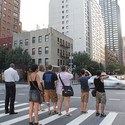
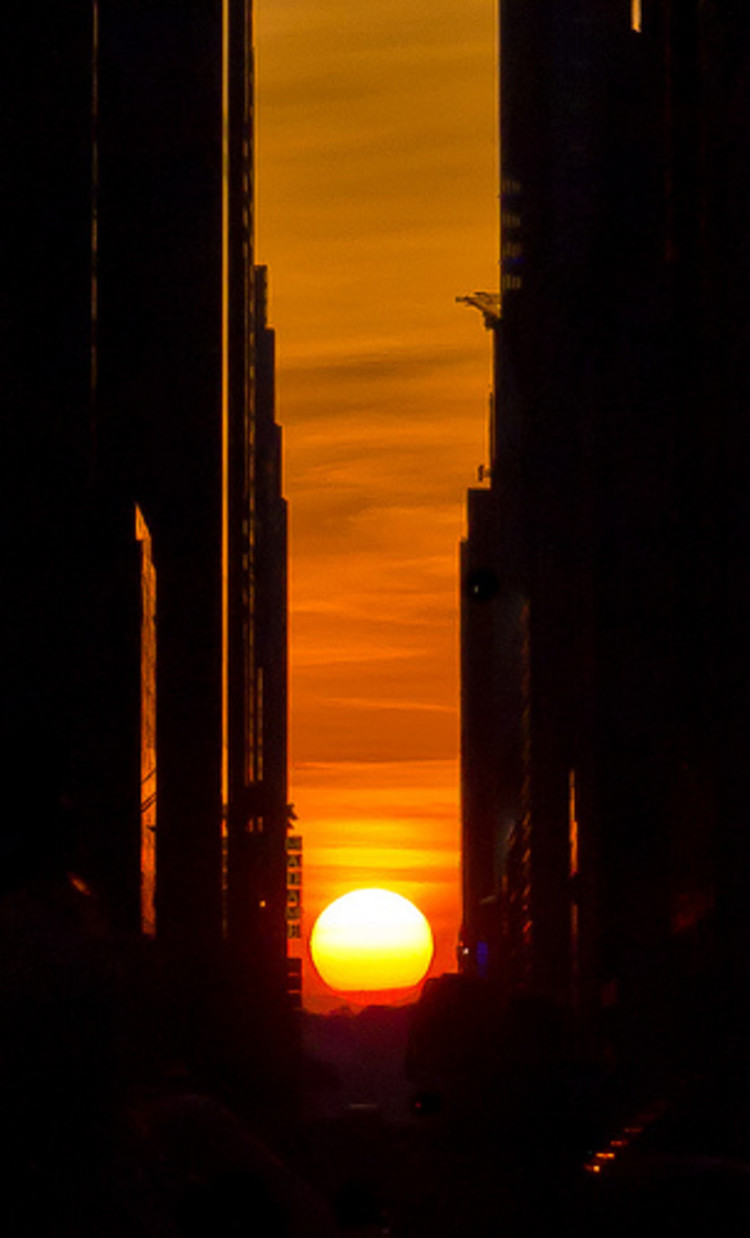
Manhattanhenge, is the term used to describe a biannual occurrence in New York City when the sun aligns with the east-west streets of Manhattan’s main grid. Adopted in 1811 the famous street grid of Manhattan, the Commissioners’ Plan, was the original design plan for the streets in which the grid plan is offset at 29.0 degrees from true east-west. Twice a year photographers gather to witness this urban solar phenomenon, when the sun sets perfectly between the skyscraper corridors and illuminates the north-south facades of the streets. Tripods and pedestrians filled the crosswalks this past Wednesday to catch a glimpse of this moment.

Víctor Enrich recently shared with us his architecture 3D illustrations and visualizations. Over the years he has experimented with a variety of mediums resulting in these 3D creations. A full description of his work and further illustrations following the break.

Adrian Lahoud and Samuel Szwarcbord shared with us their honorable mention entry for the recent Geopolitical Borders Competition organized by Think Space and judged by Teddy Cruz. This project is about two lines, one existing and one proposed. The first line is invisible. It runs horizontally from east to west across the Mediterranean Sea. Like the contour lines on a weather forecast, it bends and twists according to the vast differentials of pressure between North and South. From the perspective of the African continent, Europe holds a minimal promise of opportunity that cannot be found at home. From the point of view of Europe, North Africa represents a local pool of labor power, ready to be dipped into at will, a steady reserve of energy (increasingly solar) and kilometers of unspoiled coast ready for development. Like any bad relationship, the asymmetry is secured through structural violence. This violence must be flexible enough to accommodate the contradictions and dynamics of both parties. Changing domestic imperatives, economic demands and legal requirements form plastic limits through which the stability of the line must be coordinated.

“Made in China.” For so many in Western nations, this phrase conjures up a plethora of horrific images. There is the Human Rights argument: low wages, inhumane working conditions, and so forth. Then there is the issue of quality, as in, there is none.
First let’s talk about human rights in terms of manufacturing. The favored discourse is that Chinese factories exploit their employees and hence the resultant quality of the goods is far inferior. Sensational stories that support this conclusion always seem to cross international lines. Moreover, there are basic protestations of Human Rights’ violations and then the specter of Tibet is raised.

My old firm, the one I got laid off from almost exactly two years ago, has had another round of layoffs. I’ve lost count how many that is (over ten I think), but since it included several principles, I’m guessing that this is either a death knell or time for a major restructuring of that office.
And that got me thinking about my own situation. Again. Because if there’s one thing that triggers intense feelings when you’re unemployed, especially when it’s been a really long time, it’s hearing other people at your old firm have suffered the same sad fate.