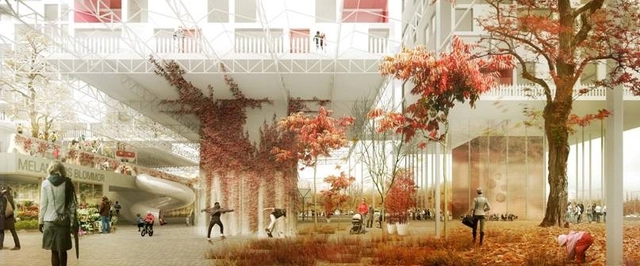
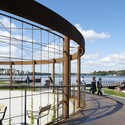
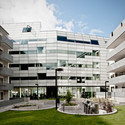
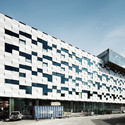
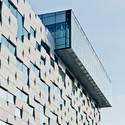
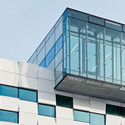
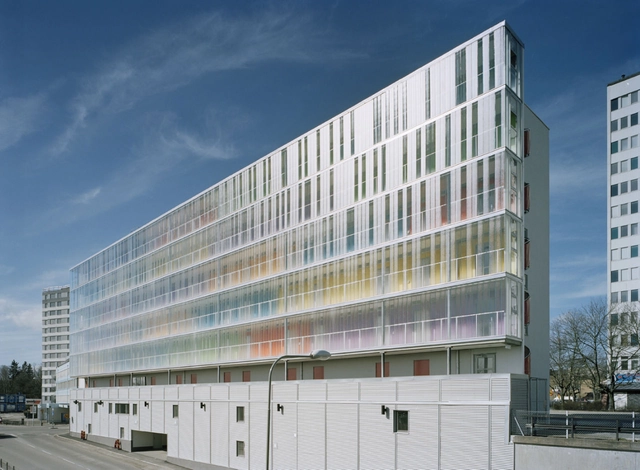
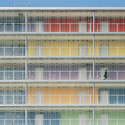
View of Waterfront. Image Courtesy of Louis Paillard Architects
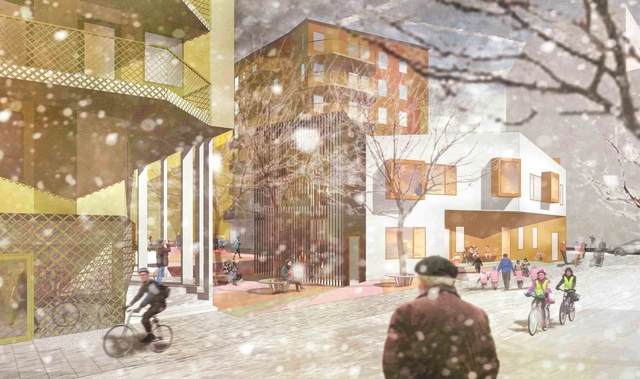
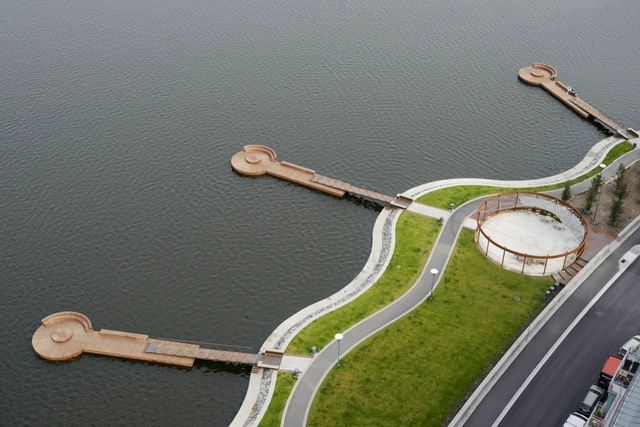
Louis Paillard Architects' proposal for Marievik, a site south west of Sweden's capital, is an attempt to condense 65,000 square metres of housing, retail, restaurants and a school into just 12,000 square metres of available space through "six iconic objects." According to the architects, Stockholm is a city built "by public spaces, shared spaces, [and] parks and gardens", which led to their design "twisting itself around the void."
SeARCH has won an invited, international competition for the urban renewal of Marievik. Their winning proposal, STA(CK)HOLM plans to transform an area along one of central Stockholm’s main access roads, opposite the island of Södermalm and facing a new bridge by Norman Foster, into a futuristic sustainable neighborhood.
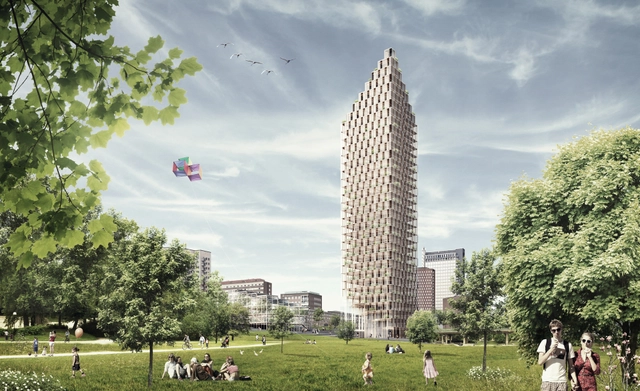
Courtesy of C.F. Møller Architects with DinellJohansson
For HSB Stockholm's architectural competition 2023, three teams of architects have produced innovative proposals for private residences of the future at three different locations in the centre of Stockholm. Berg | C.F. Møller's proposed design is a 34-storey skyscraper made of wood.
Berg | C.F. Møller Architects are working in partnership with architects Dinell Johansson and consultants Tyréns on their entry. The team has chosen to build upwards, and has designed a 34-storey residential building, which will be seen for miles. The building will be built over a wooden construction with a concrete core, and it is intended to give the people of Stockholm a new and characteristic beacon and meeting place in their city.
Developed by Spacescape, Airport City Stockholm, in cooperation with Swedavia Swedish Airports (state), Sigtuna municipality, and Arlandastad Holding (private real estate), has a new urban design strategy and urban plan that envisions a unique airport city which emphasizes urban qualities and places sustainability in focus. Such rapid expansion has placed distinct demands on planning, which has resulted in this collaborative effort. Creating these foundations, along with offering the world within walking distance, will increase value and attract even more people and businesses. More images and architects' description after the break.
The Future of Places Forum, the inspiration for our Ten Ways to Transform Cities through Placemaking & Public Spaces article published earlier this week, will open this June in Stockholm, Sweden. The forum will be hosted by UN-HABITAT, Project for Public Spaces (PPS) and the Ax:son Johnson Foundation and will be the first of three conferences leadingup toHabitat III in 2016. Its overall aim is to "contribute to a New Urban Agenda around people and places" and to "highlight how and why cities need to embrace a people centered approach in order to achieve positive urbanization." The conference series will define examples of excellent urban practices from around the world as well as future projects that reflect sustainable and equitable processes which build community, enhance quality of life, and creates safe and prosperous neighborhoods.
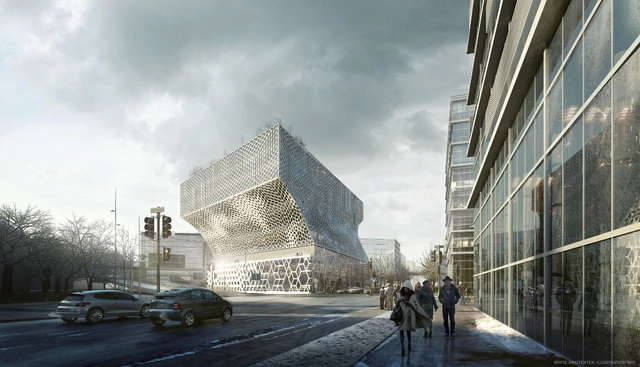
Designed by White arkitekter their Park 1 project is intended to house a traffic and emergency management center, a new fire station and a total of 1,200 new workplaces in which effective coordination will be created on an everyday basis. Located in Stockholm, the building complex inclines back from Lindhagensgatan in a generous gesture which marks the entrance while also boldly cantilevering slightly into space towards the Essingeleden highway and above all of the movement and communication at the site. More images and architects' description after the break.
GRAD Arkitekter shared with us their proposal for a housing block in the now unbuilt area of Årstafältet, a southern suburb of Stockholm. Once finished, this area will house approximately 10,000 inhabitants. To secure this variation, the city proposes that each block is divided in two halves, with a team of a contractor and an architecture team responsible for every half. The basic design principle of their block is to shift and tilt four buildings in relation to one another, to create interesting views and a good flow of natural light. More images and architects' description after the break.


.jpg?1383859827&format=webp&width=640&height=580)