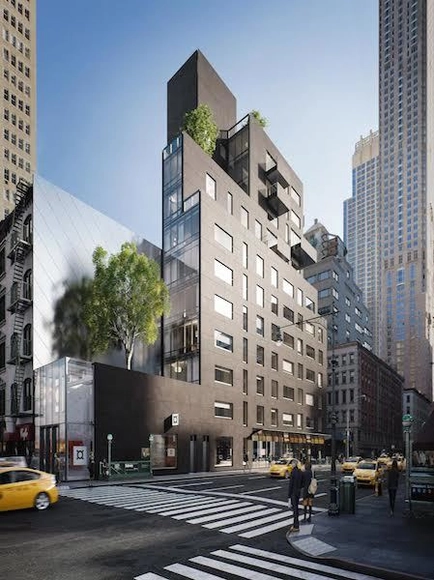
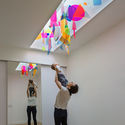
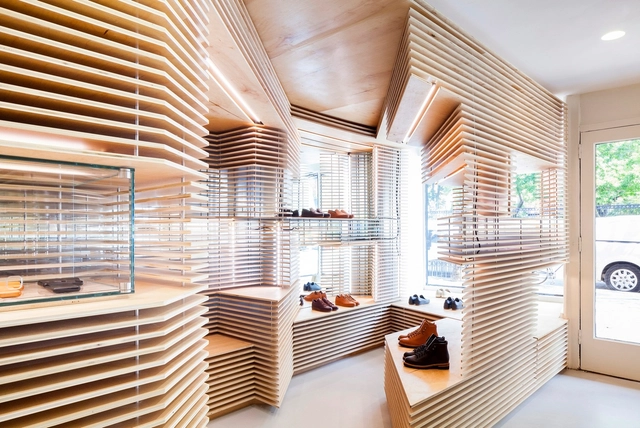
Designed by Post-Office Architectes, 30 Warren St. is a new, luxury 12-storey building, featuring 23 residences and 9,700 square feet of retail space on the ground floor. Located along Church St. between Warren and Chambers St in the Tribeca neighbourhood of New York City, the project is set for completion in the fall of 2017.
Manufacturers: Big Ass Fans, Gaggenau, Lutron, FSB Franz Schneider Brakel, Acor, +20Aluminum Group, Cassina, Ceadesign, FeeLux, George Kovacs, Herman Miller, Hydroswing, Hygolet de México, Kelley Bros, Kohler, Lounge and Ottoman, Neo-Metro, SONOS, Schüco, Stages, Stanley Hardware, Tate Access Floors, Toto, Twin Eagles USA, VitrA-20
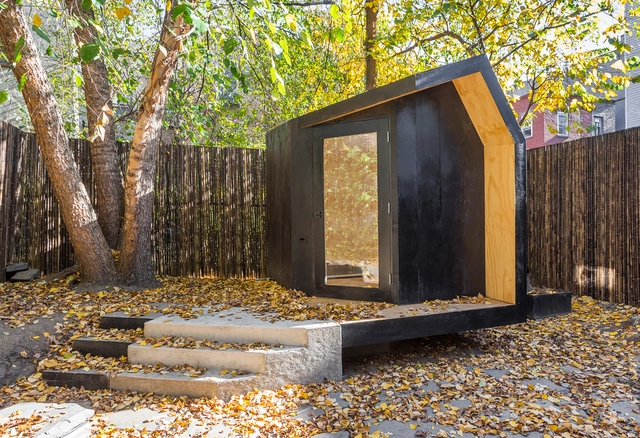
Socrates Sculpture Park and The Architectural League invite designers and architects to help shape the physical setting in which the park fulfills its mission as an environment for art, creative expression, social programming, and education. Socrates, located in Long Island City, Queens, is distinctive for its combination of waterfront setting, accessibility, and community-driven programs.
In previous years the Folly program investigated the intersection between sculpture and architecture with temporary structures that intentionally served no utilitarian purpose. This year, marking the program’s 5th and the park’s 30th anniversaries, the competition instead asks entrants to fuse form with utility, creating designs that explore the intersection of art and architecture while durably addressing and improving the conditions of the park.
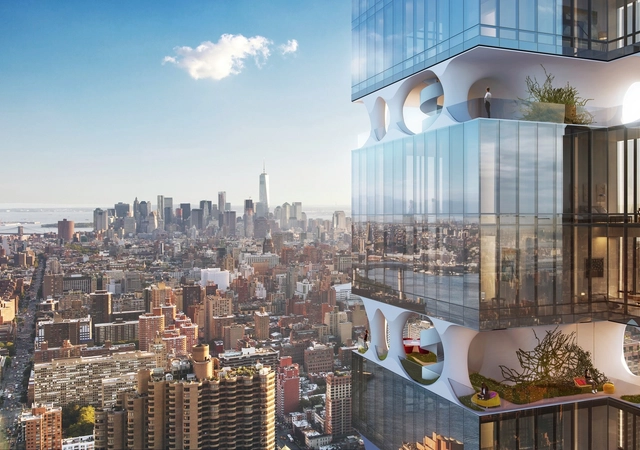
Inspired by the recent trend for super-skinny, super-tall skyscrapers currently dominating the Manhattan luxury residential market, ODA New York has developed a design for 303 East 44th Street which they describe as "a new urban reality" for the city. By taking a prototypical, modestly-sized tower building and stretching it skyward, the firm has inserted sculptural skygardens in the voids opened up between the floors to create a tower that combines the advantages of urban living with the spatial benefits of the suburban home.
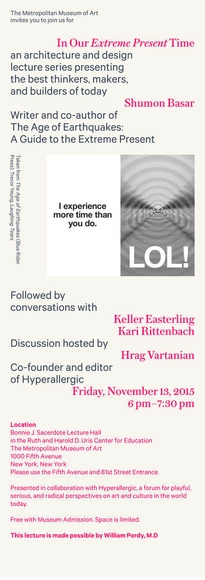
Taken from The Age of Earthquakes (Blue Rider Press): Trevor Yeung, Laughing Tears.
In Our Time is an architecture and design lecture series presenting the best thinkers, makers, and builders of today.
Shumon Basar, co-author of The Age of Earthquakes: A Guide to the Extreme Present is joined by architect Keller Easterling and writer Kari Rittenbach.
Discussion hosted by Hrag Vartanian, co-founder and editor-in-chief of Hyperallergic.
This lecture is made possible by William Pordy M.D.
Presented in collaboration with Hyperallergic.
Shumon Basar is a writer, thinker, and cultural critic. He is co-author of The Age of Earthquakes: A Guide to the Extreme Present with Douglas Coupland and Hans Ulrich Obrist (Penguin/Blue Rider, March 2015). His edited books include
Learn how to create your own eye-catching photographs of the city’s built environment in this hands-on workshop with architectural photographer Matthew Carbone. An introductory discussion about techniques, relevant mobile phone apps and considerations of lighting and composition particular to on-site architectural photography will be followed by an outdoor shooting session in the iconic South Street Seaport neighborhood. Class size limited to allow for individual feedback and instruction.
Open to all levels of experience. Digital SLR cameras or current iPhones / Android phones with high-quality cameras recommended.
Shola Olatoye Chair and Chief Executive Officer, New York City Housing Authority
and
Richard Baron Chair and Chief Executive Officer, McCormack Baron and Salazar
Third Annual Fall Fete Tuesday, November 10, 2015
Benefactors Reception, 6 to 8 pm Neue Galerie 1048 5th Avenue, New York
Friends Party, 8:30 to midnight St. George Church Choir Crypt 209 E.16th St., Stuyvesant Square, New York
The Benefactors Reception will be held at the Neue Galerie New York, located in a landmark turn-of-the-century Carrere & Hastings building on Museum Mile. Benefactors will enjoy light Austrian fare and wine in the elegant Cafe Sabarsky and meet our honorees.
The Friends Party will bring together a lively group of architects, developers, artists,
Earth as seen on July 6, from a distance of almost one million miles by a NASA scientific camera on board the Deep Space Climate Observatory spacecraft. Credit: NASA.
What do outer space capsules, submarines, and office buildings have in common? Each was conceived as a closed system: a self-sustaining physical environment demarcated from its surroundings by a boundary that does not allow for the transfer of matter or energy.
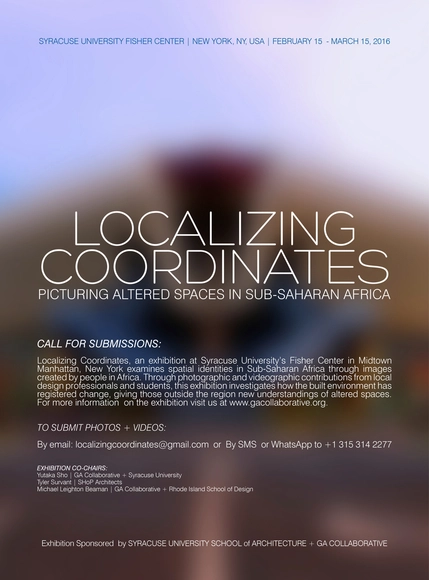
To submit photos and videos please email localizingcoordinates@gmail.com or SMS / WhatsApp to +1 315 314 2277
The story of the African built environment is often told through historical perspectives of colonization and political crises, emphasizing the difficulties that African people have faced. Economic perspectives such as poverty, development and globalization also create stereotypes of the continent. Often missing from these are the transformations in space that result from daily and repeated use. These transformations emerge from ideas exchanged between people and their movements through their neighborhoods, cities, regions and countries. The quality of spaces that we may find will paint a complex picture of Africa.
Garden Spiral Tower on the Harbor. Image Courtesy of O'Neill McVoy Architects
In Mark Foster Gage’s essay “Rot Munching Architects,” published in Perspecta 47: Money, the Assistant Dean of the Yale School of Architecture strove to find meaning in the current design landscape. Taking the essay title from a larger stream of expletives spun across the facade of the Canadian pavilion as part of artist Steven Shearer’s installation at the 54th Venice Art Biennale in 2011, Gage found truth in the vulgarities, arguing that - in a very literal sense - “architectural experimentation has left the building” as the discipline has been made impotent under the hostage of late capitalist ambition.
Last summer, when Brooklyn Bridge Parkunveiled 14 proposals as finalists for two residential towers at the park's controversial pier 6 site, you could be fooled into thinking that design is alive and well. A caveat of the park’s General Project Plan (GPP) was to set aside land for retail, residential and a hotel development, in order to secure funding and achieve financial autonomy. The plans had already fueled a decade of legal battles and fierce opposition from the local community, with arguments ranging from the environment, to park aesthetics, to money-making schemes, but last year a bright outcome appeared a possibility, when the park unveiled the competing plans including those by Asymptote Architecture, BIG, Davis Brody Bond, Future Expansion + SBN Architects, WASA Studio, and of particular interest, O’Neill McVoy Architects + NV/design architecture (NVda).
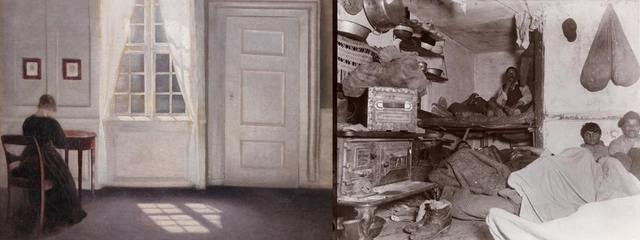
Jacob A. Riis and Vilhelm Hammershøi were Danes of the same generation who took up the challenge of understanding modernity in radically different ways. Riis left Denmark for America to become the nation's leading advocate for the urban poor. He was a media-savvy journalist who used words and pictures to make a compelling case for reform. Hammershøi, by contrast, was a Copenhagen-based aesthete whose mysterious paintings of bourgeois domestic interiors suggested the psychological experience of modern life. Join two art historians and experts on Riis and Hammershøi, Bonnie Yochelson and Thor Mednick, for an exploration of their work. After their presentations, Ambassador Anne Dorte Riggelson will lead a conversation about Riis and Hammershoi's contrasting lives and perspectives.
Critical Halloween is a party, an intellectual debate, a costume competition, and a space for the expression of radical thought. Over the past few years, it has become a referential event that brings people together through music, dance, and costume design to engage in critical discussion in New York City.
"JB1.0: Jamming Bodies", 2015. Lucy McRae and Skylar Tibbits with MIT’s Self-Assembly Lab. Storefront for Art and Architecture.
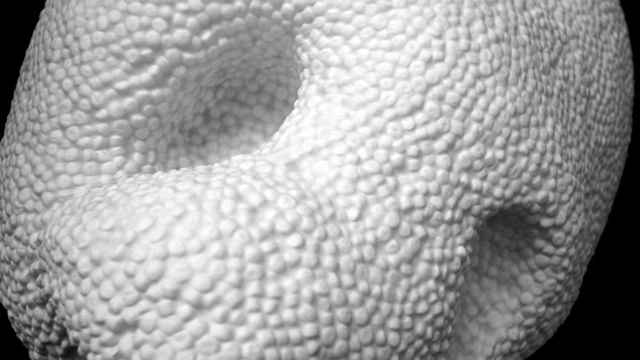
"JB1.0: Jamming Bodies" is an immersive installation that transforms Storefront’s gallery space into a laboratory. The installation, a collaboration between science fiction artist Lucy McRae and architect and computational designer Skylar Tibbits with MIT’s Self-Assembly Lab, explores the relationship between human bodies and the matter that surrounds them.
Bill Pedersen is a renowned architect and founding design partner of Kohn Pedersen Fox Associates, which is currently leading New York City's Hudson Yards Project. Less known, but equally important, is Pedersen's design versatility. He holds multiple design patents and recently created a new line of furniture, Loop de Loop, that is beautiful, comfortable, and technically innovative. Join Pedersen and Donald Albrecht, the City Museum's Curator of Architecture and Design, for a conversation exploring not only the new furniture and its influences, but also the history of architect-designed furnishings. This event is part of the Museum’s ongoing Design Talks series examining the today's leading trends in design, architecture, graphics, and multimedia.