Treehouses ignite the imagination like few other building typologies. These small, playful structures bring architecture and nature into the closest proximity and must be resilient to the unpredictability of the movement of the trees and exposure to the elements.
When selecting materials for your treehouse, a designer must consider the unique structural and weathering requirements of a treehouse. Thermowood from Lunawood is well suited to meet these challenges as it is dimensionally stable, resistant to decay and non-toxic. Lunawood produces Thermowood from Scandinavian PEFC-certified pine and spruce from Finland. It can be used inside or outdoors, in any climate. Lunawood is an eco-friendly natural product that is easy to machine and install.
Structure
The fundamental question when designing a treehouse is how the structure will relate to the tree trunks and to design an overall support system to keep the building in the tree-tops. The treehouse can be supported off a singular tree trunk, between two or more trunks or suspended from the trunks using a steel cable suspension system.
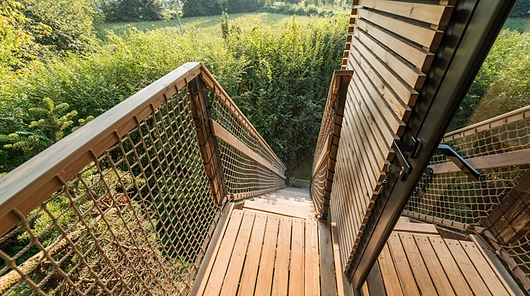
In the Treehouse Extreme by Sullalbero SRL, a hybrid structural system is used with a stair volume that supports the two storeys of the timber treehouse in combination with steel cables connected back to the main tree. The whole treehouse is clad in Thermowood battens and utilizes Thermowood decking as they are lightweight timber materials that work well to achieve an efficient structural solution
Cladding
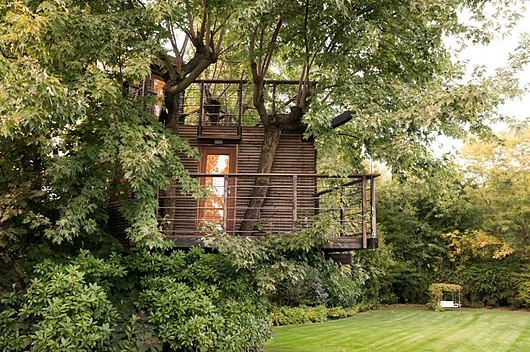
The cladding for a treehouse needs to be lightweight, durable and with a natural aesthetic. The Light Cute Treehouse by Sullalbero SRL utilizes Lunawood Thermowood Nordic Pine ventilated cladding and also Thermowood sunscreen battens with a natural surface. The Thermowood cladding is paired with wool insulation to ensure a comfortable interior environment.
Natural resin is removed from the wood due to the high temperature of the Thermowood treatment process. The color of the wood is affected by the treatment temperature and time – the higher the temperature the darker the appearance. As with all softwoods, variances occur and are due to varying densities. When the product is exposed to UV-light, it will turn beautiful silver grey unless protected by a pigmented surface protection. This natural surface variation and natural weathering make it well suited to natural applications such as treehouses.
Decking
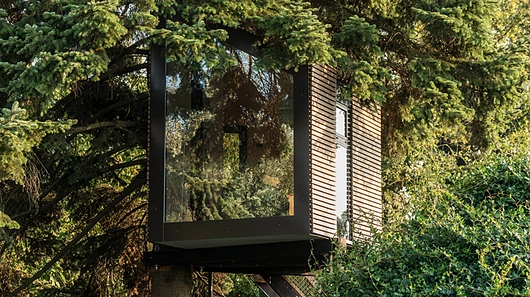
Timber decking can be utilized for internal and external platforms within a treehouse. Decking from Lunawood shares the durability and dimensional stability properties of other Lunawood Thermowood products. In addition to this, the insulation properties of the decking balances the change of heat and cold, ensuring that it is pleasant to walk on without shoes bringing you even closer to nature. The decking in Treehouse Extreme by Sullalbero SRL is laid on top of PVC base that allows water out flow and easy boards removal for cleaning.