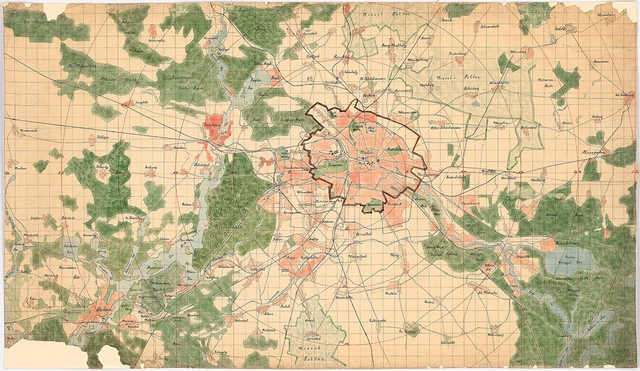
Hermann Jansen: General plan of Berlin and surroundings, built-up areas, green and water areas on a scale of 1: 30,000 for the competition Groß-Berlin 1910
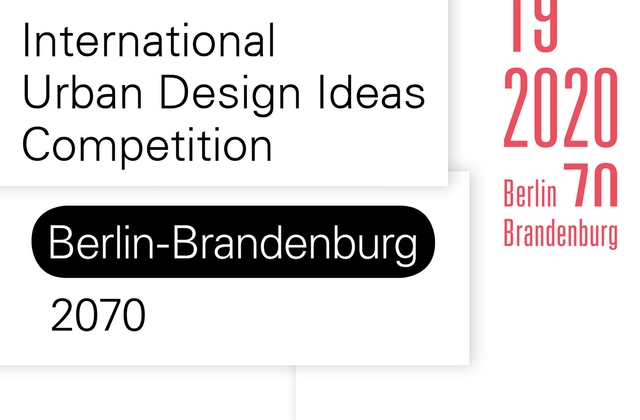
On the occasion of the 100 Years of (Greater) Berlin anniversary, Berlin 2020 gGmbH, an organization of the Architekten- und Ingenieur-Verein zu Berlin e.V. (AIV), is launching an open-call initiative for an international urban design ideas competition. Berlin-Brandenburg 2070 aims to spur a broad social debate on the future of the Berlin-Brandenburg region. The competition asks architects, urban planners and landscape architects to respond to the interdisciplinary challenges facing the region in the future. The competition is focused on urban development issues common to both the city of Berlin and the state of Brandenburg. So that the design proposals fully take into account the challenges associated with sustainable metropolitan growth, the design ideas competition seeks to promote cooperation between the various experts and their fields. The international jury comprises the following members: Brigitte Bundesen Svarre, B.V. Prof. Ir. J.M.J. Jo Coenen Beheer, Prof. Werner Durth, Prof. Hans Kollhoff, Prof. Arno Lederer, Prof. Cornelia Müller, Reiner Nagel, Prof. Dr. med. Oliver Schwedes, Prof. Miroslav Sik. The patron of the project is the Governing Mayor of Berlin, Michael Müller. The deadline to register for the competition is 27 September 2019.
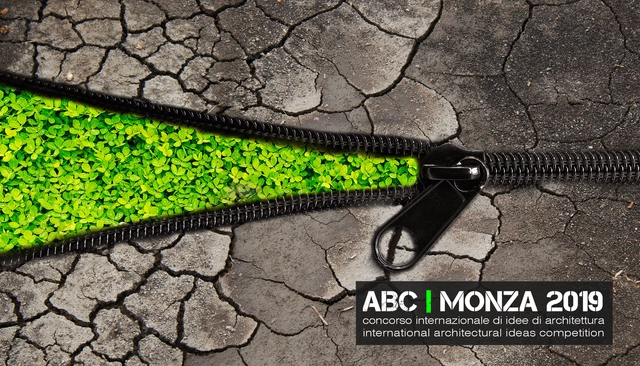
THE COMPETITION IN BRIEF ABC | MONZA 2019 is an international architectural ideas competition in the time of Digital Transformation. The theme of the competition is the urban regeneration of an industrial site of approximately 60,000 square meters in the city of Monza - Italy in accordance with the values of environmental, economic and social sustainability. One of the characterizing elements of this competition is the use of BIM (Building Information Modeling) for the ideation, design and submission of the proposal.
WHERE Via Philips 12 in Monza - Lombardy - Italy, north of the Greater Milan and close to what in the coming years will
Studio Muoto´s activities cover the fields of architecture, urbanism, design and scientific research. Muoto means 'form' in Finnish. Muoto's work often features minimal structures made of rough materials, as a means to combine different activities, and merge economical as well as aesthetic issues. Vertical diversity as an articulation between building and city scales is a recurrent figure in Muoto's projects. The office has been rewarded by several prizes, such as Holcim Awards 2014, Equerre d'Argent 2016, and Bauwelt 2017.
China is the largest consumer of cement and concrete in the world, the use of which has peaked in the first two decades of the twenty-first century. Used for the construction of extensive infrastructure and buildings, over the last twenty years renowned Chinese architects have been working in and studying the constructive limits and spatial and superficial effects of exposed concrete. In the process, they have created a wave of avant-garde architecture in China. Chinese Brutalism Today investigates the compositional, formal, and ornamental reasons for this architecture and its different surface finishes, from rough to smooth. This new wave of
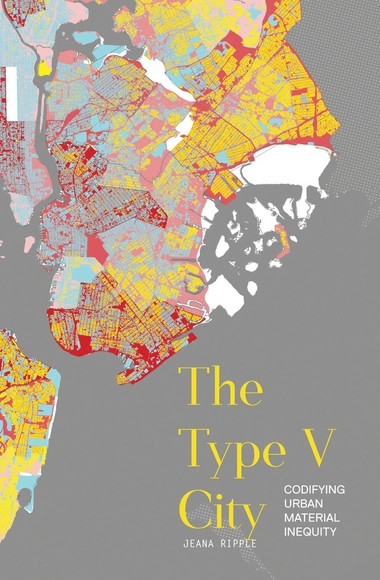
The Type V City presents innovative research into urban material patterns, expanding the understanding of socio-economic and ecological vulnerability as influenced by building material properties through various systems of regulation, financing, and construction. 'Type V' is one of the International Building Code's construction types that rate levels of material combustibility. Since the early Twentieth Century, building codes used construction types to control material distribution across American cities. Code-based urban patterns emerged from these rules to define neighbourhood material characteristics and layer new material strata. The resulting cumulative protection from conflagration was achieved. However additional, unintentional cumulative performance was ignored. The
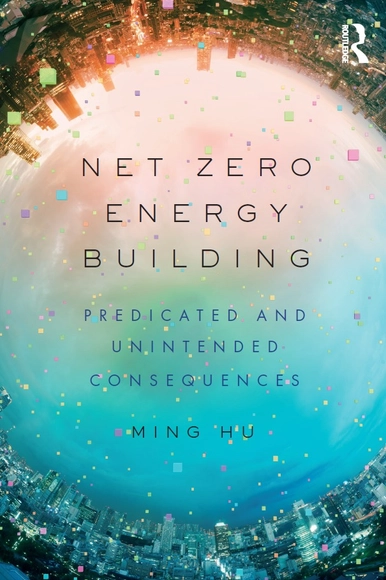
What do we mean by net zero energy? Zero operating energy? Zero energy costs? Zero emissions? There is no one answer: approaches to net zero building vary widely across the globe and are influenced by different environmental and cultural contexts.
Net Zero Energy Building: Predicted and Unintended Consequences presents a comprehensive overview of variations in 'net zero' building practices. Drawing on examples from countries such as the United States, United Kingdom, Germany, Japan, Hong Kong, and China, Ming Hu examines diverse approaches to net zero and reveals their intended and unintended consequences.
Existing approaches often focus on operating energy: how to make
Inspired by the extraordinary engravings of the ruins of Ancient Rome by Giambattista Piranesi, Langenbach uses modern-day digital photography to document the same views that Piranesi captured over a quarter of a millennium ago, displaying some of the most iconic ruins of an ancient civilization on the planet.
Join design talks (d.talks) in a discussion on the role of design in an often overlooked topic: waste. In two generations, we’ve shifted from refillable glass bottles to single-use packaging. Serial replacement has become invisible. Our city has reduced tonnes of waste entering the landfill with recycling and composting options. If we envisioned a future of zero-waste, what’s left to be done?
To explore the subject, d.talks is bringing together a panel to talk about waste from different perspectives. The panel includes Lourdes Juan, founder of the Leftovers Foundation; Sharon Howland, leader of program management for waste and recycling at the City
HKIA Architecture Exhibition in Los Angeles “Island__Peninsula”
HKIA Architecture Exhibition in Los Angeles “Island__Peninsula”
Glamor, Efficiency, Orderliness & Constant Change: Making of the Hong Kong Architecture Landscape
Bringing Hong Kong Architectures to Los Angeles Interacting with Literature and New Media to Reveal the Uniqueness of Hong Kong Architecture
【Hong Kong, 28th August 2019】Organized by The Hong Kong Institute of Architects with Create Hong Kong (CreateHK) of the Government of the Hong Kong Special Administrative Region as the lead Sponsor and fully supported by Chinachem Group, the Los Angeles Architecture Exhibition “Island__Peninsula” will be staged in Los Angeles from 19th September till 2nd October this year. The opening ceremony will be
Regenerative spaces are those that are rehabilitating, enriching and strengthening - they reverse the damaging effects of life’s challenges. We will explore what this looks like from multiple angles and broaden the discussion beyond the building.
What? A weeknight event where we define what regenerative spaces look and feel like across a range of users, sectors and services, from community health and international development to survivors of domestic violence.
How? We’ll use PechaKucha style presentations from pioneers in health, architecture and the community to spark a fresh discussion. Together, speakers and guests will develop ideas to inform the design of regenerative spaces.
Join us for the 3rd International Placemaking Week on October 1-4 in Chattanooga, TN!
The 3rd International Placemaking Week is an intimate, four-day-long global gathering of public space practitioners, researchers, and advocates that combines hands-on learning, public space activations, and innovative social events. Sign up before the regular registration rate ends on August 30!
Following the example of music publication, Source Books in Architecture offers an alternative to the traditional architectural monograph. If one is interested in hearing music, he or she simply buys the desired recording. If, however, one wishes to study a particular piece in greater depth, it is possible to purchase the score―the written code that more clearly elucidates the structure, organization, and creative process that brings the work into being. This series is offered in the same spirit. Each Source Book focuses on the work of a particular architect or on a special topic in contemporary architecture and is meant
Monotown: Urban Dreams Brutal Imperatives examines the post-industrial transformation and transnational legacy of planned single-industry towns that emerged as a distinctive sociopolitical project of urbanization in the Soviet Union during the 1920s. Monotowns took form through the teleological establishment of industrial enterprises strewn across remote parts of the Siberian hinterland and entailed the relocation of vast populations requiring services, housing, and social and physical infrastructure, all linked to a given town's productive apparatus. Today, having outlasted the political and economic systems that made them viable, many have become shrinking towns with graying populations and obsolete enterprises, even as they are
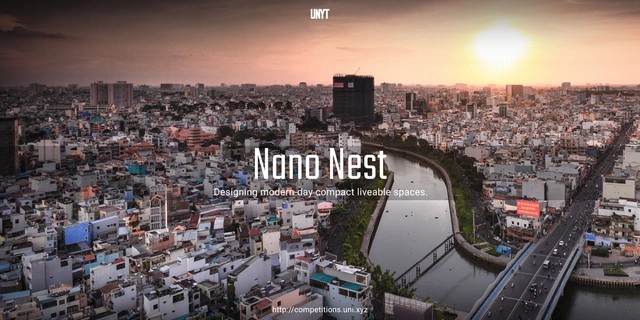
With the growing population, land is constantly seen as a depleting resource and thus has increased real estate prices. Today, the definition of a house has barely boiled down to it being a commodity that constitutes a kitchen, a living area, bedroom and bathroom. This commodity offered is sometimes so inhabitable that it even lacks the basic notion of light and ventilation. Eventually, all the other additional notions of what a house should offer then become secondary. How do we then redefine a modern living space for a space crunch situation that it is not just habitable, but also restores
Urban Design Ideas Competition for the metropolitan area Berlin-Brandenburg 2070
Berlin as we know it – with its centres, residential quarters, and suburbs – marks its 100th anniversary in 2020. A reason to celebrate, but also a spur to think about the future development of the region. After years of stagnation, dynamism is returning to the Berlin-Brandenburg region: population growth, new flows of commuters and goods, new quarters and housing developments, a new rail map, a radically new airport arrangement, and a growing public transport system. Berlin is a metropolis, its integrated hinterland extending far beyond its administrative boundaries. What we need now is a broad public debate ranging from
“eSports have joined the big leagues”, a research from Goldman Sachs wrote in a recent report about the new subsection of the video game industry. They estimate that the monthly size of competitive eSports gamers, 167 million as of year-end 2018, will hit 276 million by 2022, basing their forecast on a New Zoo survey. Out of 7700 million world population estimated 2400 million people are playing some form of games in digital media as per a report by Statista.
A survey by New Zoo (an organization dealing with games & eSports Analytics) reflects that platforms like YouTube and
The biennial Monterey Design Conference returns for 2019.
The biennial Monterey Design Conference (MDC 2019) celebrates its 25th gathering of leading global design figures along the Northern California coast, October 25-27, 2019. Organized the American Institute of Architects (AIA) California, this confab differs from most conferences because attendees can engage in casual conversations with presenters in a relaxed, oceanside setting—mingling over meals, at receptions, or along the beach. The weekend event is held at Asilomar Conference Center in Pacific Grove, CA, the wooded retreat that was designed by 2014 AIA Gold Medal winner Julia Morgan, FAIA.
Among the presenters at MDC 2019 are international architects,
Installation for the Exhibition about the Palace of the Soviets in Casa Mantegna, Mantova
14th Curitiba Biennial presents Sergei Tchoban for the first time with the concept "Open Borders" by Tereza de Arruda and Adolfo Montejo Navas, the event aims to establish reflection on the relationship between subjects and spaces.
In 2019, Curitiba International Biennial of Contemporary Art enters its 14th edition and announces its curatorial concept, signed by the brazilian Tereza de Arruda and the spanish Adolfo Montejo Navas: "Open Borders" is the theme that aligned the edition, that will happen from September 21st 2019 to March 1st 2020. The thematic proposal is a dialogue of deconstruction of the notions of physical boundaries, and