The Chicago Architecture Biennial (CAB) has announced that Sharon Johnston and Mark Lee, of the Los Angeles-based firm Johnston Marklee, have been named Artistic Directors for the 2017 event. Following a successful inaugural run in 2015, the second edition of the biennial will take place from September 16 - December 31, 2017.
Speaking exclusively to ArchDaily, Artistic Directors Sharon Johnston and Mark Lee said:
We are thrilled with the invitation to be the Artistic Directors for the second edition of the largest exhibition of contemporary architecture in North America. To have a global platform to address current ideas and showcase the talent in the field of architecture in a city with such an extraordinary architectural pedigree is a once in a lifetime opportunity.
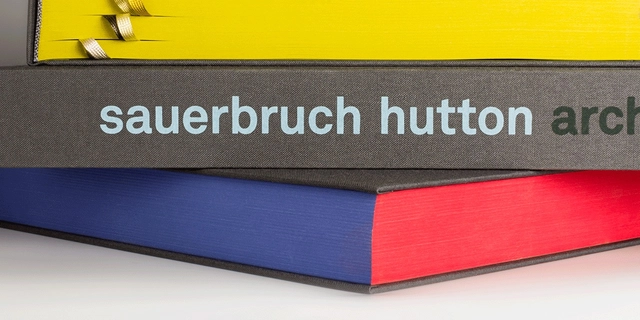
Archive 2 / Sauerbruch Hutton. Image Courtesy of Lars Müller Publishers
Louisa Hutton and Matthias Sauerbruch, of Berlin-based practice Sauerbruch Hutton, have recently published Archive 2– a second series of monographic volumes dedicated to the work of their practice between 2006 and 2015. In the nine years between two sets of books, the architects have observed that "the expansion of the digital realm has had a profound effect on the way we perceive, discuss and produce architecture." As such, and on the occasion of their second volume, they are inviting people to share their thoughts "on the convergence of architecture in concrete, pixel and print."
https://www.archdaily.com/795612/archive-2-sauerbruch-hutton-reflect-how-we-perceive-discuss-produce-architectureAD Editorial Team
“Belonging,” the curatorial quintet of the 2016 Oslo Architecture Triennale, After Belonging, argue, “is no longer something bound to one’s own space of residence, or to the territory of a nation.” For this group of Spanish-born architects, academics and theorists—Lluís Alexandre Casanovas Blanco, Ignacio Galán, Carlos Minguez Carrasco, Alejandra Navarrese Llopis and Marina Otero Verzier—the very notion of our belongings and what it means to belong is becoming increasingly unstable.
After Belonging is the sixth incarnation of the Triennale and the first one in which a single curatorial thread has woven all of the festival’s activities together, including the international conference. The goal of the two primary exhibitions—On Residence and In Residence, including a series of Intervention Strategies—is to develop platforms with the aim of “rehearsing research strategies,” providing new ways for architects to engage with “contemporary changing realities."
https://www.archdaily.com/795067/atelier-bow-wow-oma-amale-andraos-live-from-the-2016-oslo-architecture-triennale-after-belongingAD Editorial Team
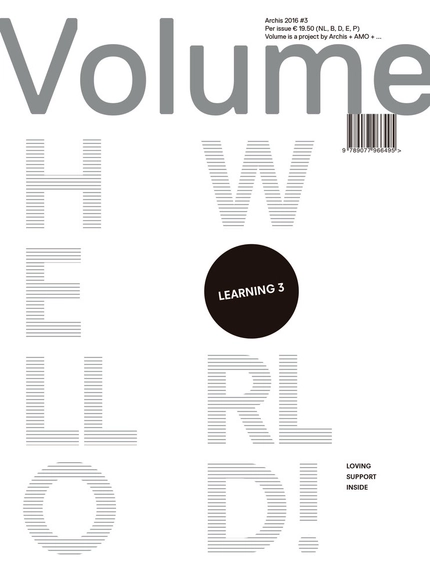
Machines have long been integral to architectural discourse. Vitruvius concluded his ten books with a meditation on war machines, and Le Corbusier published on his industrial muses just over 100 years ago. Yet something is different today. We have always learned from machines—our societies are fundamentally shaped by their processes—but now, machines learn. We live in paradoxical times. Machinic processes, computational algorithms and artificial intelligence have never been so proximate, direct, and intimate to daily life, yet we are many steps removed from their practical operations.
This issue of Volume, the third in our Learning series, seeks to take one small step in the direction towards understanding the contemporary relevance of machines for architecture, and one giant leap for mankind. Volume #49: Hello World!also includes In Loving Support, a 32-page insert produced with Het Nieuwe Instituut on living and working with algorithms.
https://www.archdaily.com/795199/introducing-volume-49-hello-worldAD Editorial Team
Our editors look at hundreds of websites per week. What do they admire and appreciate the most? Organization and simplicity. Sites that are not only clean, but fast. We actively search for projects to include on our platform, so it’s crucial that when we visit a website we not only know where to look, but how to access information. Filters and facets are our best friends. Typological differentiation is important, but perhaps not as important as distinguishing between built and un-built projects (“Is that a render?” is a question that comes up at least once a day).
https://www.archdaily.com/795078/these-are-the-best-designed-most-useful-architecture-firm-websitesAD Editorial Team
The Royal Institute of British Architects (RIBA) is pleased to announce the launch of an international open design competition for ‘The Wall’ - a structure made of a million bricks to represent answered prayer. The competition is being managed on behalf of the charity Network, The Evangelical Council for the Manchester Area Trust.
via Apple Special Event Streaming. September 7, 2016.
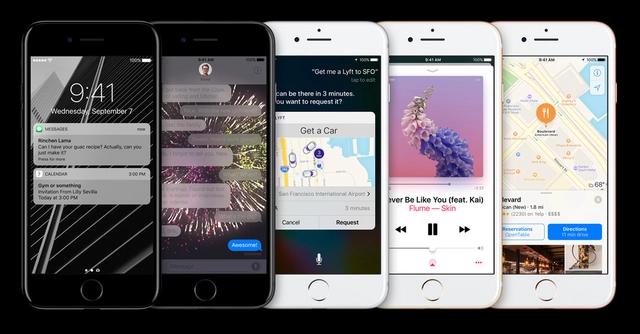
The iPhone 7 is here. Announced at Apple’s September Launch event today, the new device and its sibling, the iPhone 7 plus, have arrived after months of rumors, leaks and anticipation. The phones are loaded with a bevy of new components, including a new pressure-sensitive home button and bluetooth headphones, marking another step in the journey toward our wireless future.
Of course, in spite of the hype that the new iPhone will inevitably get—as it always does—it’s not the only smartphone on the market. Many will point to the fact that its expected RAM capabilities (2GB for the iPhone 7 and 3GB for the 7 Plus) still lag behind some competitors (for comparison the Samsung Galaxy S7 has 3GB and the S7 Edge 4GB), while the upgraded 32GB storage and newly-found water-resistance are no more than catching up with Apple’s competition. Nonetheless, Apple’s iPhone 7 also features a number of features that could make it a phone perfectly suited to architects. Read on to find out exactly why.
This past weekend, the Bauhaus in Dessau was animated by the Bauhaus Festival. Titled “Circus, Circus – from Black to White,” the event was intended to present all the fun of the fair with a monochrome twist--in opposition to the wild colors usually associated with circuses--and in the words of the Bauhaus was a “kinetic explorations of bodies, objects, media, space and sound.” The event was also an opportunity to tap into the legacy of Bauhaus legend László Moholy-Nagy, whose experiments in film and media blend well with the performative nature of the circus. The event featured a number of performances by artists, while “Cybernetic Circus” by Anhalt University of Applied Sciences and the Initiative Neuer Zirkus turned the grounds of the Bauhaus into an “architectural landscape” of performance modules inspired by Maholy-Nagy. Also featured were installations by students at Burg Giebichenstein University of Art and Design Halle titled “Neo Luna Park.” Photographer Laurian Ghinitoiu traveled to the event to capture the festivities, showing their interaction with Walter Gropius’ famous building.
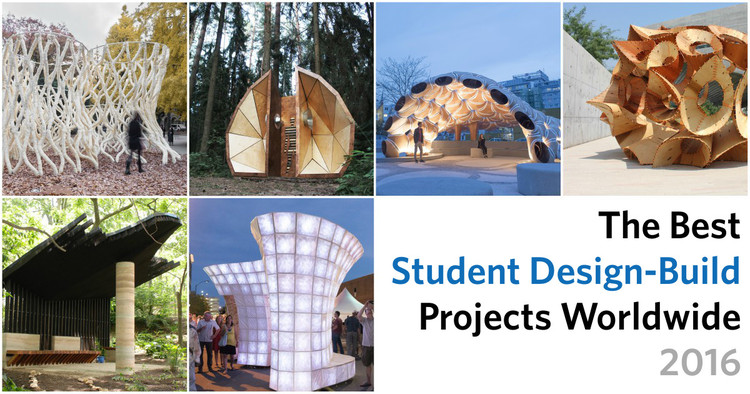
Last year, we asked the graduating students among the ArchDaily community to show us the design-build projects which they may have completed as part of their studies. The response we received was astonishing, and we were so impressed with the results that we simply had to do it again this year. So, two months ago we once again teamed up with ArchDaily Brasil andallfourArchDailyen Español sites to put out another call for submissions, and once again the response was overwhelming. Across over 100 submissions, the quality of the projects we received was so high that this year's results are bigger and better, containing 36 projects from 20 different countries. So, read on for the best student-built work from around the world in 2016.
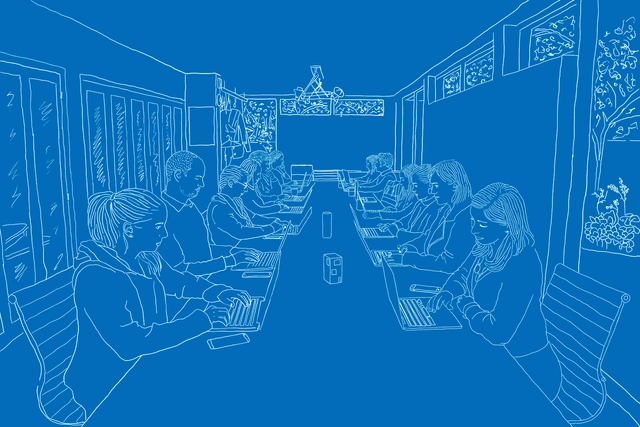
A few years ago we asked our readers to submit photos of their offices so that we could celebrate the many different environments in which architecture is created. Now we're asking you to not only show us where you work but also how you work. We want to see your immaculately curated desks and your overflowing studio cubicles—but more importantly, we want to see those sketching skills!
https://www.archdaily.com/794073/call-for-submissions-sketch-your-desk-workspaceAD Editorial Team
The skyscraper: representative of spatial economy and a symbol of power. This building typology has a storied, turbulent and even contested past. Here, we bring you a selection some of the skyscrapers and high-rise buildings featured in our AD Classics section.
https://www.archdaily.com/794582/the-stories-behind-17-skyscrapers-and-high-rise-buildings-that-changed-architectureAD Editorial Team
This video, presented by the BBC, takes a look at the work of Zaha Hadid as inspired by her favorite artist: the Russian Suprematist painter Kazimir Malevich. Featuring interviews with the dame herself, the narrative looks all the way back to Hadid’s origins, including her time at the Architectural Association School in London. It was there that she designed “Malevich’s Tektonik,” a hotel along the Thames River based upon the works of Malevich. Hadid believed that this work radically drove the architectural outlook she would employ for the remainder of her career:
“I was very fascinated by abstraction and how it really could lead to abstracting plans, moving away from certain dogmas about what architecture is. That project really liberated me, freed me from all these rules.”
Check out the video, currently on display as part of the Zaha Hadid retrospective at the Venice Biennale, for more on how Hadid drew inspiration from the Russian artist.
92 days into the 2016 Venice Biennale we have reached its exact midpoint, and the ArchDaily team, together with photographer Jesús Granada, bring you a video compilation from the opening days. With this video we want to thank the architects and talented teams that worked to produce invaluable exhibitions that were a joy to photograph and document. They showed patience, availability and attention to detail that made our job much easier. We also extend our thanks to architects in general—"viajeros en espiral que imaginan el universo" (spiral travelers that imagine our universe)—who inspire the work of all of us ArchDaily.
https://www.archdaily.com/794271/at-2016-biennale-half-point-we-celebrate-architects-spiral-travelers-that-imagine-our-universeAD Editorial Team
Earlier this summer, the Vitra Schaudepot on the Vitra Campus was officially opened. The latest in a string of structures designed by emerging and well-known architects, this gallery space is the second building by Swiss-practice Herzog & de Meuron. Conceived as "a visible storage facility" presenting a cross-section of the Vitra Design Museum's extensive collection of furniture and lighting, over 400 objects will provide "a comprehensive introduction to the history of furniture design." Featuring a café, shop and a new entrance for visitors to the museum, the building is also able to host temporary exhibitions. Photographer Laurian Ghinitoiu has turned his lens to this latest addition in Weil am Rhein.
On this day twenty-five years ago Tim Berners-Lee launched the “World Wide Web” protocol at CERN in Switzerland, ushering in the age of the Internet. Over the last two decades this global information network has rapidly evolved, increasingly influencing how architecture is conceived, produced, discussed and ultimately implemented in real space.
https://www.archdaily.com/793914/internet-25-years-old-why-we-are-celebrating-today-why-all-architects-should-tooAD Editorial Team
ArchDaily is looking for motivated architecture lovers to join our team of interns for Fall 2016! An ArchDaily internship is a great opportunity to learn about our site and get exposed to some of the latest and most interesting ideas shaping architecture today.
Interested? Then check out the requirements below.
https://www.archdaily.com/793657/call-for-archdaily-interns-fall-2016AD Editorial Team
A few months ago we put out a call for the best architecture résumé/CV designs. Between ArchDaily and ArchDaily Brasil we received over 450 CVs from nearly every continent. We witnessed the overwhelming variety and cultural customs of the résumé: some include portraits, others do not; some include personal information about gender and marital status; others do not. In the end, however, we based our selection on the CVs that stood out from the hundreds of submissions. We looked for CVs that transmitted the personality of the designer, their ability to communicate visually and verbally, and perhaps, the most intangible criteria for evaluation—the "creativity" of the CV. The documents below represent the diversity of styles and formats that just might land you a job at your dream firm.
https://www.archdaily.com/793375/the-top-architecture-resume-cv-designsAD Editorial Team
In late August, the Flanders Architecture Institute will organise Encounters in Optimism: Utopia in a Finite World, an interactive programme of lectures, debates and workshops that will take place in various national pavilions at the Venice Architecture Biennale. The overarching theme is "the architectural utopia in a finite world."
Together with The British Council, the Deutsches Architekturmuseum and the Creative Industries Fund NL, the Flanders Architecture Institute has put together a programme for architects, students and the general public to reflect on how architecture can redefine the city. The economic climate and the idea of utopia are the main topics in these discussions.
https://www.archdaily.com/793483/encounters-in-optimism-utopia-in-a-finite-worldAD Editorial Team




.jpg?1473087666&format=webp&width=640&height=580)
.jpg?1473088561 "Bauhaus Festival 2016. Image © Laurian Ghinitoiu")
.jpg?1473087820 "Bauhaus Festival 2016. Image © Laurian Ghinitoiu")
.jpg?1473088648 "Bauhaus Festival 2016. Image © Laurian Ghinitoiu")
.jpg?1473088081 "Bauhaus Festival 2016. Image © Laurian Ghinitoiu")
.jpg?1473087666)



.jpg?1473019568 "DIA 3D Jewelry Pavilion (Dessau International Architecture Graduate School). Image © Pavel Babienko")

.jpg?1472123988&format=webp&width=640&height=580)
.jpg?1472123757 "© Laurian Ghinitoiu")
.jpg?1472123736 "© Laurian Ghinitoiu")
.jpg?1472123873 "© Laurian Ghinitoiu")
.jpg?1472123884 "© Laurian Ghinitoiu")
.jpg?1472123988)