The Los Angeles International Airport (LAX), one of the world’s busiest airports, is undergoing a facelift. As part of a multi-phase project, AECOM is working with Los Angeles World Airports (LAWA) to create a sensational experience for the 61 million passengers who travel in and out of LAX annually. The project aspires to unify the disparate components of the airport’s central terminal area (CTA) and insert grand gestures that provide architectural hierarchy — yielding LAX as exciting as the city in which it resides. Through an artful integration of lighting, graphics, and architecture, the design draws from key existing airport elements such as the 1960s architecture of the Theme Building and the 60-foot polychromatic light pylons that define the airport’s entry.
Officials have warned that the 2,000 year old Colosseum in Rome is leaning. About a year ago, they noticed the south side of the Colosseum was leaning about 40cm lower than the north. As reported on the guardian, Prof Giorgio Monti from La Sapienza’s construction technology department stated that this could be the result of a crack in the 13-meter-thick concrete slab below the amphitheater; however, it too early to judge.
Unfolding around Meixi Lake, the Meixihu Culture & Arts Centre, designed by Hans Hollein & Partner, incorporates a carefully conceived mix of functions nerved generously with waterways, underground traffic roads, and boulevards. In a prime position, overlooking the waters and the ceremony island, the project will become the largest multifunctional world class culture and art centre of international standing in the Hunan province. More images and architects’ description after the break.
Zawia, a periodical publication and online forum on design, architecture, and urbanism, just released their first issue which features contributions from Saskia Sassen, Stefano Boeri, Joseph Grima, WAI architecture think tank, Carlo Ratto, Markus Miessen and many others. Their ‘Change’ volume will attempt to demonstrate if architects are ready to embrace the changing ideals and the new modes of operation, and if they are willing to help better people’s lives rather than focusing on glorifying design or architecture. It is targeted towards discussing the significantly changing realities imposed on all social, political and economic systems and their influence on design disciplines. For more information, please visit here.
Internationally acclaimed artist and architect Paul Raff just unveiled a permanent sculpture at the opening of the Waterfront Toronto Underpass Park on August 2. Suspended overhead of pedestrians, large scale mirror-like surfaces create an illusory appearance, which bends light rays to produce a displaced image much like a mirage. More images and architects’ description after the break.
As a collaborative effort involving urban designers, architects, economists, and developers, the Christchurch Central Recovery Plan was assembled as a video to present to the public. Led by the Christchurch Central Development Unit (CCDU) in New Zealand, which is part of the Canterbury Earthquake Recovery Authority (CERA), the plans for the central city rebuild was released earlier this week as a response to the earthquake sequence in Canterbury which destroyed most of the building stock in the CBD. This distinctive, vibrant, and green 21st century city has been met with overall positive feedback, which demonstrates the importance of shared ideas on rebuilding after natural disasters. On a global scale, all cities ad towns are at risk for natural disasters, and as many of us know, preparation is key to recovery. Like the video above, the power of public opinion can really have a major impact on these types of plans and give us both a feasible and optimistic view of the future.
Seattle-based Hutchison & Maul Architecture has designed an addition, dubbed the Artisan Barn, to a historic barn in Uniontown, Washington. The existing space currently houses studio, performance and gallery areas for artists, along with a gift shop. Materials will be salvaged from an onsite Loafing Shed to create a new classroom onto the existing barn structure. Additionally, Hutchison & Maul will assist in designing a master plan that will integrate landscape and outdoor performance spaces into the surrounding area.
Continue after the break for the architects’ description.
This short clip via ja+u of the Storage House by Ryuji Fukimura Architects takes you on a quick journey through the relatively compact residence that occupies a thin plot of land in the Kanagawa Prefecture, part of the Greater Tokyo Area. Smartly designed to maximize the interior volumes, a unique aspect of the house is the dry moats that line the basement floor allowing for diffuse daylight to shower the interior that would have otherwise been artificially lighted. An added benefit of the moats is that it encourages air circulation from the bottom of the house to the top creating a stack effect.
The design concept for the National Museum of Afghanistan is centered around the Afghanistan flowered arch. TheeAe LTD finds this design opportunity as a way to bring the lost heritage back to the present. The major concern for the architecture was not only about the collections but also emotional realm of space that requires a place to give a rest and the joy of the nature in its heritage safe and secured. More images and architects’ description after the break.
Taking place August 17 from 10am-6pm in Brooklyn, Intro Lab is a one-day workshop put on by modeLab on the topic of Parametric Design with Grasshopper for Rhinoceros. In a fast-paced and hands-on learning environment, we will cover introductions to Algorithmic Design, Computational Geometry, and Parametric Modeling. Additionally, participants will explore concepts such as Object Attributes/Parameters, Part to Whole Relationships, and Data Flow. Emphasis will be placed on consistent organization of data through Lists and Data Trees and best practices for Creative Project Workflow Integration, File Modularity, and Data Visualization. For more information, please visit here.
Opening up September 4 at 5pm with a lecture by 2012 Pritzker Prize Winner, architect Wang Shu, the exhibition of projects of Chinese architects focuses on the theoretical research on architecture and design as well as building practice currently found fertile ground in any contemporary China but particularly in the city of Shanghai. Organized by La Triennale of Milan and the Degree Course in Engineering/Architecture from the University of Pavia, yhe center of the debate will be on urban development and architecture thanks to the cultural milieu linked to Tongji University. More information on the exhibition after the break.
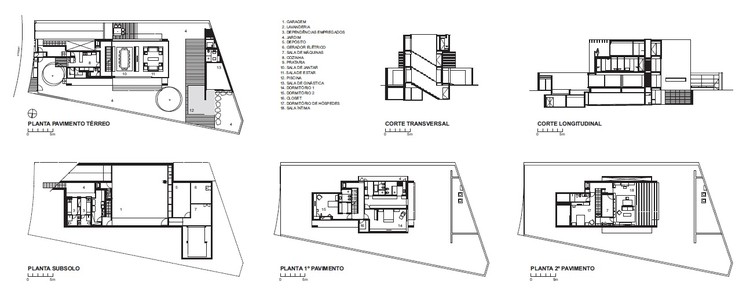
Architects: A3 Digital Location: Franklin D. Roosevelt 3120, Buenos Aires, Autonomous City of Buenos Aires, Argentina Design Team: Santiago Luppi, Javier Ugalde, Andrea Winter Project Year: 2011 Photographs: Alejandro Peral
Located on a prominent corner of Bainbridge Island, Washington, the Bainbridge Island Museum of Art is not only the anchor tenant of the Island Gateway development, but it will soon become the cultural center of its community. Designed by Coates Design Architects, an inspiring and creative experience is provided to residents and visitors alike. More images and architects’ description after the break.
Thanks to innovations in building materials, design technologies, and construction tools, a new generation of architects can finally realize structures that would have previously remained mere dreams. This emergence of a new vernacular of radically sculpted buildings, rooms, and installations melds rigorous usability with a playful and cutting edge aesthetic, facilitating highly functional yet undeniably exhilarating spaces.
In an industrial section of Düsseldorf squats a relatively unremarkable yellow-tiled modernist-looking building. It looks like the sort of building that went up in the post-war reconstruction (the city was bombed nearly flat in night raids during WWII).
The building, however, betrays obvious categorizations. At first glance it seems easy to place on an historical continuum. But just as it could be from the fifties or sixties, it could just as easily be from the twenties or thirties. It may have miraculously survived the RAF’s gasoline bombs. Post-raid aerial survey photos would always reveal those few exclamation points of untouched buildings dotting the monochromatic wastes. Could this be one of those survivors? Is this why it looks so special sitting amidst the other unremarkable buildings of Mintropstrasse? Or maybe it’s the mere fact of the photograph that makes it special.
Renowned architect Fernando Menishas been invited as the only Canarian architect to present his proposal at the Venice Biennale, starting August 29th. Menis will invite visitors “INTO THE WALL” with his handcrafted installation that will feature a selection of his most innovative projects, represented in black Foamglass. Some of these projects include the Auditorium of Pájara (Fuerteventura), Tower Agora Garden (Taiwan) and the protagonist of the facility, the Auditorium of Torun (Poland).
With a quarter million LEGO bricks and 300 hours of finger intensive labor, Warren Elsmore and his wife constructed a mini replica of the 2012 Olympic Park in London. As Gizmodo reports, the model weighs about 80kg and would cost around $300,000 to build for scratch!
The proposal for the NUK II National Library, designed by BARCODE Architects, presents a clever and pure univocal shape despite the great complexity of the given plot. By making the design compact and by moving volume from its base to the top, the building makes way and shows the characteristic ruins of Roman Emona on site, while at the same time this creates a public square along the important city junction. Prominently sited at a junction in the heart of perhaps the most important academic centre in Eastern Europe, the 20.000m2 project seeks to become a compelling architectural landmark. More images and architects’ description after the break.
The ContemPLAY pavilion project is a student-led initiative by the Directed Research Studio (DRS) of the McGill School of Architecture, in coordination with the Facility for Architectural Research in Media and Mediation (FARMM), investigating new methods of practice. The project presented a unique opportunity for the students to learn through hands-on experience in an academic context. The pavilion occupies an 8.8m x 6.7m footprint with a total height of 3.7m in front of the Macdonald-Harrington building on the McGill University campus in Montreal, Quebec. More images and architects’ description after the break.