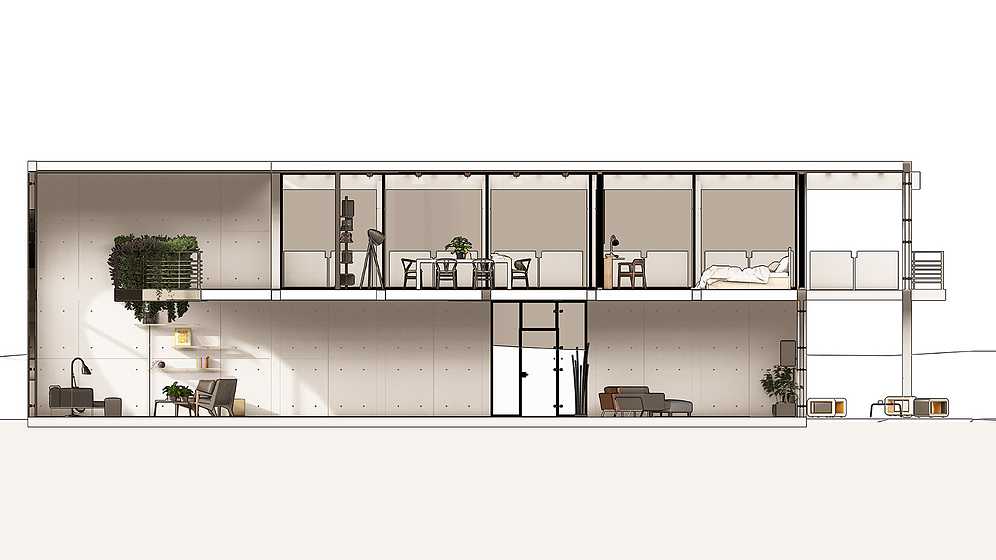
Produce personalized presentation boards that distill complex concepts into simple visual representations with a few helpful tools and effects.


Produce personalized presentation boards that distill complex concepts into simple visual representations with a few helpful tools and effects.
Think the best way to promote the economic and creative development of a city is to build stadiums and and shopping malls? Think again. In a recent article in the New York Times, Steve Lohr reveals the findings of a study from the Brookings Institution that looks into where and why specific cities emerge as hubs of creativity and innovation. By studying the patent filings of the United States' 370 metropolitan areas, the study revealed that cities with the most innovation were centers of education and research. San Jose-Sunnyvale-Santa Clara, California; Burlington-South Burlington, Vermont.; Rochester, Minnesota; Corvallis, Oregon; and Boulder, Colorado topped the list as the "output of innovation. Lohr suggests that this data can help promote policies that encourage urban development for economic feedback.
More after the break.

In 1992, the artist, Christo, with his now late-wife and collaborator, Jeanne-Claude, had a vision to suspend miles of silvery translucent fabric over the Arkansas River in Colorado. Would you expect anything less?
Christo usually works at such massive geographic scales—land interventions that can be discerned by satellites passing overhead. Here his ambition stretches for 42 miles (67.6 km) of scenic river with no less than a total of 5.9 miles (9.5 km) of fabric suspended over the eight different sections of the river.
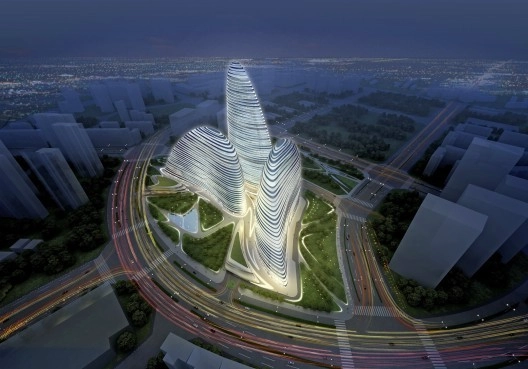
With all the recent controversy over Zaha Hadid's "copycats" in China, we decided it would be wise to get a better understanding of the often murky world of architectural copyright. In that effort, we've decided to re-print an article by Attorney Jeffrey M. Reichard, who practices construction and intellectual property law with Nexsen Pruet in Greensboro, NC, and knows a thing or two (or ten!) about the subject. The article was originally published as a Construction Law Alert for clients of his firm.
Some people say that imitation is the sincerest form of flattery. However, under architectural copyright law, imitation could be a very costly endeavor. Here are ten tips to help contractors, owners and architects protect themselves from architectural copyright disputes.
See the 10 Things You Need to Know About Architectural Copyright, after the break...

We are near to the 110,000 photos in our Flickr Pool, so keep them coming! Remember you can submit your own photo here, and don’t forget to follow us through Twitter and our Facebook Fan Page to find many more features.
The photo above is the amazing Andalucia’s Museum of Memory by Alberto Campo Baeza and was taken by DSJohnson84. Check the other four after the break.

Some people love New York. Others fancy London, Sydney, or Hong Kong. While preferences for cities are split, science says that all of us may in fact be hard-wired to love the natural world. Interface, Inc. (NASDAQ: TILE), the world’s largest manufacturer, designer and marketer of carpet tiles, today launched a global competition named “Reconnect Your Space” that calls for architectural, interior or urban landscape design entries that put this affinity for nature, or biophilia, at the forefront. Biophilic design incorporates natural elements into manmade environments in order to help people feel and perform better.
Interface’s “Reconnect Your Space” competition invites architects, designers and students of these disciplines to submit their visions for how biophilia can influence the design of a new or existing space, either inside within built environments or outside in cities. One winning submission will be selected as the most unique, inspiring and purposeful way of reconnecting this space with nature. “Reconnect Your Space” is also intended to foster dialogue, spark ideas and pique global interest in biophilic design for working, playing and living.

Online application is now open for a competition to design a temporal sustainable theatre, to be built in Cardiff, as part of the World Stage Design 2013 festival. Open to students and emerging practitioners from across all related disciplines, the winning design will be built in the courtyard of the Anthony Hopkins Centre and will be used as a major venue to house performances, presentations and seminars during the World Stage Design 2013 festival. The deadline for submissions is March 15. For more information, please visit here.

mæ architects recently announced that they were selected to design a ‘split-site’ elderly housing and healthcare hub project in Lisson Grove, Central London. Intended for City West Homes, on behalf of Westminster City Council, the housing scheme, which will be designed to HAPPI recommendations (Housing for an Aging Population Panel for Innovation), will bring contemporary, socially-orientated architecture to a deprived community which is desperately in need of re-invigoration. Construction is due to start at the end of 2013 and will be completed in two phases. More images and architects’ description after the break.

Jestico + Whiles’ design for the new £61m National Graphene Institute at the University of Manchester has recently been granted planning consent. The new facility will be designed with the goal to be the world-leading research and incubator center dedicated to the development of graphene, helping the UK to remain at the forefront of the commercialization of this revolutionary material. The project will be housed within a compact 7,600m2 five-storey building, with the main cleanroom located on the lower ground floor to achieve best vibration performance.More images and architects’ description after the break.

This article comes to us courtesy of author Jason Wee, an artist, curator, and writer who directs Grey Projects in Singapore. It originally appeared on the Guggenheim's blog on January 14th, 2013.

This article comes courtesy of our friend and cenephile Charlotte Neilson, the author of the fascinating design blog Casting Architecture, which discusses architecture and production design.
The life of a building - a few hundred years, if a building is lucky - is just a blip when compared to the billions of years required to shape the natural landscape. Even briefer is the work of a film maker: a pursuit created for momentary entertainment, which reaches completion in just a couple of hours. Strange then, that film has often stepped in to preserve buildings who have met an early demise.
While Architecture and Film have always had an uncomfortable relationship (be it the movie industry’s portrayal of modern buildings as cold and soulless - and usually associated with less than savory occupants or the stereotyping of Architects themselves as delicate, impractical types), the inclusion of a building in a feature film can often become an important part of a building’s story. And sometimes its last bastion.
More on Architecture preserved on Film, after the break...

In memory of architect and arts administrator Deborah Norden, the Deborah J. Norden Fund is calling for proposals from students and recent graduates in the fields of architecture, architectural history, and urban studies for awards up to $5000 in travel and study grants. A program of The Architectural League of New York, participants must submit a maximum three-page proposal, which succinctly describes the objectives of the grant request and how it will contribute to the applicant’s intellectual and creative development. The deadline for submissions is April 17. For more information, please visit here.

The Organizing Committee of Shenzhen Biennale of Urbanism\Architecture today officially announced the Chief Curatorship selection for the 5th Urbanism\Architecture Bi-City Biennale*Shenzhen. This biennale will be delivered by two curatorial teams, consisting of Team Ole Bouman and Team Li Xiangning + Jeffrey Johnson. Ole Bouman will act as Creative Director. He will collaborate with Stylepark on Urban Labs. Meanwhile, Li Xiangning + Jeffrey Johnson will be the Academic Directors. The 5th edition of UABB*Shenzhen will open in Shekou, Shenzhen at the end of 2013. More information after the break.

Taking place March 14-May 26, the ‘Culture:City’ exhibition encourages us to think consistently about the future of our cities from this perspective. Curated by Matthias Sauerbruch for the Akademie der Künste, the exhibit takes a critical eye to the relationship between architecture and the social reality of the 21st century and shows the impact of art and culture on cities and architecture. Art and culture have in many ways become key motors of innovative and successful urban design and planning, without which the world’s metropoles would no longer be worthy of the name. More information on the exhibition after the break.

Taking place October 10-13, this year’s Architecture Film Festival Rotterdam, which is considered the world’s largest architecture film festival, is expected to attract an audience of approximately 5,000 international visitors. The event will include screenings of over 100 movies, docs and shorts. For more information, please visit their official website here.

Organized by Christopher Marcinkoski and Javier Arpa, in cooperation with the Architectural League of New York, ‘The City That Never Was’ symposium will be taking place Friday, February 22, from 9:00am-5:30pm EST at the Scholastic Building in New York. The one day event will use the current economic and housing crisis in Spain as a lens to reconsider how planners, designers, politicians, and financiers conceive of and realize large-scale contemporary urbanization and settlement. It will be organized through four primary themes — infrastructure, waste, landscape, and instant urbanism – in order to explore new possibilities for how future patterns of urbanization can be conceived, financed, planned, deployed, and inhabited. For more details, including the complete itinerary and speaker information, please visit here.

This post is by Cian O' Driscoll, the writer of a lifestyle blog called Raconteur Living that explores architecture and popular culture. Cian is currently undergoing a Master of Science in Architecture at Cork Institute of Technology, Ireland.
Abandoned cities are an unfortunate consequence of life and growth on our planet. The reasons for abandoning a city are as varied as the people who once inhabited their buildings and walked their streets. Many of these cities are forgotten and simply line the pages of history. Some are examples of poor urban planning; some the result of the depletion of natural resources, while others are poignant reminders of the fragility of life in a nuclear world.
Below are some striking images of abandoned cities from around the world. Many of these cities have been abandoned for decades, however, due to rapid growth and expansion, particularly in China, we are now in an era of “modern” abandoned cities.
Read the stories behind these modern-day ghost towns, after the break...

The third prize winning proposal for the design of art residences in the village of Nikola-Lenivets, Russia is based on the principle of ecological compatibility and convergence with nature. Designed by Megabudka, this is achieved by architectural solutions, volumetric-spatial structures, interaction with environment, and internal physical and mental filling. This new community for artists, and all creative people, will consist of dormitories, a nursery, community center, family houses, and private units. More images and architects’ description after the break.

The U.S. Department of State recently announced a request for proposals from any U.S. nonprofit organization at the 14th Venice Architecture Biennale, which is set to take place June 7-November 23, 2014. This includes museums, galleries, design centers, schools of architecture and design, and independent curators affiliated with a non-profit organization. The deadline for submissions is April 1, 2013. For more information, please visit here.

The concept of the park is based on the existing and traditional terraces of Cyprus and, more specifically, Latsia.
These terraces not only allow for the management of the slope and water but link the project’s programme, as an environmental centre, to its spatial design. By consolidating the existing terraces, which define the park’s configuration, the terraces generate an intrinsic spatial relation between the park activities, the landscape and the views. Moreover, the terraces have been designed so a minimum amount of earth will be moved and so people with reduced mobility will have easy accessibility.
.jpg?1361404373)
Originally published on the author’s website and blog on Archinect, 'Ruins of an Alternate Future (Jinhua Architecture Park)' was written by Shanghai-based architectural designer and theorist Evan Chakroff.
One of the great, if seldom realized, promises of architecture is its capacity to affect change. The best architects seem to have this potential in mind constantly as they structure career-length narratives around the social impact that good design can achieve. While this is often hyperbole, and most projects are driven by functional or economic considerations, there is the occasional opportunity for artists and architects to create purely speculative work, where radical departures from established typologies suggest alternatives to the status quo. In these rare cases, novelty is embraced not for its own sake, but for its potential to generate new archetypes, to provide a glimpse into a parallel world where architecture truly has agency: where design can change society for the better.
Continue reading after the break...

With urbanistic planning in mind, the proposal by Baumschlager Eberle for the law courts of Caen redefines a new domain in the center of the city. In collaboration with Atelier d’Architecture Pierre Champenois, the shape of the building agrees not only with the tradition but of course with the more complex duties of law courts in the 21st century. An orthogonal pattern constitutes the base for the organization of the needs of the law courts. More images and architects’ description after the break.

New Theme Gallery in Los Angeles is proud to present their first solo exhibition of award-winning photographer Ethan Pines. Starting off with an opening reception tonight, February 2nd, from 7pm-10pm, his work documents the peculiarity of forms borne of Los Angeles’ unique urban typologies. This exhibition reveals patterns of urbanization in Los Angeles while proposing a new, sustainable form in terms of New Theme’s recent design of the Green Greenberg Green House.
Pines’ award-winning editorial and commercial work has been featured in Wired, Los Angeles Magazine, The New York Times, Food & Wine, Sony Music and Dolby Laboratories. Over the last few years he has also documented the city in terms of private moments separated from the greater agglomeration. For more information, please visit here. More images of Pines’ work can be viewed after the break.

Taking place February 8-9, the Building Pulitzer Colloquium, which is free and open to the public, will bring together key participants in the design and construction of this iconic building. The colloquium will provide unique insight into the extraordinary collaboration and dedication required to realize this project. Hosted by the The Pulitzer Foundation for the Arts and Washington University in St. Louis, the event focuses on how this building, designed by an internationally recognized architect, was completed. Topics will include the working structure between Tadao Ando’s office and the St. Louis-based team, the realization of Ando’s design intent through the translation of American methods of construction, and the creation of a work environment that fostered construction excellence. More information on the event after the break.

Awarded the second prize in the recent Ramat Efal Education Campus Competition, the ‘Fields of Knowledge’ proposal by ShaGa Studio + Auerbach Halevy Architects/Ori Rittenberg(Rotem) integrates a series of linear ‘knowledge fields’ into a rich and varied learning experience, weaving together exteriors and interiors, the public and the community. Evoking the memories of old agriculture fields in Ramat Efal, their design criticizes an existing plan that splits the campus into three divided plots and suggests instead an integration of both school & public programs within an overall ‘field condition’. More images and architects’ description after the break.