As part of the 5th International Architecture Biennale in Rotterdam, Casanova + Hernandez Architecten will be putting on the ‘Can public space be used to regenerate urban life?’ roundtable discussion today, June 26 at 3:00pm.
This roundtable discussion is based on the one-year postgraduate studio entitled “Public Space Acupuncture”, that has been guided at the Berlage Institute by Helena Casanova and by Jesus Hernandez. An accompanying exhibition will open at 7:00 pm, remaining on view until Sunday, August 12. More information on the participants after the break.
Equilibrium shows a city of the future where all feelings have been suppressed in order to avoid war. Any means of expression that could urge a sensorial response is censored and terminated. Diversity and free thinking have been replaced by uniformity and an unquestionable authority of a “Father”, who guides lives in this new society. The entire city organization is prepared for accommodating spaces needed by the administration, including public space for citizens to congregate, and several kinds of facilities for control.
Do you think we could deal with this kind of cities in the future, or maybe they already exist? As always, we wait for you to enjoy it and let us know your thoughts in comments.
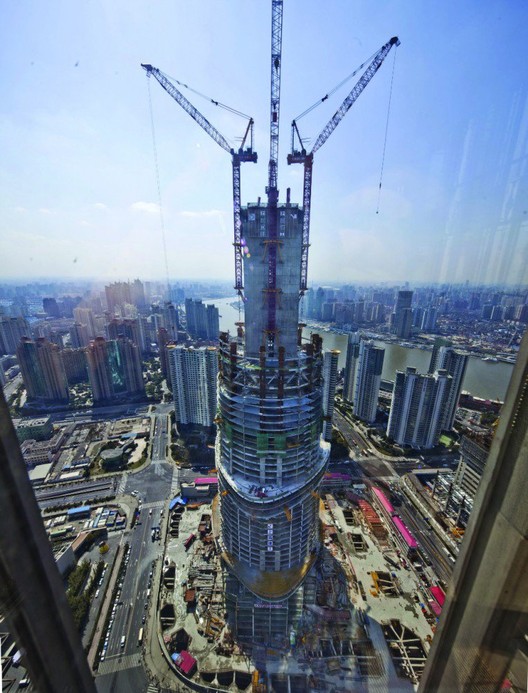
Yesterday, the final steel beam rose 977 feet into the air and was placed atop 4 World Trade Center – the 72-story tower designed by Pritzker Prize-winning Japanese architect Fumihiko Maki. As gospel singer BeBe Winans sang “God Bless America”, the 8 ton beam, signed by all members of the team and adorned with an American flag, reached its final destination atop the city’s sixth tallest tower.
At over 80 years of age, Maki is making his New York debut in an elegant manner. The tower was designed to serve as a “respectful backdrop” to the National September 11 Memorial and not to compete with 1 World Trade. ”This is a special place with a sacred meaning and we felt we had to be respectful,” explained Osamu Sassa, Maki’s project architect, to The New York Times. Such a ideology offers a strong contrast with the other architectural statements that will eventually rise as part of the World Trade Center complex, such as Norman Foster’s 2 World Trade and Richard Roger’s 3 World Trade. While the minimalism of Maki may have kept the design under the radar during its design and construction stages, the grace of its simplicity will craft a dignified presence while visiting the site. ”The design of the tower at 150 Greenwich has two fundamental elements – a ‘minimalist’ tower that achieves an appropriate presence, quiet but with dignity, and a ‘podium’ that becomes a catalyst for activating the surrounding urban streetscape as part of the revitalization of lower Manhattan,” explained Maki.
RETHINK REUSE, an independent group whose goal is to inspire discourse on the topic of reuse is inviting all to participate in their Transforming Seattle’s 520 Floating Bridge 2012 International Design Ideas Competition. The goal is to envision new, innovative reuse strategies. The 520 bridge will be decommissioned in 2014 due to high maintenance costs, damage, and the need for additional lanes. The Washington State Department of Transportation is requiring of the new bridge’s design-build team that it be reused or recycled in a sustainable fashion; current trends for the reuse of pontoons have been floating docks, breakwaters and piers, but what else could be done with such a feat of engineering? More information on the competition after the break.
In the video above, Simon King, lead MEP engineer for the King’s Cross Station Redevelopment by John McAslan + Partners, discusses the background and challenges that shaped Arup‘s unique lighting design for the new western concourse of this famous London railway station. The transformation of the station represents a compelling piece of place-making for the city of London.
The proposal for the Klaksvìk City Center by studio wok starts from a thorough study of the natural elements of the place and from a study of the context. The two qualities of the bay and the natural character of the isthmus are key factors in the project. The new masterplan for Klaksvík strives to build a new way of living in the open public spaces through “spatial ecology”: the project wants to restore continuity to residential space at all scales of the project, from the design of the sidewalk up to design of urban systems on a regional scale. More images and architects’ description after the break.
Architectural Record has published their annual list of the “Top 250 Architecture Firms” in the United States. The companies are ranked according to architectural revenue from the prior year. Gensler claimed the number one spot, with a record high of $764 million in revenue, over the long-standing leader AECOM, whom brought in $445 million in 2011.
Antoni Gaudí (1852 -1926), the Catalán architect best known for his whimsical style and his inimitable masterpiece, the still unfinished Sagrada Familia, would have turned a ripe 160 years old today.
The Green Building Council of Australia has released Green Star – a new comprehensive rating system that can assess the degree to which communities, as a whole, succeed in creating livable and sustainable environments. This is a new and dynamic way to look at the culture of sustainability. “Green building” is not only reflected in individual buildings; it is the accumulation of the buildings, the infrastructure, the urban planning and design, the amenities of the community and the lifestyles that communities live. Projects such as DIY Urbanism in the Netherlands by MVRDV and “e_co_llectiva” by Athanasios Polyzoidis & Katerina Petsiou have this kind of regard for the development of holistic community.
The New York Economic Development Corporation and Mayor Bloomberg of NYC announced the completion of the final plan for Willets Point - a peninsula on the Flushing River in Northern Queens, New York. The development of Willets Point is part of the urban renewal project associated with Citi Field – the Mets’ new stadium. Nicknamed the Iron Triangle, the project will include housing for mixed incomes, retail and entertainment amenities, a hotel, a convention center, office space, parks and open space, and a new public school, all of which falls under the umbrella of LEED-certified buildings and infrastructure. As with every redevelopment plan, there are positives and negatives to restructuring the community.
After his architecture studies at London’s Architectural Association School of Architecture (AA), Cristobal Palma worked as an assistant in London for a couple years, a time where he honed his photography skills. After this experience he took a more independent route working for some of the best architects in Chile and most renowned publications in the world.
As you may have noticed, since last year we’ve featured a series of Architecture Videos by Palma, the latest of his artistic endeavours that enable us to experience the projects in a different way. Considering this type of media offers a completely new range of opportunities for both architects and publications, we think it’s worth getting to know Palma and his professional journey incorporating audio-visual elements to the representation of architectural projects. The video above, Cristobal’s first completed video and now published online for the first time, presents the España Library in Medellin-Colombia, one of the most iconic buildings of this city’s renovation.
You can read an interview with Palma after the break.
The Green Carceri, designed by TARQUITECTOS, arises as a natural extension of the High Line Park, connecting himself with the High Line and flying over the river, thus enabling a continuation of the public space underneath with the neighborhood to the height of the street and the docks. Winding around a series of vertical communication cores, the building allows both internal transit users and visitors to descend to the level of the street without having to enter the building. More images and architects’ description after the break.
At 97 years of age, the architect Gerhard Kallmann passed away on Tuesday in Boston. Kallmann’s career was ignited with the design of Boston City Hall, a neo-brutalist building that received mixed feelings of criticism and praise upon its completion. After escaping Nazi Germany in 1937, Kallmann studied at the Architectural Association in London before moving to the United States and teaching in Chicago and New York. It was in Columbia University where Kallmann met Michael McKinnell and the two would grow to co-found Kallmann, McKinnell & Knowles in 1962 – the same year they won the competition for City Hall.
Presented at the bike festival of Gothenburg just about a week ago, the Cycling Center by We Are You + Erik Hallberg aims to promote cycling and bring together different cycling communities in the city. With Gothenburg being a city strongly dominated by cars, more than other large Swedish cities, this project has started to turn this around and make Gothenburg a ‘bike city’ with role models such as Amsterdam and the neighboring and great example Copenhagen. In this work of switching over from cars to bikes, their proposed cycling stadium would act as a catalyst. To become a ‘bike city’, the perception of the bike and the cyclist among city inhabitants is crucial. More images and architects’ description after the break.
Above is a video by Vincent Hecht, an architect and filmmaker in France, which highlights the NA House by Sou Fujimoto Architects. The video is part of a new collection of architecture movies about Japanese architecture. Designed for a young couple in a quiet Tokyo neighborhood, the 914 square-foot transparent house contrasts the typical concrete block walls seen in most of Japan’s dense residential areas.
Facing the roman Arenas and amphitheater of Nîmes, crossed by the ruins and the archeological remains of the ancient roman fortifications, the main challenge for the design of the Musée de la Romanité was to design a museum that would become a reference on an international scale. This winning proposal by Elizabeth de Portzamparc creates a strong architectural dialogue between two architectures separated by over two thousand years of history and facing each other. The project is located on the backbone of the site, on the old limit that used to separate the medieval town from the modern city. More images and architect’s description after the break.
Now in its fifth year, the World Architecture Festival moves from Spain to Singapore (October 3rd-5th). And for this year, we are happy to announce ArchDaily as a media partner, and as part of the jury!
The architecturally intense event includes the awards and a festival gallery, with more than 700 entries from around the world in 30 categories, accompanied by live presentations from the finalists, a seminar and keynotes with renowned international architects. In these, and other activities (full summary), you will be able to exchange ideas with over 2,000 architects representing more than 65 countries, broaden your horizons and your contacts book.
Any projects completed between 1 January 2011 – 30 June 2012 can be entered or if you don’t have a completed project you can enter any future projects you have on the drawing board.