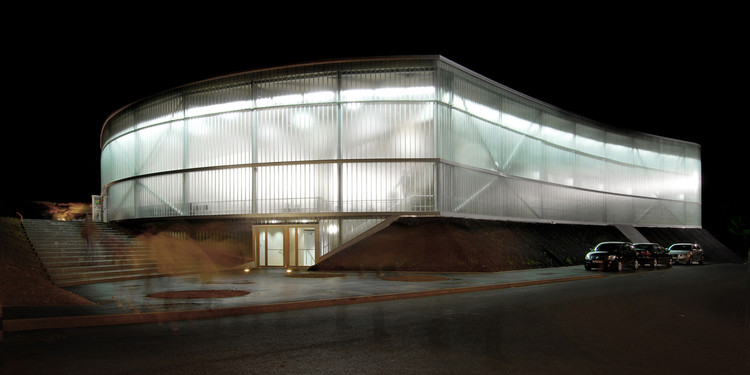
Co-sponsored by The Irwin S. Chanin School of Architecture of The Cooper Union as part of the program put on by the Architectural League, Mike Taylor of Hopkins Architects will be delivering a lecture on his current work at the Cooper Union in New York. Taking place on Tuesday, October 30th, the leader of the design team for the London 2012 Velodrome, and a senior partner at Hopkins Architects is “guided by deeply-rooted architectural, environmental, and social convictions.” Widely lauded for its elegant carefully engineered form, the Velodrome’s sustainable and flexible design has won awards for its architecture and engineering, as well as its civic presence from the RIBA, the Architects Journal, and the BCI, among others. For more information, please visit here.
The ‘Forest Corridor’ proposal has won one of the 2nd prizes (Professional Category) in the Open International Competition for Noise Barrier/Enclosure organized by the Hong Kong Government. Designed by BREAD Studio, the project gives an alternative insight to the noise mitigation structure design in the dense urban environment of the city. More images and architects’ description after the break.
WORK Architecture Company (WORKac) has won an international competition to design new Assembly Hall in Libreville – the capital city of Gabon – for the 2014 Summit of the African Union. The New York City firm impressed the jury with their proposal L’Assemblée Radieuse, which offers a self-shading, circular structure that maximizes active and passive design while incorporating the vibrant ecology of the Gabonese Republic.
The new landmark is scheduled to break ground in February 2013 and will be completed in June 2014. Continue reading for the architects’ description.
SCI-Arc Masters of Architecture graduates Liz and Kyle von Hasseln have been awarded the inaugural Gehry Prize for developing an interruptible 3D printing method, dubbed Phantom Geometry, that allows designers to make alterations to the design while it is being printed. The Phantom Geometry method is a convenient alternative to the conventional, static 3D printing systems available today. The system’s main components includes a UV light projector, a special photo-sensitive resin, and controlled robotic arms from SCI-Arc’s Robot House.
Architects: COOKFOX Client: Bank of America at One Bryant Park, LLP, a joint venture between The Durst Organization and Bank of America Location: New York, NY Completion: 2009 Size: 50,000 SF
On November 15th-17th leading architects, artists, scholars, and industry leaders from all over the Globe will meet up in Aarhus, Denmark to shape the media architecture of the future and discuss how media architecture is about to change our cities.
What happens when heat sensitive concrete ‘freezes’ the shadows of passers-by, or when a façade turns into a screen by means of thousands of tiny LED lights? What happens to architecture, people, and cities, when buildings turn into a type of digital media and allows citizens to communicate with each other in completely new ways?
Questions like these are increasingly relevant, as media architecture gains ground in cities all over the World. And they will be top of the agenda when these media architecture experts meet up in Aarhus in November.
“Media Architecture is changing the way we relate to traditional architecture,” General Chair of the biennale, Dr. Martin Brynskov, said. ”It is a field in rapid development, and we’re very much looking forward to hearing top experts’ take on how media architecture affects our perception of buildings and cities.”
Designed by architects Ângelo Lopes, Helena Gomes, and Lara Plácido, the CASALATA (Tin House) project started with a short film in Mindelo, Cape Verde. The film focuses on the issue of the shortage of housing and on the problems that cause suffering in the tin house neighborhoods. The CASALATA film then evolved into a wider project with the intention of providing a viable strategy to improve the housing problems of Cape Verde. The result is an architectural proposal with the potential for effective implementation. More images and architects’ description after the break.
Our friends from UNStudio shared their latest completed residential project, a villa nestled on the outskirts of Stuttgart that offers amazing vistas over country vineyards which are juxtaposed with cityscape panoramas. The sinuous curves of Haus am Weinberg are governed by the idea of creating a “twist” which organizes the programmatic flow of the residence. Ben van Berkel explained, “The Haus am Weinberg adopts a stereovisual spatial effect, acting almost as an optical instrument, whereby not a parallax view, but a parallax experience is created. Moments of parity with the surrounding landscape from inside the house form a constant experiential connection and awareness of its immediate context.”
More after the break, including a great photography set by Iwan Baan.
As part of the Sukkahville Design Competition in Toronto, organized by the Kehilla Residential Programme, Craig Deebank and Gina Gallaugher were selected as one of the finalists for his ‘Embryonic Canopy’ exhibition. The project re-images the Sukkah as both a temporary shelter and permanent fixture within the agricultural ecosystem. It challenges the notion of the traditional static Sukkah while creating a sense of wonder, intrigue and connection to the natural environment. More images and designers’ description after the break.
Designed by Mjölk Architekti, a high seat was installed on the main square in České Budějovice where it stayed for a month. It is situated high up so that it does not interfere with everyday life on the ground and offers sufficient privacy to its occupants. Over the month of the exhibition, this space with a floor area of 6.25 m2 hosted several inspiring personalities, the so-called “urban hunters”. They are the masters of their time and space. All the necessities needed for comfortable living are provided. More images and architects’ description after the break.
As an entry for the Land Art Generator Initiative Competition 2012 – Freshkill Park New York, ‘Wind Fountain’ is based on an adaptation of the piezoelectric effect – a well known property of certain materials to produce electrical power when they undergo strain and stress. Designed by Gembong Reksa Kawula, the project is shaped as an artificial tree, with each unit consist of 450 flexible thread 30 meters high made of carbon fiber reinforced resin pole that will sway in the wind. More images and architects’ description after the break.
Last September 25th, at Bartlett School of Architecture, the Graduate Program Exhibition was inaugurated. The same day, Peter Cook gave by himself the “Multicoloured Ear”, (the physical icon coming from the fact that exhibition was taking place at the former Ear Hospital building) for the Special Peter Cook Prize of this year, to the postgraduate student Maj Plemenitas with his research project 10⁻⁹ ]LINK[ 10⁹.
MenoMenoPiu Architectshave shared their submission for the Daegu Gosan Public Library Competition in Daegu, Korea. This project focuses on creating a community with Daegu’s Metropolitan Center with consideration for urban flows and social trends. Join us after the break for more.
ArchDaily’s previous coverage of Herzog & de Meuron‘s 56 Leonard Street was around the time when construction was just about to begin. Now four years later, construction seems about ready to restart, according to bdOnline. Join us after the break for more details.
King’s Grove, an elegant new house squeezed behind two Victorian terraces in Peckham, has been awarded the Royal Institute of British Architects’ (RIBA) Stephen Lawrence Prize 2012 – an architecture award that recognizes “fresh talent and smaller construction budgets”. The project, designed by London-based practice Duggan Morris Architects, was selected over four other contenders and was awarded last week, along with the 2012 Stirling Prize-winner, in Manchester. As you may remember, Duggan Morris Architects won last year’s RIBA Manser Medal.
Building: Inside Studio Gang Architects, is the first solo exhibition dedicated to the work of Studio Gang, which will be on view at the Art Institute of Chicago until February 24, 2013. The show immerses visitors in the energy of the studio’s creative process and the stream of ideas that connects its growing body of work. More images and information on the exhibition after the break.
The first prize winning ‘e(CO)stratègia’ proposal for the ‘Les 16 portes de Collserola, porta 13′ Competition weaves biological and urban flows in order to improve society and ecosystem together as a whole. Designed by Sau Taller d’Arquitectura, their concept aims to define the edge between the city and the mountains as a surface, a space occupied by domesticated fields, a place between nature and city where you can find community vegetable gardens, and open air green spaces. Therefore, this domesticates nature between the concrete sense of the city and the wildness aspect of the natural park. For images and architects’ description after the break.