Democratic By Design is a short film, produced by the General Services Administration and narrated by Luke Russert, that tackles the issue of federal architecture. Buildings designed for the government typically have a familiar aesthetic. Washington, DC, is dominated by Neoclassical Architecture, building on the connotations of ancient Greek and Roman fora and temples as a symbol of democracy. But they perpetuate a sense of dominance and formality. Most of these buildings – city halls, courthouses, agency headquarters – were built in the 18th and 19th century, yet they leave behind a legacy and association in the architecture of the federal government.
On the contrary, government buildings built in the mid to late 20th century, specifically after 1962, have a more varied vernacular. This can be credited to Daniel Patrick Moynihan, aide to President John F. Kennedy. His one page document outlined guidelines for public architecture – an effort to contextualize and modernism government buildings. This video brings his words to life via well-known architects who have have designed federal buildings.
Join us after the break for a look at some of these buildings.
Designed by JaK Studio Architects, their second prize winning proposal for the RIBA International Competition to Re-imagining York’s Giuldhall Complex: Connecting River and City re-energizes the area by focusing on its history while embracing the future. When the Romans settled in this outpost of their empire, they were still keen to establish some of the rigor and grandeur of Rome. To echo this we cleared the open ground around the guildhall and reclaimed two large plazas cascading down to river providing unique and accessible public spaces with direct relationships to the river. More images and architects’ description after the break.
Think Space Programme recently announced the winners of all three competitions within the Past Forward 2012 Cycle, an annual cycle of conceptual architectural competition within the Think Space programme. This cycle of competitions aimed to hold a mirror to the discipline to reflect the changes of the last thirty years by re-visiting three competitions that radically transformed architectural culture: The Peak (Hong Kong, 1982), Yokohama Port Terminal (Yokohama, 1994) and Blur Building (Swiss Expo, 1999). The renowned architects, winners of the original competitions – Zaha Hadid and Patrik Schumacher, Alejandro Zaera-Polo, Charles Renfro and Ricardo Scofidio – were jurors in this year’s Competition Cycle. Their upcoming events – Exhibition at Storefront for Art and Architecture, New York and the Unconference at Lauba House for People and Art, Zagreb in 2013 were also recently announced. More images and information on the winners after the break.
CLOG recently announced their call for submissions for their upcoming SCI-FI issue, which has been inspired by a the recent rise of a number of designs from significant international offices exhibiting a striking resemblance to science fiction icons, such as the Death Star. In doing so, they are demonstrating the impact this genre has had on the creative imagination of a generation. As science fiction continues to both draw upon historic and contemporary architecture while simultaneously influencing future design, it is time to critically examine the improbable made possible: SCI-FI. Submissions are due no later than January 21. For more information, please visit here.
Grimshaw Architects recently announced their completion for a detailed masterplanning study for Fraport, which provides a new vision for the existing forecourt area at Frankfurt Airport’s Terminal 1. Using creative design solutions, the masterplan embraces the challenges presented at the site by bringing light, greenery, and fresh air into the heart of the airport. More images and architects’ description after the break.
Never Built: Los Angeles will present a thorough compendium of projects by some of the worlds most celebrated architects that never made it past the drawing board. After two years of extensive research, countless untold stories and hundreds of beautiful designs – many promoting a denser, more vibrant Los Angeles – have been unearthed. Co-curated Sam Lubell and Greg Goldin and designed by Clive Wilkinson Architects, Never Built: Los Angeles will present the most visionary designs that had the greatest potential of reshaping the city and question why they were never built. Forgotten, yet innovative projects from Frank Lloyd Wright, John Lautner, Rudolph Schindler, Frank Gehry, Thom Mayne, and more, will be presented.
The research and exhibition design is complete. However, they need your (tax deductible) donations to help make Never Built: Los Angeles a reality. Learn more and support the exhibition on Kickstarter!
The exhibition plans to open this spring at Los Angeles’s A+D Architecture and Design Museum.
A shortlist of six international teams has been chosen to advance to the second stage of the architectural competition for the Museum and Educational Center of the Polytechnic Museum and Lomonosov Moscow State University.
The competition’s objective is to create a Museum and Educational Center that will compliment the historic Moscow Polytechnic Museum – one of the largest and oldest technical museums in the world – on the new territory of the Moscow State University (MSU). The new center is envisaged as a meeting point for the Russian and international scientific community. It will demonstrate the most recent scientific and technological discoveries using state-of-the-art multimedia technologies, for accommodating multiple displays and exhibitions as well as for conducing scientific educational programs for over 1.3 million annual visitors.
A recent survey into the billing activity of architecture firms across the country has revealed a growing trend in homeowners’ preferences. The AIA Home Trends Survey released a series of charts, marking the rise between 2011 and 2012 of preferences for low maintenance, and energy efficiency home options with a rise in a desire for homes that have a proximity to neighborhood amenities. What this means is that home buyers are moving away from the auto-centric lifestyle of mid century suburbs and are coincidentally opting for the more sustainable choice where walking and public transportation may take preference. AIA Chief Economist, Kermit Baker, PhD, Hon. AIA, notes that in many areas, there has been a rise in interest in urban infill locations over exurbs, and a general push within communities for public accessibility and proximity to work places, retail options and open space.
What is behind this trend? Is the influence of sustainable design breaking into the mainstream of the American home-buying conscience? Is sustainability changing the “American Dream”?
In an effort to alleviate some of the stress and frustration associated with New York’s continued housing crisis, Jaye Moon, a Brooklyn-based street artist, decided to leave new buildings made of Legos cradled in the limbs of trees, or wrapped around their trunks. Carefully designed, the blocked geometry of her architectural construction is considered to allow for the expansion of tree limbs and to avoid damage. Catching the eye of local New Yorkers and captivating anyone who may pass by her creations, Moon says she chose Legos as a medium because they are ready-made objects that mimic industrial, mechanical uses and because they summon a certain childlike innocence and sense of play. More images and information after the break.
The IIDA recently released the photos on the winning projects for their 2012 Best Interiors of Latin America Competition. The competition was created to recognize, honor and celebrate outstanding Interior Design/Architecture projects that represent the highest level of creativity, originality and design excellence in the following countries: Argentina, Aruba, Belize, Bolivia, Brazil, Chile, Colombia, Costa Rica, Ecuador, El Salvador, Falkland Islands, French Guiana, Guatemala, Guyana, Honduras, Mexico, Nicaragua, Panama, Paraguay, Peru, Suriname, Uruguay and Venezuela. The design project(s) must have been completed between January 1, 2010 and June 31, 2012. A complete gallery of the winning projects can be viewed after the break.
Jaeger and Partner Architects shared with us their Hanking Nanyou Newtown Urban Design proposal for the renovation of a parcel of Nanyou in Nanshan District, Shenzhen. Their concept focuses on creating a ‘multi-functional ring’ which combines the planning theories of the compact city, green city, and digital city. Acting as a unifying element, the multi-functional ring at the site’s core is a prominent feature of the design, providing the best site accessibility solution to an otherwise difficult to manage site. More images and architects’ description after the break.
The Governor General of Canada, David Johnston, has bestowed Officer of the Order of Canada – one of Canada’s highest honors – to Toronto architect Marianne McKenna of Kuwabara Payne McKenna Blumberg Architects. Similar to the Order of the British Empire in Britain and the Kennedy Center Honors for artists in the United States, the award recognizes Canadians for a lifetime of outstanding achievement, dedication to the community and service to the nation.
Office of the Secretary to the Governor General stated:
Massimiliano and Doriana Fuksas has been announced as winner of an international competition to design and construct the first cultural center in Chengdu, China. In their winning proposal, Fuksas combined four, elliptical shaped buildings with a spiral structure to create an inclusive artist complex that offers a center for the performing arts, a cultural center, offices Writer and Literary Association, and an apartment building for artists.
Learn more about the Chengdu Tianfu Cultural and Performance Center after the break.
Luca Peralta Studio shared with us their design concept for the Helsinki Central Library competition. Their ‘three cubes on a leaf’ concept is designed with the intent of creating an animated light in the distance. As a result, their project becomes an urban lantern that attracts and guides you on your journey in the direction of the city center. This light emanates from geometric objects, with a modern and minimal design, gently suspended on the landscape. More images and architects’ description after the break.
NEX recently won the Cadogan Café design competition, organized by Malcolm Reading Consultants. The £2 million project for a new café, which will sit near the entrance to the Saatchi Gallery in Duke of York Square in Chelsea, is an organic coiled form. Their design features a roof terrace and incorporates an ingenious glass wall that rises and falls depending on the weather. More images and architects’ description after the break.
Designed by Tomas Ghisellini Architetto, the proposal for the new “Malga Fosse” refuge, which won an honorable mention, chooses the language of the rough and simple local construction scattered among the mountains. In doing so, their design builds up the impression of an old archetypal building surrounded by valleys and peaks of great beauty. Aimed at being an unforgettable place right in the heart of the Dolomites, the old is here replaced by a fascinating and iconic architectural body. More images and architects’ description after the break.
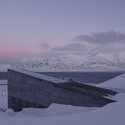
In 1945, the United States dropped 2 nuclear bombs on Hiroshima and Nagasaki. While the act devastated and destroyed these two Japanese towns, it also created an entirely new political climate, one based on apocalyptic fears. As tensions with Soviet Russia heightened, and the United States entered an age of potential nuclear destruction, the landscape itself adapted in response - becoming littered with bunkers and fallout shelters, the “concrete responses to the political social and existential anxieties of the atomic age.”
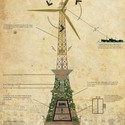
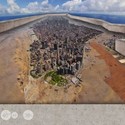
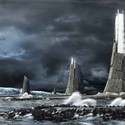
Fast-forward nearly seventy years, and we’re currently faced with a new apocalyptic scenario of our own. Assuming you’re reading this, we have all survived the Mayan Apocalypse. Congratulations. However, that’s not to say that out apocalyptic fears - and its resultant architecture - has come and gone. Our apocalypse is more based on the fear of natural disaster - hurricane, tornado, viral disease, even infected-zombie-people - than nuclear attack; and our apocalyptic architecture is less of the bunker variety, and more of the vertical farm/fortress - let’s call it ESD: Extremely Sustainable Design.
More on apocalyptic architecture of the 21st century, after the break...