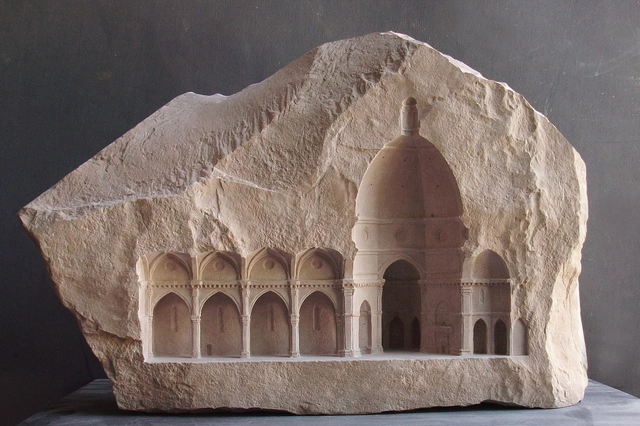
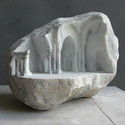
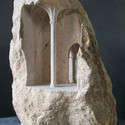
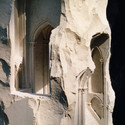
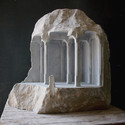
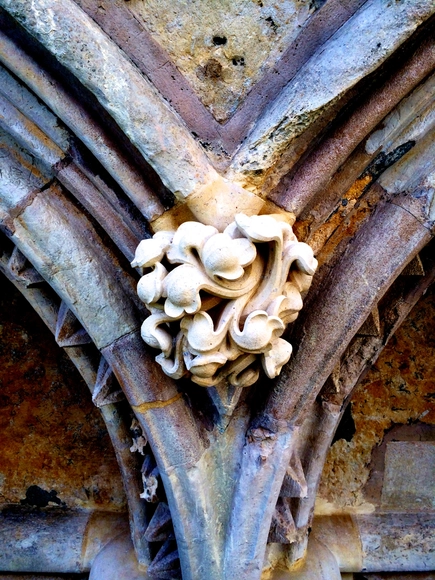
Matthew Simmonds, an art historian and architectural stone carver based in Italy, has created a collection of exceptionally beautiful miniature spaces carved from stone. Having worked on a number of restoration projects in the UK - from Westminster Abbey to Ely Cathedral - his skills have been transferred into work of a much smaller, if not more intricate, scale. Hewn from large stone blocks (some of marble), the level of intricacy Simmonds has achieved in the architectural detailing is almost incredible. Capitals, vaults and surfaces all distort and reflect light in a very beguiling way.
Videos
Arrette Scale: perspective. Image Courtesy of Arrette Scale
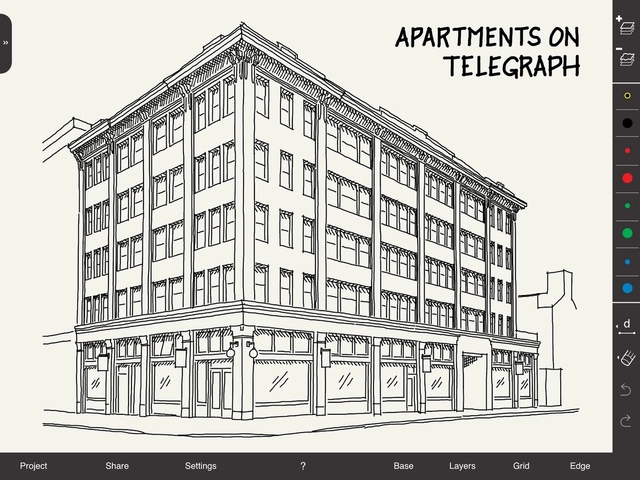
Building upon our Top 10 Apps for Architects, this collection brings together some of the best quality and most valued technical apps for designing, sketching, calculating and collaborating. Although the majority of those featured here are designed solely for the iOS platform, every time we collate lists such as these it's clear that more and more high quality apps for the Android and Windows platforms are being developed. From condensed versions of large scale software packages that architects and designers use every day, to blank canvases to scratch ideas down onto, you might just find an app that could improve the way you work.
With conscious material choices, Australian architects Tonkin Zulaikha Greer are known for their ability to integrate buildings into a city’s existing fabric. Michael Holt, editor of the Australian Design Review, caught up with partner Tim Greer, for the following interview, picking his brain on materiality, site, history and more.
Since the practice’s inception in 1988, Tonkin Zulaikha Greer (TZG) has become expert in the reuse of existing built fabric and how best to reintroduce the past into the contemporary. Through projects such as the restoration of Hyde Park Barracks, the National Arboretum Canberra (featured in AR131–Present), Carriageworks, and Paddington Reservoir Gardens, certain design characteristics are notable: volumetric boxes, a shifting in typology, an overarching and encompassing ceiling or roof plane, a restricted material palette, and working-off the existing while simultaneously revealing the existing.
La Samaritaine was once Paris’ most famous department store. Image via Wikipedia
What is the preservationist's role in our modernizing world? According to Michael Allen of Next City, preservationists exist to ensure that redevelopment meets both cultural heritage and economic demands. Read his entire article, originally published on Next City, below.
https://www.archdaily.com/524597/the-paris-debate-must-preservation-inhibit-urban-renewalMichael Allen
Modernism induced a shift in lighting away from luminaires and towards invisible light sources that render spaces in a purer (forgive the pun) light. For the first time, lit walls were used to define rooms and to structure architecture. Today I’d like to explore early prototypes - including Philip Johnson’s Brick House and the Seagram Building - and discuss how their lighting techniques continue to influence architecture today.
Savoy-Plaza Hotel, New York City. Image via Wikimedia
The following list of the ten tallest buildings ever demolished, by Michael Aynsley, was originally published on BuzzBuzzHome.
Before we get to the countdown, a caveat: this list only considers buildings that were demolished on purpose by their owners. If it included all tall structures that are no longer standing, number one, two and four would be occupied by the three World Trade Center buildings tragically destroyed on September 11th, 2001.
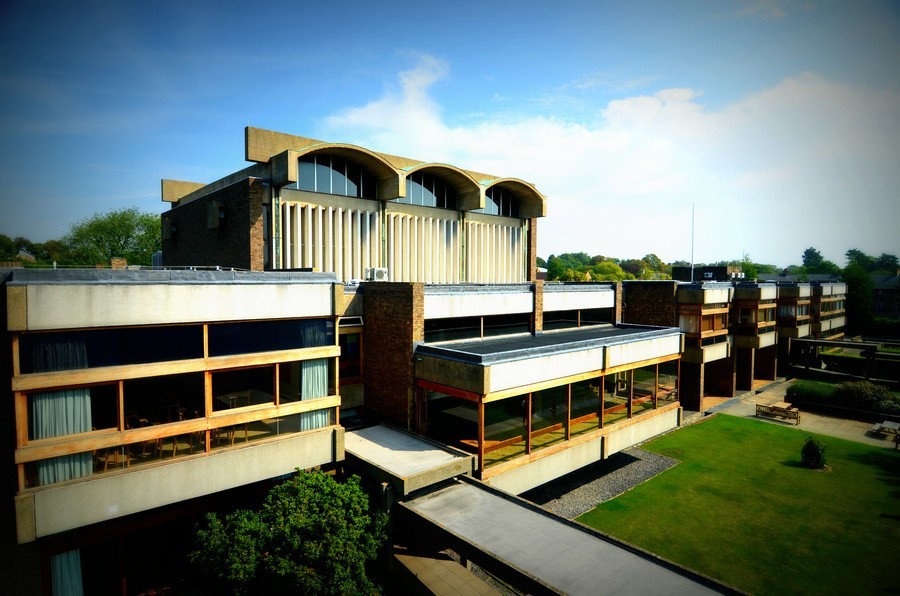
Fifty years ago Churchill College Cambridge opened its doors. In contrast to the historic Colleges, with their medieval Gothic and Neo-Classical buildings corralled behind high walls, this was in an almost rural setting on the outskirts of the city, modern in design, and Brutalist in detail.
The 1959 competition that brought the College into being is considered by many to be a watershed moment in British Post War architectural history. It brought together 20 names, young and old, all practicing in Britain, all working in the Modernist and more specifically the nascent Brutalist style. It was a “who’s who” of British architecture at the time, including the Smithsons, Hungarian-born Erno Goldfinger, Lasdun (then in partnership with Maxwell Fry, Jane Drew & Lindsay Drake, and formerly with Russian émigré Lubetkin), Lyons Israel Ellis and Robert Matthew (one half of the Royal Festival Hall team, who teamed up with Johnson Marshall). None of these made the shortlist of four.
In an age when 1:1 3D printed buildings are becoming ever more commonplace from the Netherlands to China, it's important to pause and assess the existing built fabric of our cities, towns and villages. If we want to maintain and preserve them whilst protecting the inherent craft imbued in their construction, the importance of nurturing and promoting these skills should be recognised.
In the UK, the Heritage Skills Hub(HSH) push to see "traditional building skills, conservation, restoration and responsible retrofit" included within all mainstream built environment courses. In a recent conversation with Cathie Clarke, CEO of the HSH, we discussed the obstacles faced by an organisation dedicated to conserving and teaching skills like stonemasonry, roof thatching, glass making, traditional brick construction to a new generation.
If there is one thing to be learned from the unsuccessful prohibition period of the 1920s, it is that we, the people, will go to great lengths to exercise our right to drink alcohol in the company of others. Our determined forefathers could have simply enjoyed a small-batch bathtub brew in the comfort of their own homes, but instead they established a system of secret places to congregate and consume collectively, even under threat of federal prosecution. Though it is no longer a felony to consume alcohol, New Yorkers are still pushing the legal limits of drinking with others, challenging the open container laws that prohibit public drinking.
Drinking is a recreational activity. It is a means of stepping beyond the realm of normal perception and seeing things differently, in the metaphorical sense (though sometimes a literal one). It is an act of recreation and repose, the parallel of peering at passerby from a park bench. In New York City, as in most of the United States, it is illegal for any person to possess an open container of an alcoholic beverage in any public place, “except at a block party, feast or similar function for which a permit has been obtained." Rarely do individuals have the resources for a block party or occasion for a full-scale public feast. More likely, they simply seek to crack open a can with neighbors on their front steps or with friends in Central Park, thereby enjoying a beverage in one of the country’s most vibrant and diverse public spheres for a mere penance. Unfortunately, that is not a legal option. Even the outdoor space we own is not completely open to our discretionary use: a resident cannot drink on his own stoop because it is “a place to which the public or a substantial group of persons has access."
https://www.archdaily.com/519234/alcohol-and-urbanism-a-case-study-breaking-new-york-city-s-open-container-lawRennie Jones
The much anticipated Treetop Walkway through the Arboretum in Cape Town's Kirstenbosch Botanical Garden is now open to the public. Located 11 metres above the ground, the galvanised steel and timber structure offers breathtaking views from the treetops. The project, a collaboration between Mark Thomas Architects and Henry Fagan & Partners consulting engineers, has been nicknamed Boomslang - a large, highly venomous African tree snake - due to its elevated, twisting form. Check out the stunning photographs by Adam Harrower, a horticulturist at the garden, after the break.
Soft, spongy, and delicious on pizza, mushrooms have approximately as much to do with structural engineering as alligators or lawnmowers. Or so we thought, until architect David Benjamin of New York firm The Living walked into our offices with a brick grown from fungi.
This brick was the key to his concept for an entry to MoMA PS1’s Young Architects Program competition. Every year, the museum commissions a designer to build a centerpiece for its popular outdoor Warm Up concert series.
If architectural design competitions are where brave, innovative ideas rise to the top, The Living’s mushroom tower (official name: Hy-Fi) checked all the right boxes. In addition to the novelty factor, mushroom bricks offer a host of sustainability benefits. The raw materials needed to produce them — mushrooms and corn stalks (waste material from farms) that the spores feed on — are as eco-friendly as they come. Bricks can be grown in just five days, and the process produces no waste or carbon emissions. When the structure is taken down at the end of the summer, they can be composted and turned into fertilizer.
https://www.archdaily.com/520763/arup-engineers-explain-how-the-moma-ps1-yap-winners-grew-ten-thousand-mushroom-bricksMatt Clark and Shaina Saporta
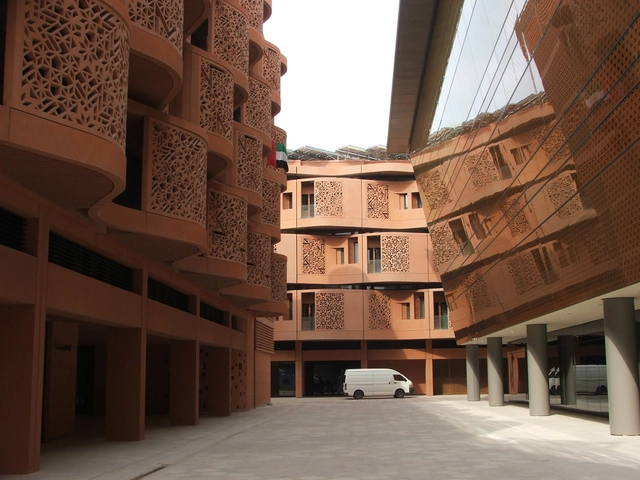
The Middle East has historically been known for many things — sustainability not being one of them. The clash of Western values with the harshness of the local climate can often wedge sustainability between a lot of sand and a hard place. Though there is a broad critique of the unsustainable attributes of the region’s development path, for years there has been a shining exception: Masdar City in the United Arab Emirates, seventeen kilometers east-south-east from the city of Abu Dhabi.
Masdar City exists as an urban development project run by the renewable energy company Masdar, who has committed $15 billion to making Masdar City the planet’s most sustainable new city. Unlike Abu Dhabi, a city which unthinkingly follows antiquated models and Western building principles, Masdar City has a wealth of potential to offer the world of green urban planning - something the world sorely needs.
But Masdar City is certainly not without its share of critics. On first approach, the concentrated development, located in the center of six square kilometers of empty space, does little to awe, especially in comparison to the sprawling wave that is Abu Dhabi. Thanks largely to the global financial recession, buildings currently comprise less than 10% of the area committed to the urban experiment. Even today there is a group of onlookers that suggest Masdar City may just be a mirage after all.
However, this broader view is not necessarily synonymous with the bigger picture.
“Architects make architecture; Phyllis Lambert made architects,” Rem Koolhaas said of his decision to award Phyllis Lambert with this year’s Golden Lion for Lifetime Achievement at the Venice Biennale. In an interview published on iconeye.com, the website for Icon Magazine, the 87-year-old founding director of the Canadian Centre for Architecture (CCA) discusses her career, Mies van der Rohe, and the state of contemporary architecture with the editor of Icon, Christopher Turner. Read on to learn about her influential life in architecture.
Congratulations on your Golden Lion for Lifetime Achievement. How did you learn that you'd been awarded the honour?
Thank you very much. I got a phone call from the curator, Rem Koolhaas, telling me and I had to wait for weeks as it went before the board, unable to tell anybody – then I got an official letter. Isn't it wonderful?
https://www.archdaily.com/518476/interview-phyllis-lambert-on-winning-the-golden-lion-for-lifetime-achievementChristopher Turner for Iconeye
Project example from MIT OpenCourseWare's Geometric Disciplines and Architecture Skills: Reciprocal Methodologies by Isabel Collado and Ignacio Peydro. Image Courtesy of Luisel Zayas-San-Miguel
Learning doesn't necessarily need to be formal – or expensive for that matter. Thanks to the Internet and some generous benefactors, you can further your education for free from the comfort of your own home. Top schools such as MIT and Harvard University are affiliated with free online learning resources, allowing people from all over the globe to connect and audit courses at their own pace. In some cases, these services even provide self-educators with proof for having completed courses. Keep reading after the break to check out our round-up of four free online learning resources.
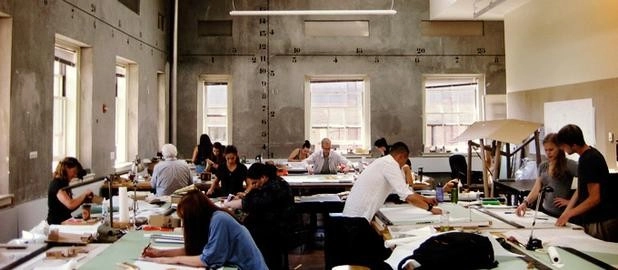
Courtesy of University of Washington Department of Architecture website, http://arch.be.washington.edu/
In a posthumous 1990 essay “A Black Box: The Secret Profession of Architecture”, Reyner Banham warned of architecture’s corrosive trend toward insulating itself from discussions outside of the discipline. Decades later, architecture finds itself in an even more dire state of affairs. Despite a transformed global context, the same paternalistic model of studio culture that has existed since the Beaux Arts remains in place. “Studio culture”, as currently practiced, promotes an outdated and parochial understanding of how design knowledge is produced, valuing expertise over synthesis and image over process and practice.
It also affects the health and wellness of students. Over ten years ago, the AIAS (American Institute of Architecture Students) and NAAB (National Architectural Accrediting Board) created a new requirement for accreditation, requiring all schools to address these precise concerns through a written policy on studio and learning culture. However, many schools of architecture across the country still do not educate students about this policy nor seem to follow it.
While there are certainly creative strengths and a generalized camaraderie fostered by traditional studio models, they do not adequately prepare students for navigating the global present. We believe there is an urgent need to reconfigure the institution of studio in order to address the pressing academic and professional issues of our time. We are putting forth what we feel are the guiding principles which must inform a progressive studio culture: agency, balance, flexibility, diversity, interactivity, interdisciplinarity, and sustainability. It is our hope these principles spur debate and much needed action for fundamentally transforming studio culture.
https://www.archdaily.com/515146/7-ways-to-transform-studio-culture-and-bring-it-into-the-21st-centuryLori Brown & Joseph Godlewski
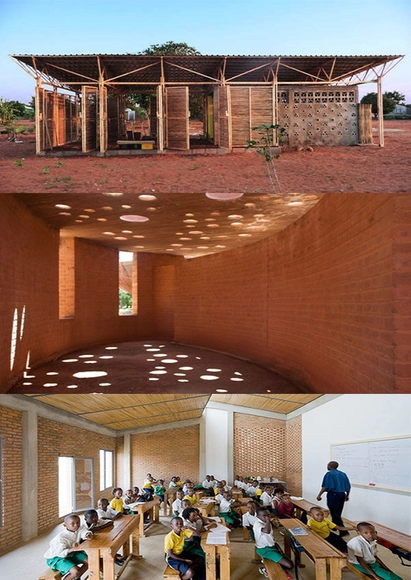
Top: Educational Building In Mozambique / Bergen School of Architecture Students. Middle: School Library Gando / Kere Architecture. Bottom: Umubano Primary School / MASS Design Group
The following article is presented by Materials, ArchDaily's new US product catalog.
How many times in the last year have you heard 3d printing mentioned? What about double-skinned curtain walls or “smart” buildings? High-tech materials almost always seem to dominate the conversation - at least in architectural circles. But using the latest invention in material technology usually does not make a building “innovative.” More often than not, it just makes it expensive and flashy.
Low-tech materials like lumber, stone and brick, on the other hand, are often overlooked, even though the use of local and locally produced materials offers the lowest possible carbon footprint. And while these common materials may seem boring, with a bit of imagination and technical skill, an architect can transform these materials into something fresh. With that in mind, check out three truly innovative projects which use low-tech materials in different and exciting ways.
The following article was originally published on Medium.
On a perfect autumn morning Rem Koolhaas parks his black 1998 BMW along an Amsterdam canal. It’s not really a sports car, but rather the racing model that a child would draw. Moments later, he is placed behind an impressive desk. This is to be a normal working day. Not in his Rotterdam offices though. Today he deals with his appointments in an Amsterdam hotel. Does that sometimes, more efficient. But this morning, a journalist has been in front of him for more than half an hour. And the guy is saying what?
‘Just about everyone responds the same when I mention your name: He’s a very unpleasant man, right?’ Halfway this remark Koolhaas leans back and moves away from the desktop. He rocks back and forth. And he nods. Stuttering he says something like: ‘Yeah, that happens, yes. With people, yes.’ He seems embarrassed, even a little ashamed. Outside assistants, clients, projects, calls about million dollar projects on different continents are waiting, but here, his head is so nude… those little ears that stick out to the sides… Can you describe a man of six feet tall as resembling a little injured bird? Not much more comes out of him. The conversation is over.