Venice Biennale 2012: Walk in Architecture / Republic of Korea Pavilion

The pavilion aspires to shed new light onto the status of Korean Architecture allowing the outside world to acquire a deeper and more in-depth understanding of what is currently relevant in the field of architecture in the country. “Walk in Architecture” expresses an idea and at the same time its paradox; it treats architecture as a place or a subject, like “Walk in Venice” or “Walk in a forest”. Walk is a collective action which combines associations: when you walk you think, you meditate, you observe, you dream, you wonder.
The exhibit is is supported by thin wooden supports, holding drawings, diagrams and video displays. Great examples from a country where pedestrians are taking more space than cars. This takes place at the Korean Pavilion at the Giardini, designed by Seok Chul Kim and Franco Mancuso in 1995.
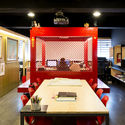
Club Octagon / Urbantainer

Architects: Urbantainer
Location: Seoul, Republic Of Korea
Area: 2,600 sqm
Year: 2011
Photographs: Namgoong Sun
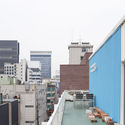
The 243 Building / Hyun and Jeon Architectural Office

Architect: Hyun and Jeon Architectural Office - Goon-Bo, Hyun, Phil-Gyou, Jeon of Hyun and Jeon Design Partners
Location: 243, Tanbeol-Dong, Gwangjoo, Gyeonggi Do, Republic of Korea
Client: Woon-Ok, Jo
Project area: 593 sqm
Project Year: 2011
Photographs: Kim Dong-Kwan
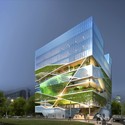
In Progress: Culture Forest / Unsangdong Architects

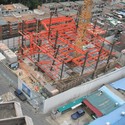
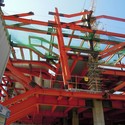
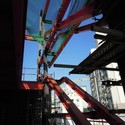
Unsangdong Architects have nearly finished the steel structure of the “Culture Forest”, revealing the distinctive figure of the Culture & Art Center in SeongDong-gu, Republic of Korea. Read the architect’s description and view schematic renderings on our previous post.
More photos after the break.
Architects: Unsangdong Architects – YoonGyoo Jang, ChangHoon Shin, SungMin Kim
Location: 656-323, SeongSu-dong, SeongDong-gu, Seoul, South Korea
Client: Municipality of SeongDong-gu
Structure: Steel framed reinforcement concrete
Use: welfare, education and research, culture, nursery school
Site Area: 1694m2
Bldg Area: 1001.77m2
Gross Floor Area: 9597.37m
International Competition Winner of Government Building in Sejong City / Tomoon Architects & Engineers

The 3-1 Zone of Government Building in Sejong City is a symbolic gate of the central administration town. The Urban Gate, where nature and citizen are together, and the Urban Plaza, which anybody can freely use, are planned for here. It is designed as a comfortable and cozy resting place shaped after nature. It will be used for various events including festivals and various culture and art activities. In terms of urban scale, the linear shape of existing master plan had been maintained.
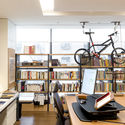
Social Incubating Center / Hyunjoon Yoo Architects

Architects: Hyunjoon Yoo Architects
Location: Seoul, Republic of Korea
Project Team: HyunjoonYoo, Yeongseop Yoon
Project Year: 2011
Project Areas: 680 sqm
Photographs: Seunghoon Yum
ChonGae Canal Restoration Project / Mikyoung Kim Design

The ChonGae Canal Restoration Project is an ambitious redevelopment initiative that transformed the urban fabric of Seoul, Korea. This design was the winning project in an international competition and celebrates the source point of cleansed surficial and sub grade runoff from the city at the start of this seven mile green corridor. The main competition requirement was to highlight the future reunification of North and South Korea. The project symbolizes this political effort through the use of donated local stone from each of the eight provinces of North and South Korea. The individual stones act to frame the urban plaza and the eight source points where runoff is daylighted and represents the unified effort in the transformation of this urban center.
Landscape Architect: Mikyoung Kim Design
Location: Central Seoul, Korea
Owner/Client: Seoul Metropolitan Government
Project Area: 91,000 sqm [2.25 acres]
Project Year: 2007
Photographs: Taeoh Kim, Robert Such
Jeju World Natural Heritage Center / poly.m.ur

Jeju is an island formed by volcanic activities and celebration of its distinctive geological features was one of the main objectives of the brief. The design started from answering the brief which explicitly requested that the scheme to symbolise the volcanic landscape of Jeju consists of caves and mounds. poly.m.ur viewed these two geological feature in terms of their morphological forma-tions – one as constructive space (volcanic mounds) and the other one as subtractive space (volcanic caves), and were repre-sented in the formation of the massing of our scheme.
Jeju University Cultural Heritage Center / poly.m.ur

The design of the new Jeju Cultural Heritage Centre started from an attempt to interpret the cultural value of the traditional artifacts that are to be exhibited here with contemporary view. poly.m.ur was intrigued by the fact that these artifacts are exemplary in showing the influence of regional material on the life of early settlers, and they wanted their proposal to be seen as an object which can symbolize the local characteristics shaped by the abundant availability of basalt as raw material and the indigenous techniques of tool making.
Sweet Parliament Home / Andres Jaque Arquitectos

Architects: Andres Jaque Arquitectos
Location: Gwangju, Republic of Korea
Curator: Anthony Fontenot
Design team: Dagmar Stéeová (coordinator), Álvaro Carrillo, Roberto González, Jorge López Conde, Kristian Ly Serena, Silvia Rodríguez
Project year: 2011
Renders and drawings: Courtesy of Andres Jaque Arquitectos
Times Square / JUNGLIM Architecture

Architects: JUNGLIN Architecture
Location: Seoul, Republic of Korea
Client: Kyungbang
Site area: 44 sqm
Photographs: Park Wansun
La-cubo / JUNGLIM Architecture

Architects: JUNGLIM Architecture
Location: Dongnam-gu, Cheonan-si, Chungcheongnam-do, Republic of Korea
Client: No Hyon Tae
Site area: 1,000 sqm
Photographs: Namgoong Sun
TT Project / BCHO Architects

Architects: BCHO Architects
Location: Seoul, Republic of Korea
Project team: Kang Woo-hyun, Erik Horn, Park Gi-hyun, Pai Yong-eun, Nicholas Locke, Kwon Sung-Hwa, Seo Ji-young, Park Joo- hyun, Eric Druse
Project area: 4,403 sqm
Project year: 2006 – 2010
Photographs: Kyungsub Shin, Wooseop Hwang
Engineering College Korea Polytechnic VI / Baum Architects

Architects: Baum Architects
Location: Gyeongsangbuk-do, Republic of Korea
Project team: Young Sung Shin, Sung Ho Son, Ho Soub Shin, Sung Hwan Choi, Ko Eun Lee, Ho Seok Lee
Project area: 4,082 sqm
Project year: 2009 – 2011
Photographs: Won Yang Kim
Onnuri Methodist Church / JUNGLIM Architecture

Architects: JUNGLIM Architecture
Location: Onnuri, Republic of Korea
Client: Haeundae Onnuri Church
Site area: 2,688 sqm
Photographs: Namgoong Sun
DongWha Pharm Laboratory / JUNGLIM Architecture

Architects: JUNGLIM Architecture
Location: Gyeonggi-do, Republic of Korea
Client: DongWha Pharm
Project area: 22,692 sqm
Photographs: Namgoong Sun
The Yellow Diamond / Jun Mitsui & Associates Architects + Unsangdong Architects

Architects: Jun Mitsui & Associates Architects + Unsangdong Architects
Location: Seoul, Republic of Korea
Design Team: Jun Mitsui, Nicolai Kruger, Ray Wu, Minsu Kim, Yoshie Shinbo, Jang Yoon Gyoo, Shin Chang Hoon, Lee Soon Phyo, Moon Sang Ho, Kim Se Jin, Kim Bong Kyun, Kang Seung Hyun
Project area: 4,316 sqm
Project year: 2007 – 2010
Photographs: E-Jae-seong, Shinkenchiku
International Ideas Competition for Busan Opera House

This is an international ideas competition to establish a design for the Busan Opera House to construct in 2014. The design will be based on a variety of ideas from both domestic and foreign specialists, as well as student groups. The opera house will include a variety of facilities that will foster a wide range of artistic activities all the while being accessible to the city’s citizens. The grand scale of this project will be suitable for Busan’s status as an international city.
Basic direction
1. The building will be designed to stand as a landmark symbolizing Busan′s rise as a world─class tourism center.
2. The buildings and surrounding green space will provide a venue for artists and performers to display their craft, as well as a place for the public to meet, congregate and enjoy the natural surroundings.
3. The area surrounding the facility will provide the public with picturesque views of both the ocean and the Busan cityscape.
For more information, visit the competition’s official website.
L House / BCHO Architects

Architects: BCHO Architects
Location: Gyeonggi-do, Korea
Project area: 892 sqm
Project year: 2009 – 2010
Photographs: Wooseop Hwang
Book City Hermann Houses / Ken Min Architects

Architects: Ken Sungjin Min, AIA / Ken Min Architects
Location: Kyoha-eup, Paju-si, Kyunggi-do, Republic of Korea
Project area: 12,637 sqm
Project year: 2006
Photographs: Lee Jung-hun, Lee Gi-hwan