
Day care centre de kleine Kikker / Drost + van Veen architecten

Uploaded by — Filed under: Educational ,Selected , , , ,
 

kik14

Architects: Drost + van Veen architecten
Location: De Uithof, Utrecht, The Netherlands
Client: Skohold BV
Project Area: 520 sqm
Project year: 2003
Photographs: Rob ‘t Hart

kik01 kik32 kik09 kik24

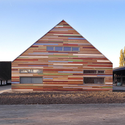
The new building is a playful design, joyful and with a lot of colour. It overlooks the grazing sheep in the meadow. Next to the building, to the left, there is a characteristic old farm, a monument, with a thatch roof, on the right, a wooden cowshed.

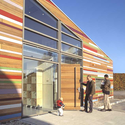
The new building is conceived as a contemporary type of farm, in form, material and construction ( structure). The coloured facade and the aluminium roof contrast the rustic environment. The silhouette of the pointed roof refers to the existing farm building. Towards the back of the building, it transforms into a modernistic, functional building, with a flat roof, instead of a farm.

kik12RGB

The new extension contains four children’s groups, age 0-4. The organization of the spaces is simple and logical, yet provide many surprising views from one room to the next that makes it a perfect environment for children and their mentors.

ground floor plan

ground floor plan

kik30

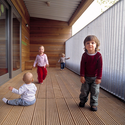
The building is symmetrical and is two stories high. The organization of the day-care is mirrored across the building’s central axis. There is a clear division in three zones. The front is reserved for the employees, the middle zone is used as playground and entrance, while the zone at the back contains the children’s groups. The big balcony at the back of this zone creates the outdoor space for the children on the first floor and also functions as a sun canopy against direct sunlight for the ground floor.

De kleine Kikker’s recognizable shape refers to that of its surrounding buildings, while it surprises through its distinguishing shape and its use of material and colour.


Thumb up Thumb down 0
pero says:

looks nice 4 me. even those crazy colours

 
# October 1, 2009 at 14:50
Thumb up Thumb down 0
mkose says:

love the facade, looks stunning

 
# October 1, 2009 at 14:59
Thumb up Thumb down 0
Andrew Geber says:

wait, is this captain slow’s lego house? :)

 
# October 1, 2009 at 15:09
Thumb up Thumb down 0
john wayne says:

auuuuuu… another missed shot… just look at those children faces “WHAT? WHY? WE DON’T WANNA BE HERE.” I understand that somebody has an idea&feel of aesthetics & proportions but for god sake… you do it for children… so it’s bad, unless you wanna bore them to death

comparison http://www.archdaily.com/519/taka-tuka-land-baupiloten/

 
# October 1, 2009 at 16:57
    Thumb up Thumb down 0
    Stephen says:

    I agree with john wayne completely…and look at all of those sharp edges – accidents waiting to happen. It looks like this architect didn’t consider ALL of the clients that would be using this facility (as far as the pictures can tell).

     
    # October 1, 2009 at 18:20
      Thumb up Thumb down 0
      Matt Nolette says:

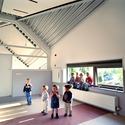
      I understand your sentiments. I suspect this isn’t so much an indictment of poor design as poor photography. There’s no furniture in the few interior shots and the staged feeling really comes through. I take it the building wasn’t yet occupied at the time of the photographs.

      However, the architect has certainly thought through the building from the perspective of an adult managing a group of toddlers. Take a look closely at the stair photograph and you can see a built-in gate on the stair and the door handlesets are set unusually high.

       
      # October 1, 2009 at 21:20
Thumb up Thumb down 0
Ralph Kent says:

Its funny, that so much of the stuff that got people so excited about the “superdutch” movement in the 1990s continues to be trotted out and looks so generic and dull now.

 
# October 2, 2009 at 11:10
    Thumb up Thumb down 0
    Dan says:

    Ralph,
    I have noticed from a few recent comments on projects at this site that there appears to be a subtle backlash or rejection of the ‘superdutch-minimalism’. I was one who didn’t like it at first, but now I do. I will agree it has become expected and standard.

    Some of the big-building US firms (NBBJ, HOK, and KPF) have done the same thing with their highly-articulated Meier-esque architecture. (I like it, and its good design, but I want to keep the criticism objective). It seems once a fresh aesthetic has legions of competent followers – it no longer seems as fresh.

    Its like a cult college rock band, which gains broader fame, and then loses the interest of its original fans.

     
    # October 2, 2009 at 12:31
Thumb up Thumb down 0
Peter says:

This project is some years old now, 4 or 5… I visited it 3 or 4 years ago, while traveling around the Netherlands, and its a wonderful building, its response is precisely driven by its context… its form is no accident or stylistic shape making over contextual response… you approach through agricultural buildings towards the gable end, responding the relationship of the surrounding buildings, and as you travel through the building, the view opens to that wonderful panoramic “snorkel” over the flat dutch landscape. There are very few “sharp edges” int he building… its like the built environment in which children grown up, like their homes… children should not be warped in cotton wool… and infact, from meeting and talking with the children (and parents), the building is really loved by its users… a very successful bit of architecture and building… BRAVO!

 
# October 2, 2009 at 18:52
    Thumb up Thumb down 0
    Stephen says:

    …”very few “sharp edges”"??? Look at the photo of the 4 toddlers on the balcony – the wooden bench has a sharp edge around it’s entire front perimeter, the galvanized metal railing has sharp vertical edges, the concrete stairs have sharp edges at the last two steps, the little bench behind the stairs has 4 sharp edges, what looks like a wall radiator adjacent to those same interior stairs has sharp edges, in the photo with the 4 children sitting in the window there is a box (fire hose? fire extinguisher) that protrudes from the wall with sharp edges that a small child can bump their head into, the same room has yet another radiator with, yes, sharp edges, there are metal lockers in the photo with two men entering the building – those metal lockers sit on what appears to be metal legs that protrude out from underneath the lockers with sharp metal edges…

    How can you say there are “few sharp edges” when I just pointed out numerous examples in only a few of the photos. This design for a child day care is still poor in my opinion. Little children are prone to falling, to tripping, to finding the sharp edges when an adult does not.

     
    # October 5, 2009 at 09:37
      Thumb up Thumb down 0
      Seek says:

      I take it you don’t have children? No matter what you do, children will find ways to hurt themselves. If you pamper them too much, they will fall that much harder in unfamiliar places.
      The one thing I’ve learnt from my kids is that they respond best by being taken seriously. Of course you try to protect them best you can, but, in my case at least, that did not mean replacing all the furniture in my house with rounded stuff and I don’t expect my daycare centre to do that either. I expect them to look after my children and create an environment where they feel at home. A building like this accomplishes that by playing into the imagination of a child (the front is precisely how a child would draw a house, the colours in the facade are a wonderful idea, imo).

       
      # October 13, 2009 at 04:10
      Thumb up Thumb down 0
      Stephen says:

      I have one child, one on the way, and 8 nieces and nephews so I know quite well that children will find ways to hurt themselves – that doesn’t mean we should be carefree in our designs by introducing sharp edges that aren’t necessary for a daycare design to be successful. There are such things as recessed fire extinguisher cabinets, benches with rounded edges, etc.

      I have nothing against the colors – in fact I think they’re wonderful for the children in the same respect that you indicate – that the children would probably draw with the same colors.

      ‘m simply making an observation that for a daycare it appears to have more sharp edges than necessary for a successful design. Not having sharp edges in a daycare has nothing to do with pampering a child, it has to do with protecting someone else’s investment which is the daycare’s responsibility – hence the word “dayCARE”.

       
      # October 13, 2009 at 12:29
Thumb up Thumb down 0
danada says:

i need complete plans please

 
# November 1, 2009 at 06:22
    Thumb up Thumb down 0
    niloufar says:

    have you found the complete plans?

     
    # November 7, 2009 at 13:59
Thumb up Thumb down 0
windzerg says:

simple and elegant~

 
# May 1, 2010 at 10:57
Thumb up Thumb down 0

Hey I had to tell you, I had a good time reading this blog and the ideas from all that takes time to chime in. It’s very interesting and well written. Thanks again for taking the time to put this up.

 
# December 20, 2010 at 16:44
Thumb up Thumb down 0
texas roofer says:

I am not sure the place you’re getting your information, however good topic. I needs to spend a while learning much more or working out more. Thanks for magnificent information I was looking for this information for my mission.

 
# February 3, 2012 at 10:52
Thumb up Thumb down 0

2:57 AM Oct 7th

Really like this building. Color in the facade > Day care centre de / Drost + van Veen architecten http://t.co/re6HWk1m via @archdaily

Thumb up Thumb down 0

12:27 AM Jan 3rd

Day care centre de kleine Kikker / Drost + van Veen architecten http://t.co/fGYyciUa via @archdaily

Leave a Reply »


Latest Comments »

very attractive great construction.[+]
Very attractive great job.[+]
I love buildings of this proportion. May be I should go...[+]
how does the tall one stay up?[+]
Oompa Lumpa + Violet Beauregarde...[+]

Upcoming Architecture Events »

got events? invite us! click here

Architecture Books & Magazines »

The New Modern House: Redefining Functionalism

The New Modern House: Redefining Functionalism


The New Modern House is a comprehensive look at the emerging trend of architecture that favors substance over style, combining functional design and sustainable processes with a straightforward, honest aesthetic.The New Modern House features 50


Building Community / Eskew+Dumez+Ripple

Building Community / Eskew+Dumez+Ripple

If you have enjoyed the Eskew+Dumez+Ripple (EDR) projects we have featured then this is the book for you. With stunning photography and informative text, this book examines not only an architect’s physical impact on the built landscape, but also…


MARK Magazine #35

MARK Magazine #35

As you well know already we love MARK Magazine, and this issue fails to disappoint. It has projects from many of the architects we have featured here on ArchDaily such as, StudioGreenBlue, Heri&Salli, Clavel Arquitectos, Kengo Kuma, Colboc Franzen, Studio Velocity, Takeshi Hosaka, Fuhrimann Hachler, Toyo Ito, Nieto Sobejano, L3P…


Our partners »

AD on iPad via Pulse

Browse by date »

Browse by category »

Friends »