-
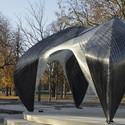
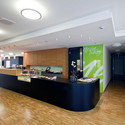
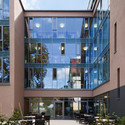
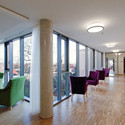
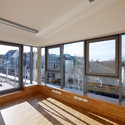
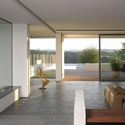
Interior Designers: University of Stuttgart, Faculty of Architecture and Urban Planning
- Area: 29 m²
- Year: 2012

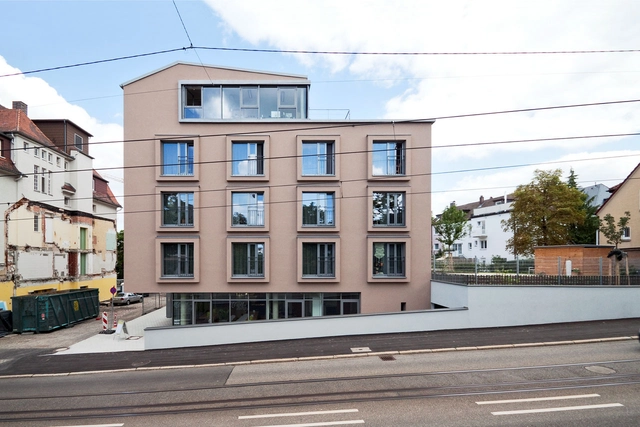
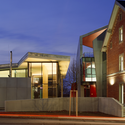
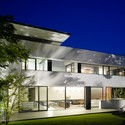
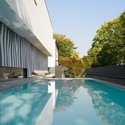
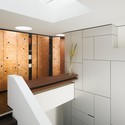
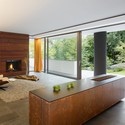
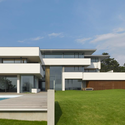
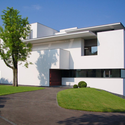
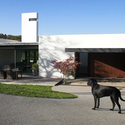
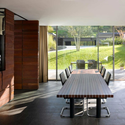
Our friends from UNStudio shared their latest completed residential project, a villa nestled on the outskirts of Stuttgart that offers amazing vistas over country vineyards which are juxtaposed with cityscape panoramas. The sinuous curves of Haus am Weinberg are governed by the idea of creating a “twist” which organizes the programmatic flow of the residence. Ben van Berkel explained, “The Haus am Weinberg adopts a stereovisual spatial effect, acting almost as an optical instrument, whereby not a parallax view, but a parallax experience is created. Moments of parity with the surrounding landscape from inside the house form a constant experiential connection and awareness of its immediate context.”
More after the break, including a great photography set by Iwan Baan.

Taking place October 10-12 at the University of Stuttgart, Germany, the “Beyond Green! – Tall Buildings in a Sustainable Future” symposium focuses on how tall buildings be designed, built and maintained in a sustainable fashion. The keynote lectures will be held by Christoph Ingenhoven and Helmut Jahn_Murphy/Jahn. The sessions are dedicated to urban development and economy, ecology, planning and realization, structure and skin and building services. More information after the break.

Focusing on the relationship between tall buildings and sustainability, the ‘Beyond Green! – Tall Buildings in a Sustainable Future’ international symposium will take place October 10-12 at the University of Stuttgart, Germany. Due to urbanization and land being a fixed commodity, metropolitan areas become denser and can only respond with the typology of tall buildings to satisfy the demand for space. However, with respect to the provision of infrastructure, use of energy, shortage of resources and the demand for ecological compatibility there is the inevitable need to design green and sustainable cities. This seemingly contradicts the typology of tall buildings. The aim of the symposium, hosted by the Institute for Lightweight Structures and Conceptual Design at the university, is to evaluate and investigate in detail the green and sustainable credentials of tall buildings regarding their economy, ecology and functionality. More information on the event after the break.

72 Hour Urban Action, the world’s first real-time architecture competition, gives selected teams only three days & three nights to design and build interventions in public space in response to local needs. The competition will be the kick-off of a series of major urban interventions around Stuttgart 21, site of the largest urban redevelopment in Europe and the center of a heated 30-year-old public debate. The competition is defined by an extreme deadline, a tight budget and limited space and will challenge participants to rapidly leave a lasting impact on the city’s urban fabric.


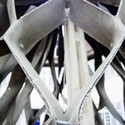
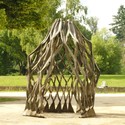
Most design and building processes relay on pre-determination and accuracy, plus an efficient coordination of data input leading to a physical realization representing previously conceived ideas as closely as possible. Parametric and generative design add an extra element of “objective” formulae playing role of legitimizations of designer’s intentional design, while the choice of data pools, algorithms or auto-generative formulae is in fact another intentional element.
Architect: Centrala Location: Schloss Solitude, Stuttgart, Germany Designer: Jakub Szczęsny Assistant: Helmut Dietz Project Year: 2011 Photographs: Rolf Wohrle, Hagen Betzwieser and Jakub Szczęsny