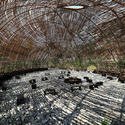

-
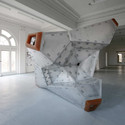
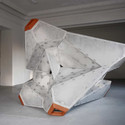
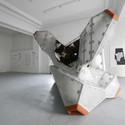
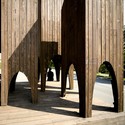
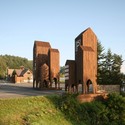
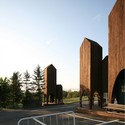
Architects: Marco Casagrande
- Area: 270 m²
- Year: 2011



This article, recently seen on The New York Times, was kindly shared with us by the author Sarah Williams Goldhagen.
A REVOLUTION in cognitive neuroscience is changing the kinds of experiments that scientists conduct, the kinds of questions economists ask and, increasingly, the ways that architects, landscape architects and urban designers shape our built environment.
This revolution reveals that thought is less transparent to the thinker than it appears and that the mind is less rational than we believe and more associative than we know. Many of the associations we make emerge from the fact that we live inside bodies, in a concrete world, and we tend to think in metaphors grounded in that embodiment.

The first stage in the Augmented Structures project by Salon2 is the Augmented Structures v1.1: Acoustic Formations / İstiklâl Caddesi installation which reanimates phenomena (architecture, sound and visual arts) that appear to be completed and concluded. The acoustic memory of İstiklâl Caddesi is first transformed into an architectural surface and then this solid form becomes a dynamic visual performance through a 400m2 installation on the facade of Yapı Kredi Bank Culture Building. More images and architects’ description after the break.
At first glance, Dr. Behrokh Khoshnevis’ Contour Crafting (CC) seems both fascinating and unreal – a fabrication machine that has the potential to construct entire structures in a single run. Supported by the National Science Foundation and the Office of Naval Research, CC’s combination of conventional robotics and “age-old tools” creates a layered fabrication process where large-scale parts can be fabricated at remarkable speeds. On his blog, Khoshnevis, a professor in the USC Viterbi School of Engineering, explains that the system is a scale-up of the rapid prototyping machines now widely used in industry to “print out” three-dimensional objects designed with CAD/CAM software, usually by building up successive layers of plastic. ”Instead of plastic, Contour Crafting will use concrete,” explained Khoshnevis.
More about Contour Crafting after the break.

Arcollab‘s “Jack Up The Box” pop-up store concept was selected winner of the DesignByMany’s latest challenge: “A Pop-Up Retail Store”. Vertical retractable drawers embedded within the raised store allow shoppers to inhabit the space underneath, redefining the shopping experience. Judges Carmen Trudell, Daniel Kidd, and Giancarlo Valle reviewed over 40 entries before selecting the winning proposal. For winning the HP-supported challenge, RPGS will take home a brand-new HP Designjet T790 24″ PostScript ePrinter.

The new extension designed by 1+1=1 Claudio Silvestrin Giuliana Salmaso architects and planners for laRinascente in Piazza della Repubblica, Florence, is conceived as a symbol of strength through the square, yet of lightness, in the detail of the Archangel’s wing in Filippo Lippi’s painting of the Annunciation. Visually, the new extension is floating above Palazzo del Trianon while preserving its authentic architectural structure. More images and project description after the break.

SHRM‘s Umbra_vela was announced as the winner of DesignByMany‘s latest challenge: “A Rapidly-Deployable Shade Structure”. The challenge asked professionals and students in the AEC community to submit proposals for a rapidly-deployable shade structure that could just as easily be deployed during a day at the beach or park, or in a desert environment. SHRM were chosen by a select group of judges, Andrew Payne, David Benjamin and Kevin Klinger. For winning the HP-supported challenge, SHRM will take home a brand-new HP Designjet T790 24″ PostScript ePrinter.

The “Open Monument” project is a permanent public space installation, by MAI_lab | MAIpublicspace, that wants to recover the link between the inhabitants of Crestuma, Portugal and its landscape history. At the same time, the design aims to boost an experimental, pedagogical and participative realm that should develop new senses of appropriation and belonging. More images and project description after the break.
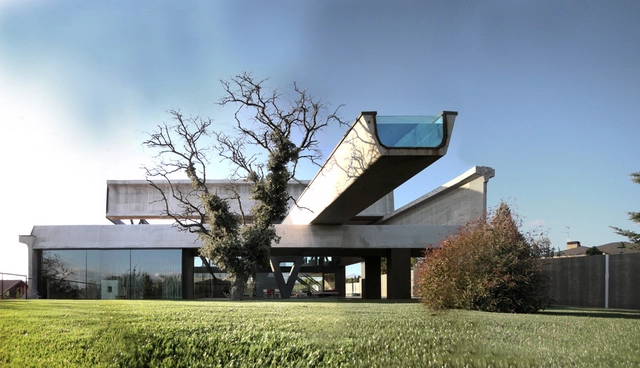

The Acoustic Pavilion Project, developed by AREA and Electrotexture Lab, is created from evolutionary algorithms that search the optimum form and reflective environment for electronic music within the context of Aalborg’s harbor front. More images and brief project description after the break.

Inspired by the existing lattice pylon originally designed by Sir Reginald Blomfield RA in 1927, New Town Studio, who was recently shortlisted for the Pylon Design Competition, uses a lattice steel framework to create a vertical structure which retains the transparent and open qualities of the original in a more modest form to be visually and symbolically appropriate for today. More on the project after the break.
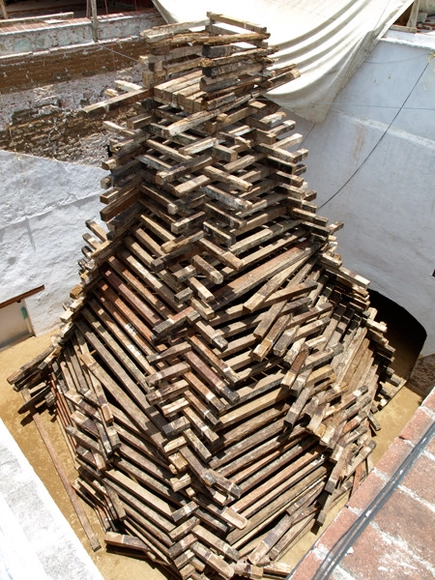

The major of the city of Sant’Elpidio a Mare, Giovanni Renzi, with the manifesto of the 15th of September 1903, communicated to his citizens the tender for the construction of the social aqueduct of the Tennacola company. Since then, this work has been in constant evolution and all the structures linked to the aqueduct are still deep-rooted in the territory and they have become symbols of the project by LED Architecture Studio. More images and architects’ description after the break.

In today’s world “going green” has become a top priority in our society, and sustainable buildings and design are at the forefront of this green revolution. While many designers are focusing on passive and active energy systems, the reuse of recycled materials is beginning to stand out as an innovative, highly effective, and artistic expression of sustainable design. Reusing materials from existing on site and nearby site elements such as trees, structures, and paving is becoming a trend in the built environment, however more unorthodox materials such as soda cans and tires are being discovered as recyclable building materials. Materials and projects featured after the break.