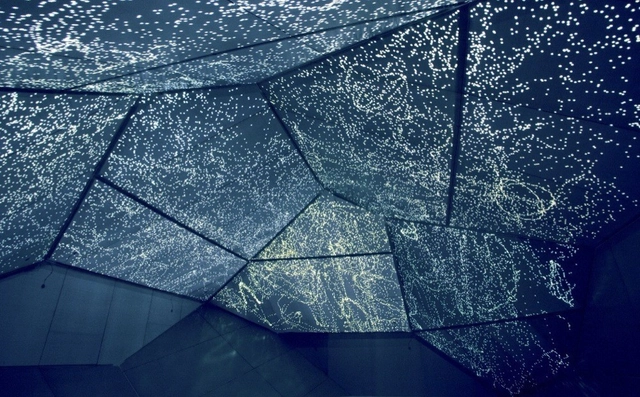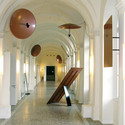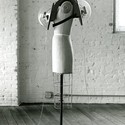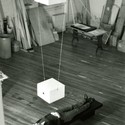
The syn chron space by Carsten Nicolai was designed to combine experiences of sound and light. Image Courtesy of artcentron.com
In this interesting article in the New York Times, Allison Arieff highlights the often unconsidered importance of sound in architecture (outside of theaters and museums at least). She profiles the work of Acoustic Engineers at ARUP who have begun to work inschools and hospitals, taking into account the effects poor sound environments can have on us in our everyday lives. You can read the full article here.
There are many forms of architectural representation - from sketches to construction drawings to photographs - but they all privilege vision over any of the other senses. This problem has perhaps only been exacerbated by the internet, which has made it easier to 'experience' buildings from afar, to the detriment of four of the five senses.
Now though, Karen Van Lengen, the Kenan Professor of Architecture at the University of Virginia, has created Soundscape Architecture, a website that aims to redress this imbalance. In collaboration with artist James Welty and musician Troy Rogers, Van Lengen has used sound recordings of iconic architectural spaces to create synaesthetic animations and musical compositions of the ambient noise there.
Read on after the break for more about Soundscape Architecture
The syn chron space by Carsten Nicolai. Image Courtesy of artcentron.com
“The modern architect is designing for the deaf.” Canadian composer R. Murray Schafer makes a valid point. [1] The topic of sound is practically non-existent in modern architectural discourse. Why? We, as architects, think in terms of form and space; we balance scientific understanding and artistic vision. The problem is, we have a tendency to give ample thought to objects rather than processes and systems. Essentially, our field is ocular-centric by nature. So how do we start to “see” sound? And more importantly, how do we use it to promote health, safety and well-being?
The GSA has announced that Skidmore, Owings, & Merrill have been selected as the architects of the new Los Angeles Federal Courthouse, which will house the U.S. District Court, Central District of California, and the U.S. Marshals Service. The architects beat out 3 other shortlisted teams to win the $318 million project.
According to the GSA, "The new 550,000-square-foot building will be a sustainable, cost-effective, state-of-the-art court facility that includes security upgrades that are not available in the current 312 North Spring Street courthouse."
The site, located at 107 South Broadway (down the street from Morphosis’ Caltrans building, LA’s City Hall, and the Walt Disney Concert Hall) has been dormant since 2007; although a $1.1 billion design by Perkins + Will was selected soon after, it was abandoned when Congress slashed the GSA's construction budget. The GSA considers the approval of the new redevelopment plan a "major milestone."
In architecture we talk about space and form. We talk about experience and meaning. All of these qualities are inextricably the sensory experience of light, touch, smell and sound. Sound expert Julian Treasure asks architects to consider designing for our ears, citing that the quality of the acoustics of a space affect us physiologically, socially, psychologically and behaviorally.
The space of sound created by Carlito Carvalhosa’s Sum of Days on exhibit at MoMA until November 14, 2011 is a sublime environment of billowing white fabric and the white noise of the atrium reflected upon itself. The psuedo-boundaries established by the translucent material that hang from the ceiling create a confined space of light and ambient sound – fleeting and ephemeral. Upon entering the exhibit, you pass an array of speakers affixed to the wall. They are emitting a low hum – the sound of voices and echoes that are distant, yet recognizable. It is unclear at first from where these sounds are originating, but behind the fabric bodies are drifting in and out of view. The curtains, which are constantly swaying, direct you in an ellipse to the center of the space where a single microphone hangs, picking up the noise within the exhibit and sending them to the dozens of speakers that hang at intervals inside the curtains, along the walls of the exhibit, and up through the galleries at the mezzanine levels that overlook the atrium.