NOWNESS has released the latest in their "In Residence" series, a collection of short videos that interview designers in their homes. This time, internationally renowned Mexican Architect Fernando Romero presents his Mexico City villa, designed by Francisco Artias in 1955, which he describes as "the ultimate modernity dream come true."
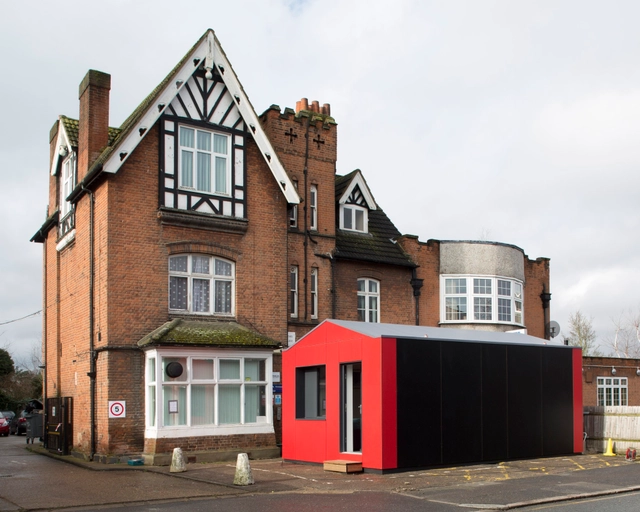
The Y-Cube Deployed. Image Courtesy of Rogers Stirk Harbour + Partners
The Y-Cube, a £30,000 factory-built 26 square meter flat which can be easily transported and craned into place, has been prototyped and successfully tested in the UK. The YMCA asked Rogers Stirk Harbour + Partners to create the Y-Cube, an affordable alternative for residents moving on from the non-profit’s hostels. And now, the YMCA wants more of these one-bedroom dwellings.
“The beauty is that the units can be moved off site as quickly as they are installed,” says Andy Redfearn of the YMCA, “as we operate on short-term leases – we expect people to stay [in the Y-Cube] for between three to five years, giving them time to skill up and save for a deposit.”
Videos
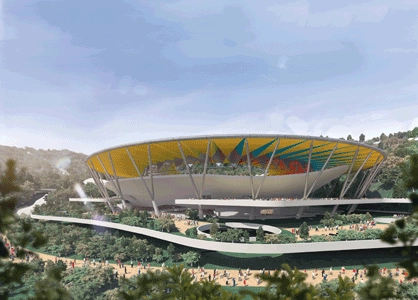
The proposed football stadium. Image Courtesy of the municipality of Caracas
On January 17th, the mayor of Caracas, Jorge Rodriguez, and British architect Richard Rogers signed a contract that confirms Rogers will oversee the design and construction of two new stadiums within "Hugo Chavez" Park. Both stadiums should be completed by 2015.
The 200-hectare "Hugo Chavez" Park will be located around the race course La Rinconada and the Museum Alejandro Otero (MAO). The project, which began in April 2013, includes the construction of a football stadium with capacity for 50,000 people and a baseball stadium with capacity for 45,000, plus a multipurpose gym and the new headquarters of the Bolivarian University of Venezuela.
https://www.archdaily.com/470520/richard-rogers-to-design-stadiums-for-hugo-chavez-parkPola Mora
“Architecture is too complex to be solved by any one person.”
Richard Rogers is an architect who understands the significance of collaboration. As a man with an intense social mind and a thirst for fairness in architectural and urban design, Rogers’ substantial portfolio of completed and proposed buildings is driven by the Athenian citizen’s oath of “I shall leave this city not less but more beautiful than I found it.”
In honor of his success, London’s Royal Academy (RA) is currently playing host to a vast retrospective of Richard Rogers’ work, from his collaborations with Norman Foster and Renzo Piano, to the large-scale projects that define Rogers Stirk Harbour + Partners (RSHP) today. The RA’s extensive exhibition has been condensed into a series of motifs that have defined his architectural work, punctuated by memorabilia which offer personal insights into how Rogers’ career has been shaped by the people he’s worked with and the projects that he has worked on.
Continue after the break for a selection of highlights from the exhibition.
Developers in London are so afraid of encountering opposition from the Prince of Wales that they seek his approval before applying for planning permission - so says Richard Rogers, as revealed by this article in BD. Prince Charles, who is not shy about promoting his traditional tastes, has a sometimes difficult relationship with the architecture community, and Rogers previously accused him of "an abuse of power" when he was ousted from his Chelsea Barracks Project. You can read the full article here.
The New London Awards, which recognize the best projects in London - both recently completed and on the drawing-board - were held at London's Guildhall on the 12th of July. Richard Rogers took the top prize of "New Londoner of the Year" in recognition of his life-long commitment to raising the quality of urbanism in the UK capital. The award coincides with his 80th birthday and a major retrospective at the Royal Academy.
See all the winners of the 17 different awards after the break.
Having made his name with the Centre Georges Pompidou and the Lloyd's building, Richard Rogers - who turns 80 today - was commissioned in 1980 to design the Inmos microprocessor factory in Newport, Wales. The factory's design was targeted for the delicate process of microchip assembly, which requires a clean and controlled space. Built at the time of the computer-chip boom, construction had to be completed within one year, a factor which would greatly influence the design.
Rogers's response, based on his previous high-tech designs, was to move the services to the outside of the building and split the interior into 'clean' spaces for microchip assembly and 'dirty' spaces for other tasks. Moreover, Rogers opted for an off-site prefabrication of parts, which not only increased the speed of construction, but would also allow for the factory to be easily replicated as a model.
Tomorrow (July 19th) at 1pm GMT, The Guardian will be hosting a live webchat with renowned English architect Richard Rogers. The soon to be 80-year old has already begun celebrating with a retrospective exhibition on his work at the Royal Academy. You can keep the Rogers-fest going by heading to The Guardian's site and posting your questions in the comments section. The next day, you'll be able to see responses from the architect himself. So, what would you ask Rogers?
As reported by BDOnline, Richard Rogers of Rogers Stirk Harbour & Partners has announced his support in the long-standing battle to save England’s Preston Bus Station from demolition. In a letter to the English Heritage, Rogers described the 1969 brutalist landmark as “truly a major modern building and an outstanding piece of 20th century architecture” that is in dire need of refurbishment.
“Preston Bus Station is not only admired internationally, but it also continues to be fully functioning. It is a critical transport hub,” he stated. “I would encourage you to consider listing the bus station and support a much-needed refurbishment.”
Peter Rice has been described as both one of the best engineers and architects of the twentieth century. Unhappy with the role that engineers play in designing buildings, Rice dedicated his life to championing brave innovation and poetry through structure in a way that helped bridge the gap between engineering and architecture. His desire to work in tandem with architects, towards a shared vision, made him one of the most in-demand engineers of the twentieth century.
‘What is proposed is like a monstrous carbuncle on the face of a much loved and elegant friend.”
It’s easy to see why British Architects get their hackles raised when it comes to Prince Charles. The oft-quoted gem above, said in reference to a proposed extension to the National Gallery in 1984, is one of hundreds of such Architectural criticisms Prince Charles has made over the years. Which wouldn’t matter of course, if, like any average Architectural layman’s opinions, his words didn’t have much weight.
His do. They’ve resulted in the intervention, squelching, and/or redesign of at least 5 major plans over the last twenty years. But let’s not write off Charles just yet.
RIBA President Angela Brady discusses design in 2012 with British architect Richard Rogers. Together, they discuss the important issues surrounding housing and cities, both agreeing that “intensification is critical”. Homes built within a compact city are said to be five times more efficient than those built outside the city. This realization is an important fact that should guide government officials, builders and architects to work together towards more intelligent and beneficial growth patterns.
This week, with the help of our readers, our Architecture City Guide is headed to Paris. For centuries Paris has been the laboratory where innovative architects and artists have come to test their ideas. This has created a city that has bit of everything. Where the architecture of some cities seems to undergo phases of punctuated equilibrium, Paris’s architectural fossil record gives an impression of gradualism; all the missing links are there. This makes it easy to trace the origins of the most contemporary ideas throughout history. Nothing seems to come out of nowhere. If you look around you kind find the design’s inspiration running through the city’s Roman, Medieval, Renaissance, Baroque, Classical, Rocco, Neo-Classical, Empire, Art Nouveau, Art Deco, Modern, Post-Modern, and Contemporary Architecture. Seen in another context, many of Paris’s buildings might seem out of place, but the bones of this city support the newest iterations on the oldest and most profound questions. The 24 contemporary designs that comprise our list probably should not be viewed outside of this context, even though that is the stated goal of some of the designs.
As the most visited city in the world and arguably the capital of culture, it is impossible to capture the essence of Paris in 24 modern/contemporary designs. Our readers supplied us with great suggestions, and we really appreciate the help and use of their photographs. The list is far from complete and we realize that many iconic buildings are not yet on the list. We will be adding to it in the near feature, so please add more in the comments section below.