Dan Wood from WORKac will be conducting a lecture in Syracuse Architecture NYC Studio next Tuesday June 8, 6pm at 171 Madison Ave, 14th floor, NYC. The lecture is open to the public but seating is limited, so be there early to grab a seat.
Dan Wood from WORKac will be conducting a lecture in Syracuse Architecture NYC Studio next Tuesday June 8, 6pm at 171 Madison Ave, 14th floor, NYC. The lecture is open to the public but seating is limited, so be there early to grab a seat.

“You do not have to look at it for long before you realize that this is as sensual a building as New York has seen in a very long time,” stated Pulitzer-prize winning architecture critic Paul Goldberger of the American Folk Art Museum. Completed by architects Tod Williams and Billie Tsien in 2001 the museum is 40 feet wide and 100 feet long and is surrounded by the Museum of Modern Art on three sides. It was the first new museum built in New York in over three decades.
More on the American Folk Art Museum after the break.

Being awarded the Pritzker means you’ve hit it big. Having that ribbon placed around your neck proves you’re top dog in the architecture world and you’ve practically become a household name….doesn’t it? While that may seem that case for Gehry and Hadid, even Piano and Meier, the Pritzker’s seventeenth honoree, (France’s first laureate, in fact) Christian de Portzamparc sometimes feels forgotten.


modeLab will be conducting a Strip Morphologies Workshop in New York between June 19 and June 21. This workshop will introduce participants to the cultural, technological, and tectonic domain of parametric design and digital fabrication in a fast-paced and hands-on learning environment. Over two-plus days, the workshop will investigate the morphology of the ’strip’ by cross-linking developable surfaces and joining strategies. We will identify and exploit the constraints inherent in sheet material and High-Force CNC cutting technology to explore and construct highly articulated material assemblies.

It seems that after Cornell overcame the danger of having both their accreditation and new architecture school eradicated from the campus, there has been smooth sailing in terms of the physical construction of OMA’S Milstein Hall. The building is right on schedule to be fully completed in the Fall of 2011, as the structural steel, and the exterior structure + roof are being erected.
More images of the steel and more about the current construction phase after the break.

This has been reflected trough several initiatives, such as the White House Redux Competition (2008), Pike Loop (Gramazio & Kohler, 2009), the Reef (Urbana + Radical Craft, 2009), the itinerary Spacebuster (Raumlabor, 2009), and editing publications such as “49 Cities” by Work AC and Storefront Newsprints.

San Francisco based IwamotoScott sent us their latest tower development produced for the Greenwich South design study led by Architecture Research Office, Beyer Blinder Belle and Architects & Planners and OPEN. Contributing architects, artists and designers included Coen + Partners, DeWitt Godfrey, IwamotoScott Architecture, Jorge Colmbo, Lewis.Tsuramaki.Lewis Architects, Morphosis, Rafael Lozano-Hemmer, Transolar Climate Engineering and WORKac.
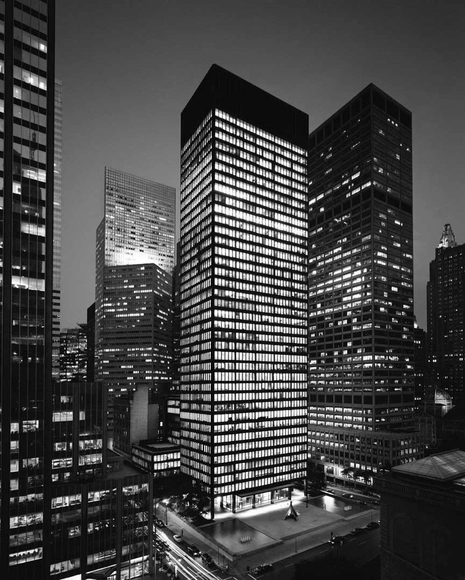
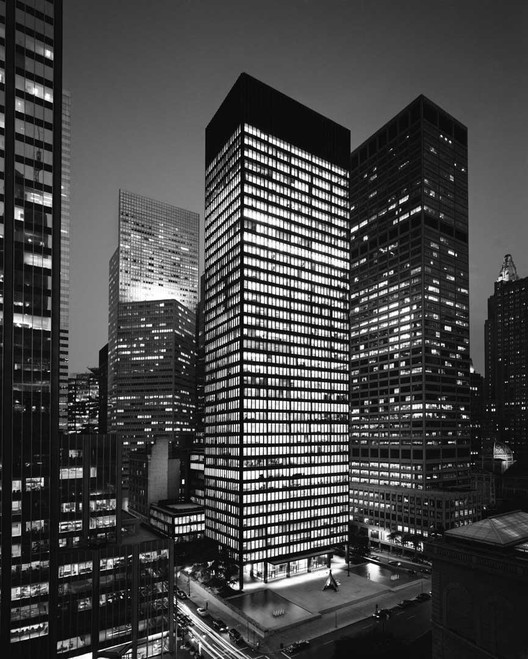
Text description provided by the architects. Located in the heart of New York City, the Seagram Building designed by Mies van der Rohe epitomizes elegance and the principles of modernism. The 38-story building on Park Avenue was Mies' first attempt at tall office building construction.

Architects, landscape architects, engineers, and other designers are invited to submit projects to the Architectural League’s New York Designs series.

What began in a rented townhouse on Manhattan’s Upper East Side has grown to become an internationally recognized preeminent source for exhibitions and publications related to historical and contemporary African art. The Museum for African Art will finally find a permanent home along Manhattan’s “Museum Mile” and will be open to the public next April. Designed by Robert A.M. Stern Architects, LLP, the museum will bring the prestigious row of museums of Manhattan to Harlem, one of the country’s most important centers of historic and contemporary African-American culture.
More about the museum and more images after the break.

The 2010 AIA New York winners were recently announced (we’ll share the full over view this weekend with you), and this project by Kohn Pedersen Fox received a design award in the Unbuilt category. Just like the other winning projects, the design showcases New York talent and was chosen for its “design quality, program resolution, innovation, thoughtfulness and technique.” The project, entitled Urban Market, is for Tianjin, China. The urban center is a way to reinvigorate the river banks through new uses, such as cultural institutions. The hope it that the center will grow to establish “a new identity for the city that links its culture to its historic place of commerce.”
More about the winning project after the break.

The East River Park Museum Competition in Brooklyn, New York have just announced it’s winner. We really love it’s simplicity and good use of materials. We couldn’t find out who designed it, so if you know, please do tell us!
Proposal after the break.