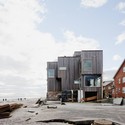
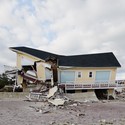
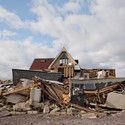
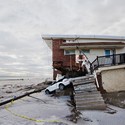
Since Hurricane Katrina swept through New Orleans, leaving devastation in its wake, the Make It Right Foundation has been working to redevelop the Lower 9th Ward by recruiting world-renowned architects (from Frank Gehry to Shigeru Ban) to the cause. The foundation, the brain-child of actor Brad Pitt, aims to design houses that aren't just temporary solutions, but rather parts of an on-going process of sustainable, community development.
Learn more about the Make It Right Foundation's goals and progress, and check out some of the starchitect-deisgned prototypes that will eventually make up a 150-house neighborhood, in our ArchDaily original infographic, after the break.
After months of debate, the United States Congress has passed a bill that will allocate $51 billion to Hurricane Sandy relief helping the thousands who lost their homes and businesses to the devastating storm last October. New York Governor Andrew Cuomo announced that $400 million of the aid will be used to fund New York's buyout program, an initiative to help address the damaged homes and coastline. The program is two-fold; in part it will help reimburse the property damage caused by the storm, but the initiative has a larger goal, which is to address the nature of coastal flooding and create a barrier that would mitigate the damage created to the coast by storm surges in the future. Since the storm, there have been many suggestions as to how to prepare for the type of damage brought on by Hurricane Sandy of 2012 and Hurricane Irene of 2011. These suggestions range from flood gates to barrier reefs. Cuomo's buyout program, as reported by the Architect's Newspaper Blog, hopes to encourage residents along vulnerable flood zones to sell their land to the city for the development of a natural coast that would absorb the impact of strong winds and storm surges.
In response an outrage that broke out amongst Democrats and Republicans, after House Speaker John Boehner failed to vote for Sandy relief before the end of the Congressional session two days ago, the House of Representatives have approved a $9.7 billion relief measure to aid flood victims of Hurricane Sandy. This is good news, as the Federal Emergency Management Agency’s (FEMA) recently warned that it would soon run out of funding if no measures were taken. Senate approval is likely to come later in the day and a second congressional vote is scheduled to take place on January 15 for a larger $51 billion request.
Understanding the importance of issuing this federal support, AIA President Mickey Jacob has offer Congress three key objects for helping these communities recover.
Read AIA President Jacob’s letter to congress and his three objectives after the break…
In 1945, the United States dropped 2 nuclear bombs on Hiroshima and Nagasaki. While the act devastated and destroyed these two Japanese towns, it also created an entirely new political climate, one based on apocalyptic fears. As tensions with Soviet Russia heightened, and the United States entered an age of potential nuclear destruction, the landscape itself adapted in response - becoming littered with bunkers and fallout shelters, the “concrete responses to the political social and existential anxieties of the atomic age.”
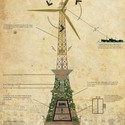
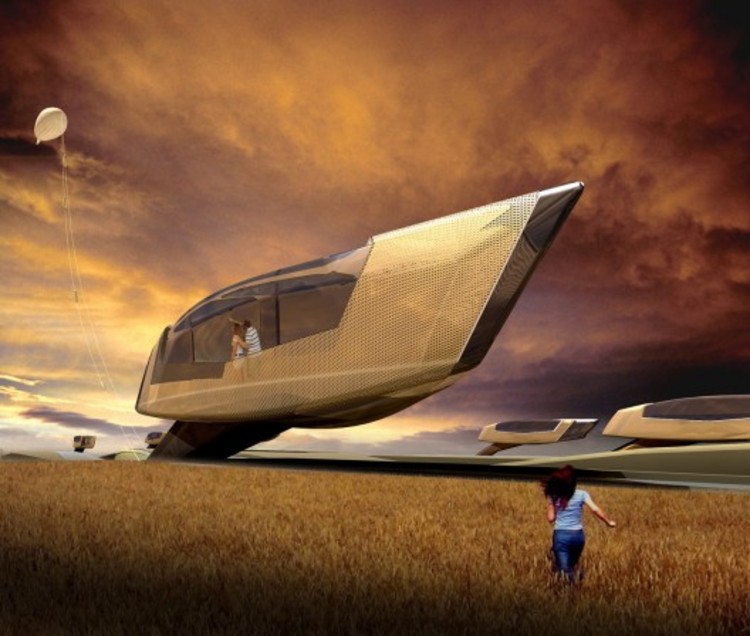
Fast-forward nearly seventy years, and we’re currently faced with a new apocalyptic scenario of our own. Assuming you’re reading this, we have all survived the Mayan Apocalypse. Congratulations. However, that’s not to say that out apocalyptic fears - and its resultant architecture - has come and gone. Our apocalypse is more based on the fear of natural disaster - hurricane, tornado, viral disease, even infected-zombie-people - than nuclear attack; and our apocalyptic architecture is less of the bunker variety, and more of the vertical farm/fortress - let’s call it ESD: Extremely Sustainable Design.
More on apocalyptic architecture of the 21st century, after the break...
In the wake of Hurricane Sandy, as communities band together to clean up the devastation and utility companies work tirelessly to restore the infrastructure that keeps New York City running, planners and policy makers are debating the next steps to making the city as resilient to natural disaster as we once thought it was. We have at our hands a range of options to debate and design and the political leverage to make some of these solutions a reality. The question now is, which option or combination of options is most suitable for protecting New York City and its boroughs? Follow us after the break for more.
Hurricane Sandy has come and gone, but the destruction she left in her path remains a stark reminder of her strength.
Photographer Amanda Kirkpatrick has shared with us her images of The Rockaways in Queens, an upper-class beach neighborhood that was one of the areas hit hardest by the storm. Kirkpatrick's objective eye documents the twisted boardwalks and unrecognizably distorted homes in an almost "clinical" way, honestly portraying the damage from the perspective of the broken structures themselves.
If you're interested in getting involved with Hurricane Sandy Recovery Efforts, you can get more information here. For more images from Amanda Kirkpatrick, read on after the break...
We got in touch with Iwan Baan to ask him how on earth he got that incredible aerial shot of a Sandy-struck New York City for New York Magazine; he told us what it was like to face the frenzy and fly into the storm itself. Read his incredible story, after the break...
"As whenever disaster strikes, it will be many days before the full impact of the storm is brought to light, and which communities will be in largest need of design support as the broader reconstruction effort proceeds. However we are not waiting for water to recede before preparing a reconstruction campaign." - Cameron Sinclair, Architecture for Humanity co-founder
Following Hurricane Sandy’s devastating path through the Caribbean, up the Atlantic and into the East Coast of the United States, hundreds of communities are in need of immediate relief and facing the daunting challenge of rebuilding. In effort to help,Architecture for Humanity and the American Institute of Architects (AIA) are mobilizing their teams to provide instant assistance and plan for the long term reconstruction efforts. Professional design and construction volunteers from both organizations will be working together to help households, schools, heath facilities, small businesses and local government rebuild in the coming days and weeks. However, relief and reconstruction cannot happen without your support. Learn how you can help after the break.
3-D Printing technology is developing at quickening pace as both engineers and architects experiment with its technological and social potential. Consider Enrico Dini’s D-Shape printer that prints large scale stone structures out of sand and an inorganic binder or Neri Oxman’s research at MIT which involves a 3-D printing arm and nozzles that can print with a variety of different materials, from concrete to recycled plastic.
Dutch firm DUS Architects, in collaboration with Ultimaker Ltd, Fablab Protospace, and Open Coop, have added another 3-D printing machine to the list known as KamerMaker, the room builder. KamerMaker is the world’s first mobile 3d printer and has the ability to print “rooms” that are up to 11 feet high and 7 feet wide. The machine was unveiled at OFF PICNIC, a precursor to Amsterdam’s annual PICNIC technology festival.
In an effort to promote resilience for the Sandy-affected region, U.S. Housing and Urban Development (HUD) Secretary Shaun Donovan has launched a multi-stage regional design competition that is intended to attract world-class talent, promote innovation and develop projects that will actually be built. Dubbed Rebuild by Design, the competition will accumulate a variety of design solutions, ranging in scope and scale, for review. Once the best ideas are identified, HUD will incentivize their implementation using funds made available through the Community Development Block Grant Disaster Recovery (CDBG-DR) program as well as other public and private funds to actually build the project.
According to the national weather service, 30 tornadoes struck 6 Midwest states hit by a string a tornadoes. In many places there was a severe weather warning but no tornado alert. Harrisburg, a town in southern Illinois of 9000, was hit the hardest with 300 homes, 25 businesses and 6 lives lost. Illinois and Missouri declared state emergencies and are being assisted by relief organizations.
2011 was the worst tornado season since 1936 and the events of this week mark an early start to the Midwest’s storm season. More tornadoes touched down in Alabama Friday morning, destroying several homes and damaging a prison. More continue to touch down as this message is going out. Harrisburg was spared further damage this week, but storm season has just begun.
Currently, community members and the Red Cross are teaming to repair roofs, clear debris and provide emergency relief services in Harrisburg. Branson, MO, launched a similar cleanup. As lightly-damaged homes and households recover, attention will turn to long-term recovery. That’s where we come in.
Yesterday brought an impressive appeal for volunteer and fundraisings support, and Architecture for Humanity has launched the Midwest Tornadoes Recovery campaign with a fundraiser goal of $100,000.
Architecture for Humanity is calling all architects for help! If you are in the area, please consider volunteering. If you are not in the area but would like to help, just go to this link at Architecture for Humanity to donate and support architects volunteering in the Midwest.


.jpg?1361552339&format=webp&width=640&height=580)