

-
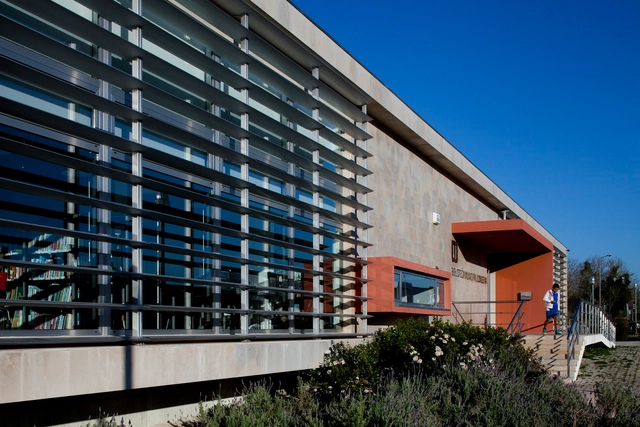
Architects: Sitios e Formas
- Area: 863 m²
- Year: 2008



The Motor Sports Complex Museum, which is located next to a new race track and a dragster speedway, is another component of the development in Kuwait City. Designed by Marc Anton Dahmen / Studio DMTW, its main function is to be a public showroom for the King‘s private collection of vintage racing cars. Besides the main exhibition hall with approximately 50 cars, it also houses a pit building including a garage for restaurant, a driving school for kids, a small conference center, a cinema and some private VIP spaces. More images and architects’ description after the break.

Titled ‘Standing Shelves’, the design concept for the Daegu Gosan Public Library agrees that people are in need of finding places to sit and get relaxed for getting information from books, magazines, articles, etc. Thus, the expanded program for the local community by providing classrooms, an exhibition area, lecture room, semi‐private reading areas, digital data corner, etc. will be another major change in the current library system. TheeAe LTD believes not in a dramatic way, but strongly, the new design of a space that should convey this change in a way to enhance and motivate the public to come and enjoy the use of a library. More images and architects’ description after the break.

Not long ago the library was thought of as a huge archive, a storage of human knowledge. Now, all human knowledge is just information that after being digitalized can fit into the pocket. Therefore, FORMA aims toward the accessibility of information and etherealization of knowledge. Also, the concept of information (being shared) is wider than the concept of knowledge (being rather stored than shared), which means the space and activities in the library should become significantly more diverse. Not only does it share information, but also provides an intelligent pastime for local community and sets space for live communication between people. More images and architects’ description after the break.

Designed by Land+Civilization Compositions and Impressively Simple, their proposal for the Daegu Gosan Public Library, titled ‘Open Source’, is consciously not a singular gesture, but more as a series of interpretable spaces. Previously libraries were seen as places to gain access to books, but this library provides places for the dissemination and sharing of knowledge. More images and architects’ description after the break.

The proposal for the Daegu Gosan Public Library competition, designed by École Architects and AAKAA, consists of a massive cubic construction, in stark contrast with the surrounding cityscape. The singularity and unexpected nature of this landmark building is legible at once, without, however, bearing the trace of any logo, or distinctive sign of its function. It is its absence of obvious identity – its apparent neutrality and slickness – that consecrates it as a singular landmark. The library projects no further identity than its mass. More images and architects’ description after the break.

Designed by STL Architects, the new Daegu Gosan Public Library focuses on the evolution of the role of the library in regard to the new ways we now learn and teach. With extensive amounts of information, that could historically only be accessed in and from a library, being readily available to nearly anyone, this library will be a place where people come to live and vast knowledge resources are more than stereo-typical encyclopedias. Instead of libraries being generically thought of as a dusty place where books come to age and be seldom used, this library will be a place where social interaction is the essence of existence. More images and architects’ description after the break.

Designed by JBAD (Jonathan Barnes Architecture and Design), the proposal for the Daegu Gosan Public Library proposes to simply, and radically, invert the conventional relationship of public space, circulation and access. In doing so, the public space typically defined and confined as interior, enclosed space becomes externalized, extroverted, stretched, and reformed. With their ”INversion’ concept, the way of interpreting the library as structure and space provides an opportunity to create exterior public space in ways that are both more integrated with the library’s functions and more connected to its urban context. More images and architects’ description after the break.


Designed as a social landmark, the proposal for the Daegu Gosan Public Library by Group8 is to be seen as an open entity, welcoming and willing to share its content. Located in a district with high educational standards, the library will become one of the main cultural facilities of the neighborhood, open to everyone. It will offer all the classic functions of a library but with a strong community identity and convenient amenities. More images and architects’ description after the break.

The construction of the National Museum of Afghanistan aims to celebrate the richness of the country’s cultural heritage and the spirit of its people. The “Timeless Cube” design proposal by Matteo Cainer Architects awakens the nation’s cultural heritage through powerful symbolic references, where physical fragments and traces inform us of its past. This concept is well illustrated in the ‘negative spaces’ of the artist and sculptor Rachel Whiteread that highlight the memory of an object, rendering the invisible visible through a reversal of solid and void. More images and architects’ description after the break.

The driving force in the proposal for the Daegu Gosan Public Library Competition was how new technologies can apply to libraries. Gillot + Givry Architectes, therefore, created a library that would mainly use virtual components. As thinking about South Korea as a world technology leader, could these skills change the way to design architecture? Since use of tabs is a common thing in Korean urban population, it is possible to create a library based on a wireless network. More images and architects’ description after the break.

The winning proposal in the Daegu Gosan Library competition, by architect Gorka Blas, conceives the library as a cultural and social space for the local community. For this purpose the project focuses in obtaining a functional, attractive and confortable facility that constitutes an essential element for neighborhood´s everyday life. In order to achieve this objective, the project translates the scale of the domestic space to a public facility, without lack of its public dimension. More images and architects’ description after the break.

Most people would imagine libraries being made up of large platforms fully equipped with rows of desks and bookshelves stacked on one another with strict division of programs in the building. However, the second prize winning proposal by Seung Hyun, Yuh and Se Hyeon, Kim from studio SH for the new library typology for Gosan starts by examining and breaking apart this hierarchical inclination. By blurring this strict boundary and providing flexibility in its library program, the ‘White Diamond’ becomes not only a place for exploring knowledge but also a space for meditation with diverse private and public experiences. More images and architects’ description after the break.