The famous actress Mae West once described a curve as "the loveliest distance between two points." While she may have been discussing the human form, this observation goes beyond physical appearance and gets to the heart of that which comforts and soothes the human psyche in the design of nature.
When exposed to heat, the body activates several physiological mechanisms to maintain thermal homeostasis. However, these natural defenses are often overwhelmed in our modern cities.In an urban environment defined by heat-absorbing asphalt, concrete, and a lack of green spaces, these mechanisms become inefficient. If the surroundings are excessively hot, humid, or poorly ventilated—conditions amplified by the Urban Heat Island effect—the core body temperature begins to rise, and the risk of serious complications increases, ranging from cramps and exhaustion to potentially fatal heat strokes.
Since its inauguration this spring, Expo 2025 Osaka has captured global attention from multiple perspectives, demonstrating how architecture can function as a laboratory for exploring solutions to pressing challenges. After 55 years, Osaka is once again hosting the World Expo, with each installation organized around the sub-themes Saving Lives, Empowering Lives, and Connecting Lives. These pavilions take forms that express the identity and values of their region through distinctive architectural languages, forming the central axis of their design. Building on this foundation, some installations serve as laboratories for the future society, utilizing technology to enhance experiences both inside and outside the spaces, transforming the visit through light, sound, visuals, and movement as part of the technological innovation showcased at the event.
https://www.archdaily.com/1034374/12-pavilions-at-expo-2025-osaka-highlight-immersive-spatial-experiencesEnrique Tovar
With “The Rock”, fittings manufacturer Dornbracht presents its first Atelier Edition. The clear lines of the classic MEM meet expressive rock–shaped handles made of solid metal, and finished in Brushed Dark Platinum. Image Courtesy of Dornbracht
In an era of digital precision, AI automation, and mass reproducibility, the value of the human craftmanship is being reimagined rather than lost. It's in this intersection between machine logic and material intuition that Dornbracht, the German manufacturer renowned for sculptural fittings, launches The Rock, the debut piece of its new Atelier Editions.
Sound, when emitted by a source — whether a person or a piece of equipment — propagates in all directions through space, being reflected, absorbed, transmitted, or diffracted as it encounters surfaces and objects. As a result, every environment has its own acoustic quality, often difficult to perceive without a trained ear or eyes. But sound shapes architecture in subtle yet profound ways, directly influencing how we concentrate in an office, how students engage in a classroom, how patients recover in a hospital, or how an audience connects in a performance hall. Despite its decisive role, acoustics often remain in the background of design discussions, overshadowed by visual and structural considerations.
Architectural professionals recognize how exterior design choices influence both perception and performance. A canopy is more than a functional overhang — it is a visual statement, a layer of environmental control, and a reflection of the project's overall design vision.
Series 8670 Casement Window. Image Courtesy of Western Window Systems
Windows have long held an ambivalent role in architecture, as they both define and enclose interiors while simultaneously creating a link to the outdoors. This dual function goes beyond simply meeting construction needs or providing daylight, directly influencing how occupants experience and engage with the views. The 20th century saw the introduction of materials such as steel, aluminum, and glass, which enabled different types of windows with thinner frames and expansive panes, enhancing transparency and reinforcing the visual connection with the surrounding setting.
https://www.archdaily.com/1034016/framing-interiors-and-landscapes-in-aluminum-and-glass-to-master-the-viewEnrique Tovar
What is architecture? For some, its traditional role is to bring together imagination, technical knowledge, and problem-solving, allowing architects to design and construct while balancing ideas with the means to realize them. From the stone and wood of early buildings to the steel and concrete of the 20th century, each era demanded not only an understanding of form but also of the properties and potential of the materials in use. This grasp of materials has always been a core part of the creative process, though its scope was limited by the know-how and technologies available.
https://www.archdaily.com/1034101/the-architect-as-a-scientist-new-materials-emerging-between-science-and-designEnrique Tovar
Jafar Centre at Dubai College. Image Courtesy of Godwin Austen Johnson
Established in the UAE in 1989 by Chairman Brian Johnson and now led by Managing Director Jason Burnside, Godwin Austen Johnson draws on a British design lineage dating back to 1847 and has contributed to the development of the Middle East's built environment for over three decades. Its 110 multinational professionals, based in Dubai, Abu Dhabi, Sharjah, and the United Kingdom, work across disciplines, combining technical rigor, contextual analysis, and digital methodologies within a collaborative design process.
Innovation is at the core of architecture, expressed through new approaches to design, material experimentation, and, of course, ways of living. As a result, the conception of buildings and indoor spaces is constantly evolving. This evolution is especially evident in regions with a rich cultural heritage, such as Spain, where innovation reinterprets traditional ways of relating to space. This attentiveness to memory and daily life extends into interiors, where each intervention has the potential to actively reshape how people experience a space and open new possibilities for living and interaction.
https://www.archdaily.com/1033256/how-are-new-design-innovations-shaping-interiors-in-spainEnrique Tovar
Blending vernacular techniques with contemporary experimentation, Mexico's architectural landscape is shaped by a continuous dialogue between tradition, materiality, and modernity. As the fifth most biodiverse country in the world, Mexican architecture seeks to respond to its vast range of natural environments, climates, and cultural traditions, all within a territory marked by striking contrasts. Reflecting a visible duality, it can embody both exclusivity and act as a catalyst for social transformation.
Since its opening in 1987, Four Winds Field — home of the AA Minor League team South Bend Cubs — has undergone several transformations. In each of them, brick has remained a central architectural element, evoking tradition, permanence, and a distinct urban character. Now, with a major expansion underway, the stadium reaffirms this legacy while embracing innovative construction techniques, most notably, the integration of thin brick as a contemporary solution that honors the past without compromising technical performance.
With deep roots, sturdy trunks, and the ability to withstand extreme temperatures, date palms (Phoenix dactylifera) are among the species best adapted to the arid desert environment. It is no coincidence that in many local indigenous cultures they are known as the "tree of life," as their fruits, leaves, and trunks have provided food, shelter, and building materials for thousands of years. Without them, much of human settlement in desert regions would not have been possible. Today, widely cultivated across desert regions around the world, the species continues to sustain traditional agricultural practices, yet its potential can be further enhanced and expanded through the efforts of contemporary researchers.
In Plato's allegory of the cave, light symbolizes knowledge: it is what guides the human being out of the shadows of ignorance and toward truth. In many religions, light is also associated with divinity, as a manifestation of the sacred. Over time, light ceased to be merely a symbol of reason and became an instrument of sensitivity, a living material capable of shaping atmospheres, influencing perception, and revealing meaning.
Spain combines cultural diversity and a long constructive tradition that is directly reflected in its architecture. The country is home to influential schools, a consistent body of theoretical production, an active generation of architects, and a well-established construction industry with strong capabilities in innovation, standardization, and export. Contemporary Spanish architecture is marked by a plurality of approaches and by the articulation between material tradition, technology, and performance.
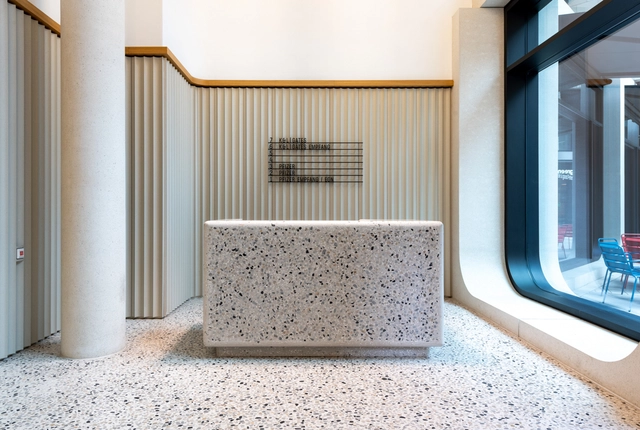
Stones hold time. Some are formed by the sudden solidification of magma, like basalt, whose dense structure and dark color result from rapid cooling at the surface. Others, such as granite, are born slowly in deep magmatic chambers, where gradual cooling allows the growth of visible crystals, creating unique patterns and colors. There are also sedimentary rocks, formed by the compaction of mineral and organic debris over millions of years, with tones that reflect their chemical composition and the environment in which they were deposited. Transforming this geological diversity into a single continuous surface, terrazzo is a cementitious or mineral composite in which fragments of marble, granite, quartz, basalt, and other lithologies are embedded in a binding matrix, then polished to reveal the structure and luster of each particle. Unlike a homogeneous surface, terrazzo acts as a mineralogical showcase, where each aggregate retains its identity while contributing to a coherent whole, which can become a floor, wall cladding, or even furnitures.
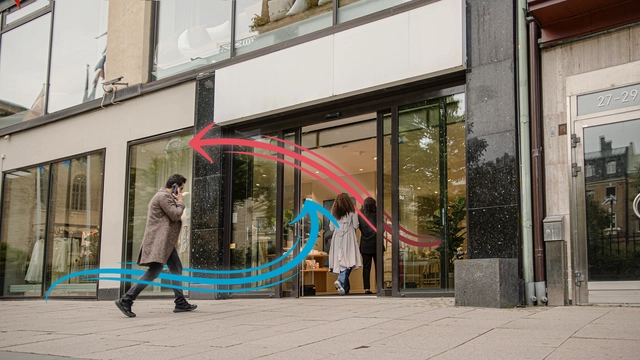
In Jacques Tati's Mon Oncle (1958), architecture itself becomes a character: sliding doors, an automatic fountain, gates that emit mechanical sounds, devices that both enchant and frustrate the inhabitants. The comedy arises precisely from the fact that these seemingly trivial systems silently shape everyday life. More than six decades later, the observation seems prophetic. In contemporary buildings, countless systems work autonomously and discreetly, going unnoticed when they function well. Among them, automatic doors, traditionally seen as secondary elements, are emerging as part of a new "invisible infrastructure": connected, efficient, and intelligent systems that support comfort, sustainability, and operational resilience.
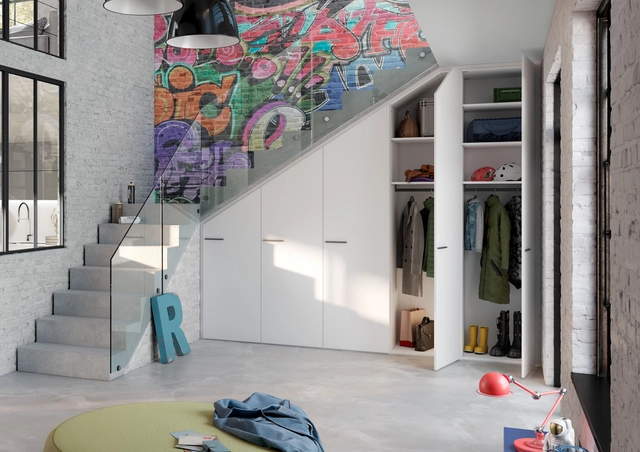
The capsule wardrobe concept, popularized in the 1970s by Susie Faux, proposes an exercise in synthesis: a compact set of versatile pieces, capable of combining in countless ways to suit different occasions. In visual culture, there are a few metaphors for this: in cartoons like Doug Funnie or Dexter's Laboratory, opening the closet revealed rows of identical clothes, ready to simplify life (and, in the case of animators, the work). In the real world, figures like Steve Jobs turned this logic into a method, adopting a daily uniform to eliminate the small but recurring decision of "what to wear?", freeing up time and energy for more important matters.