Videos
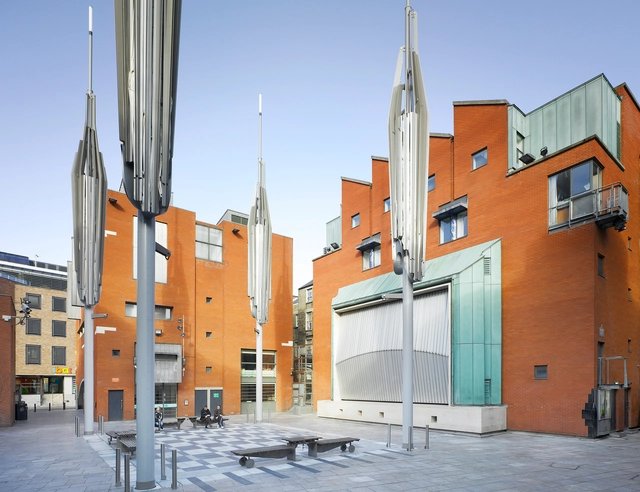
Meeting House Square, Temple Bar. Image Courtesy of Sean Harrington Architects
The veteran Irish architecture critic Shane O'Toole once remarked that when traveling in Europe in the 1970s, "The universal comment was is there modern architecture in Ireland? Now, in less than 50 years, we've gone to a Pritzker Prize and two RIBA Royal Gold Medallists in five years." He attributes this change in perception to a design competition that launched the careers of several of Ireland's award-winning architects of today. This was the Temple Bar Framework Plan competition of 1991 in the center of Dublin, the capital of Ireland, which was won by a group of architects still in their 30s, running under the name of Group 91.
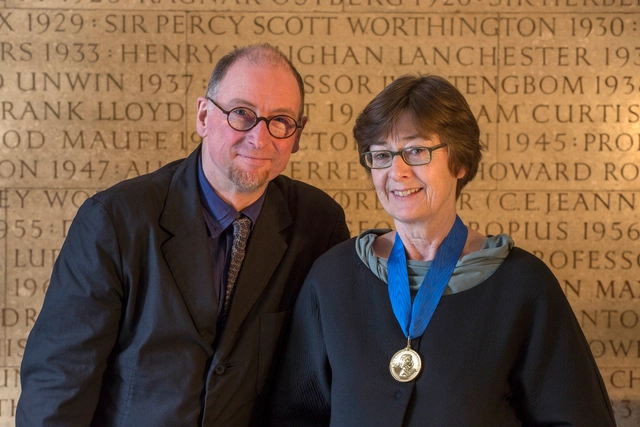
John Tuomey and Sheila O'Donnell - recipients of the 2015 Royal Gold Medal. Image Courtesy of RIBA
When Sheila O'Donnell and John Tuomey, who practice in partnership as O'Donnell + Tuomey, were named as this year's recipients of the RIBA Royal Gold Medal, a palpable collective satisfaction appeared to spread throughout the profession. No one could find criticism in Joseph Rykwert and Níall McLaughlin's nomination, nor the ultimate choice of the RIBA Honours Committee, to bestow the award upon the Irish team. Their astonishingly rigourous body of work, compiled and constructed over the last twenty five years, has an appeal which extends beyond Irish and British shores. A robust stock of cultural, community and educational projects, alongside family homes and social housing projects, leaves little doubt about the quality, depth and breadth of their mutual capabilities and the skill of those that they choose to collaborate with.
Read the conversation with the Gold Medallists after the break.
In an essay and accompanying mini-documentary film by Ellis Woodman for The Architectural Review, Siza's iconic Quinta da Malagueira housing estate (1973-1977) in Évora, Portugal, is comprehensively explored and examined with a refreshingly engaging critical weight. Rather than develop multi-story housing in the sensitive landscape around the city, Siza proposed "a plan that distributed the programme between two fields composed of low-rise terraced courtyard houses." As a result, the arrangement of these structures adjust to the "undulating topography ensuring that the narrow, cobbled streets along which the houses are distributed always follow the slope."
As is made clear in the film (above), one of the remarkable aspects about the Quinta da Malagueira estate is that it is "governed by a third layer of infrastructure" which takes the form of "an elevated network of conduits that distributes water and electricity [...] much in the manner of a miniature aqueduct." For Siza, this was a logical move as it provided the cheapest means of distributing utilities around the complex. Woodman ultimately concludes that "Siza’s work at Malagueira invites a reading less as a fixed artefact and rather as one episode in the site’s ongoing transformation."