The Internet is now the library of the past. Where the public library has historically served as the primary source of information gathering and dissemination, we now look to this new virtual, infinitely large library that can be accessed anywhere at any time as the Library of the present.
As a result, the primary roles of today’s physical libraries have shifted. Libraries of the past focused primarily on individualized information consumption. Communal aspects of interaction and information dissemination now represent the core mission of the library when information is more easily accessible. The silent grand beaux-arts reading rooms of New York or Boston have of the past been transformed into flexible communal “living rooms” in Seattle.
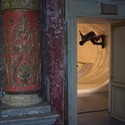
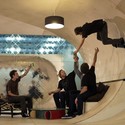
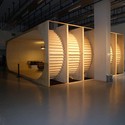
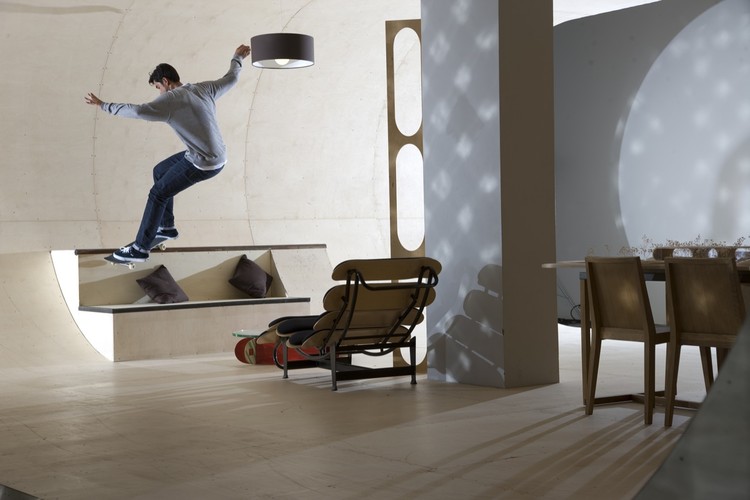
A unique concept the PAS House is imagined to be a place to both live and skateboard. The skateable surface of the home, interior to exterior, fluidly moves from the ground to the wall and then to the ceiling in a continuous surface forming a tube of a 10ft diameter. The PAS House will be constructed in Malibu, California for Pierre Andre Senizerques (PAS), a former World Champion and Pro Skater as well as Founder and Owner of Sole Technology, the design by Francois Perrin and Gil Lebon Delapointe divides the home into three separate spaces; including a living room, dining area, and kitchen, the second one includes a bedroom and bathroom and the third a skateboard practice area.
Architects: Francois Perrin and Gil Lebon Delapointe Location: Malibu, California (house); Exhibition Public Domaine/Skateboard Culture, La Gaite Lyrique, Paris, France (prototype) Client: Pierre Andre Senizergues Project Area: 2,200 sqf (house); 700 sqf (prototype) Project Year: 2011 Photographs: Mike Manzoori and Sam Mc Guire
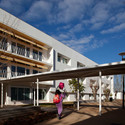
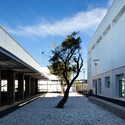
The key concept of this project was to create not only a building but also a new meaningful city space connecting the people, the place, its history and their music. The building delimits the boundaries of the plot, enclosing an expanse of green at its core: a garden that is urban yet isolated from the hubbub of the city.
https://www.archdaily.com/149451/tallinn-music-high-school-ballet-school-and-georg-ots-music-school-atelier-thomas-pucherChristopher Henry
Construction of Schweger Associated Architects‘ Dubai Pearl is continuing. The groundwork, foundations, basements and lower grounds floors of the four towers which form the central section of Phase 1 of the development is now complete. A total of 3.5 million man hours have so far been spent since work started on site and over 60,000 cubic meter of concrete has been poured on one of the largest construction projects still being developed in the UAE.
The Karoo Wilderness Center represents a significant shift in perspective and practice, sponsoring and provoking the learning, dialogue, and action necessary to redefine the consequence of human inhabitation on the land. The Center aims to re-establish the connection between the built and natural world as one that is mutually beneficial. Forming an exemplary model of sustainability, the Center generates its own energy, harvests its own water, processes its own waste, and provides thermal comfort using no municipal water or power. Learning from the continuum of life in the Karoo, the architecture of the Center provides a lasting connection to the landscape, and fosters an understanding of the interdependence of ecosystem health, and human well being.
Architect: Field Architecture Location: Karoo, South Africa Project Team: Stan Field, Jess Field (Design Principals), Andy Lin, Erik Bloom, Chris Graesser Structural Engineers: Arup Conservation Management: Wilderness Foundation South Africa Environmental Impact Analysis: Integrated Environmental Management Project Area: 21,800 sqf
https://www.archdaily.com/135314/in-progress-karoo-wilderness-center-field-architectureChristopher Henry
JET Architecture in joint venture with CXT Architects and Archasia Design Group earned an Honorable Mention for the Kaohsiung Port and Cruise Service Center International Competition in September 2010. Their entry, “Openair,” ranked in the top five, advancing the scheme to the second stage of the competition. Now, they decided to submit their competition entry for the Kaohsiung Port and Cruise Service Center International Competition to Azure’s AZ AWARDS, the magazine’s first annual international competition recognizing excellence in design. The project was chosen as a finalist for the AZ AWARDS in the Concepts: Unbuilt Competitions Entries category and is eligible for the AZ People’s Choice Awards. More images and architects’ description after the break.
Here is another video from OFIS arhitekti, this time showing the making of Dot Envelope, a project which we already published back in 2008, located in Ljubljana, Slovenia.
Back in 2009 we published the Farewell Chapel by OFIS arhitekti that went on to win the ArchDaily’s Building Of The Year Award in 2009 for the Religious category.
Songdo International Business District (IBD) occupies over 1,500 acres of reclaimed land on the West Coast of Incheon, Korea. This waterfront master plan includes a diverse array of programmatic elements and is designed to be a pedestrian friendly city with walkable streets and an urban density that allows for an active street life. Signature features include, the New Songdo City First World Towers, Northeast Asia Trade Tower, the 100-arce Songdo Central Park, and the Songdo City International School.
Turning an element synonymous with security in Iraq into a method for constructing affordable housing, New World Design LLC has shared with us their T-Wall Housing proposal for Al Qurnah, Basrah, Iraq. Follow after the jump for further images and a description from the architects.
“In order to design buildings with a sensuous connection to life, one must think in a way that goes far beyond form and construction.” This quote from Peter Zumthor rings true in his design of Bruder Klaus Field Chapel, where a mystical and thought-proving interior is masked by a very rigid rectangular exterior.
Once again, Vítor Gabriel shared with us this beautiful video of the Musealization of the Archaeological Site of Praça Nova of São Jorge Castle designed by portuguese architect João Luís Carrilho da Graça to preserve some archaeological discoveries – Iron Age settlement, Mediaeval Muslim occupation and a Fifteenth Century Palace – found in 1996. You can check the complete project material on our previous article, over here.