
Musealization of the Archaeological Site of Praça Nova of São Jorge Castle / JLCG Arquitectos

Uploaded by — Filed under: Heritage ,Museums and Libraries ,Selected , , , , ,
 

FG+SG – Fernando Guerra, Sergio Guerra

Architect: João Luís Carrilho da Graça
Location: Lisbon,
Landscape Architect: João Gomes da Silva
Project Team: Francisco Freire, Vasco Melo, Pedro Abreu, Monica Ravazzolo, architects; Paulo Barreto and Vanda Neto, models
Foundations and Structures: Estudos Betar / José Pedro Venâncio and Paulo Mendonça
Water Installations: Estudos Betar / Marta Azevedo and Jorge Pinheiro
Electrical Installations: Ruben Sobral
Security Installations: GIPIC – Alexandre Martins
Graphic Design: Henrique Cayatte, Mónica Lameiro and Pedro Gonçalves
Project Area: 3,500 sqm
Budget: 1,000,000 €
Project Year: 2008-2010
Photographs: FG+SG – Fernando Guerra, Sergio Guerra

“Language is an archaeological vehicle… the language we speak is a whole palimpsest of human effort and history.”

Russell Hoban

FG+SG – Fernando Guerra, Sergio Guerra

The one hill occupied by the Castle of São Jorge is the site of the first known human settlement — dating to the Iron Age — of the place that would become the city of Lisbon, a strategic vantage point overlooking both the estuary of the River Tagus and its inland territory. The ‘Praça Nova’ of the Castle occupies an intramural promontory, enclosed by defense walls to the North and the West, and by the Santa Cruz Church, to the South, with a visual domain above the East walls over the city and the estuary.

FG+SG – Fernando Guerra, Sergio Guerra

An extensive archaeological excavation of this site, begun in 1996, uncovered remnants of its successive periods of inhabitation — Iron Age settlement, Mediaeval Muslim occupation and a Fifteenth Century Palace —, and the most significant artifacts removed, protected and now exhibited at the Castle’s Museum, leaving the exposed archeological site open to an intervention of protection and musealization.

This intervention addressed the themes of protection, revelation and readability of the palimpsest that any such excavation represents, with a pragmatical approach aimed at clarifying the palindromic quality of interpretation that the exposed structures suggested in their spacial distribution.

axon

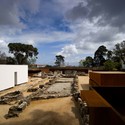
Thus, the first action was the clear delimitation of the site with a precise incision, comparable to that of a surgical intervention on a living body. A membrane of corten steel was inserted to contain the higher perimetrical surface, allowing both access and a panoramic view of the site, the materiality of these walls slowly evolving and changing over time as a living material. The same precision of cut was used in the inserted elements that allow the visitor to comfortably wander through the site — the limestone steps, landings and seating — setting them apart from the roughness of the excavated walls.

FG+SG – Fernando Guerra, Sergio Guerra

Stepping down to the site, to its simultaneously first material level and last period of occupation — the remnant pavement of the Fifteenth Century Palace of the Bishop of Lisbon — a hovering structure protects the existing mosaics, its underside covered in a black mirror that allows the visitor to see reflected the vertical perspective of the pavements that the eye level of their placement denies.

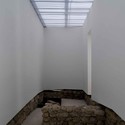
Further down the site and its timeline, the necessary canopy for the protection of the Eleventh Century Muslim domestic structures and its frescoes was taken as an opportunity to reproduce, through conjectural interpretation, its spacial experience as a series of independent rooms arranged around a patio that introduced light and ventilation into an otherwise exteriorly isolated dwelling. Professedly abstract and scenographic, the white walls that stage the domestic spatiality of the two excavated dwellings float above the visible foundations of the original walls, touching the ground on the mere six points where the evidence of the primeval limits is absent, while its translucent covering of polycarbonate and wood filters the sunlight.

FG+SG – Fernando Guerra, Sergio Guerra

section 02

Underlying the whole site, the evidence of the Iron Age settlement is exposed and protected trough a self-contained volume that, in a spiraled movement, extends from the perimetrical corten walls to embrace the depth necessary to its revelation. Massive and dramatic, the volume is pierced with horizontal slits that invite the curiosity for the observation of its interior, leading the visitor around the excavated pit to the point where the view is unobstructed and both the physical and time distance of the exhibited structures is made obvious.

The palimpsest of the site History is thus decoded and the possibility of its palindromic time-space reading made clear: not only trough the informational signage at the disposal of the visitor, but also, and significantly, trough the experience construed by its material protection and musealization.

* Location to be used only as a reference. It could indicate city/country but not exact address.
 
 
Thumb up Thumb down 0
Frederico Guedes says:

Good morning,

About the text of “Praça Nova do Castelo de São Jorge, The correct name of the river is “Tejo”, not Tagus. Please, you must say in portuguese, is a portuguese river.

Thank you,

Fred Guedes

 
# November 19, 2010 at 08:39
    Thumb up Thumb down 0
    godryk says:

    Tagus is the latin AND english name of the river. Some countries, regions, cities and geographical features have names in different languages which are used when writing/speaking in those languages. It makes sense to use the english name of an international geographical feature in an english text. That portuguese river whose name “must” be written in portuguese runs in front of my town in Spain, where we call it Tajo, and I’m not offended by seeing its name in english as I’m not offended, you may not believe me, when I see my country’s name written in portuguese (Espanha), english (Spain) or german (Spanien), you may

     
    # November 19, 2010 at 11:24
Thumb up Thumb down 0
GC says:

Modern yet subtle.. Beautiful project!

 
# November 20, 2010 at 12:12
Thumb up Thumb down 0

10:37 PM Nov 18th

RT @ArchDaily: Musealization of the Archaeological Site of Praça Nova of São Jorge Castle / JLCG Arquitectos http://archdai.ly/aW7GgF #a …

Thumb up Thumb down 0

10:38 PM Nov 18th

Musealization of the Archaeological Site of Praça Nova of São Jorge Castle / JLCG Arquitectos… http://goo.gl/fb/W0bOo

Thumb up Thumb down 0

10:46 PM Nov 18th

RT @ArchDaily: Musealization of the Archaeological Site of Praça Nova of São Jorge Castle / JLCG Arquitectos http://archdai.ly/aW7GgF #a …

Thumb up Thumb down 0

10:49 PM Nov 18th

RT @ArchDaily: Musealization of the Archaeological Site of Praça Nova of São Jorge Castle / JLCG Arquitectos http://archdai.ly/aW7GgF #a …

Thumb up Thumb down 0

11:04 PM Nov 18th

Musealization of the Archaeological Site of Praça Nova of São Jorge Castle / JLCG Arquitectos: Architect: João L… http://bit.ly/aZstAz

Thumb up Thumb down 0

11:13 PM Nov 18th

Musealization of the Archaeological Site of Praça Nova of São Jorge Castle / JLCG Arquitectos via ArchDaily http://tinyurl.com/2f9h35a

Thumb up Thumb down 0

12:01 AM Nov 19th

Musealization of the Archaeological Site of Praça Nova of São Jorge Castle / JLCG Arquitectos: FG+SG – Fernando … http://bit.ly/bfjKB1

Thumb up Thumb down 0

1:07 AM Nov 19th

Musealization of the Archaeological Site of Praça Nova of São Jorge Castle / JLCG Arquitectos http://bit.ly/cgGwHR via @archdaily

Thumb up Thumb down 0

7:49 AM Nov 19th

埋まってる。 Musealization of the Archaeological Site of Praça Nova of São Jorge Castle / JLCG Arquitectos http://bit.ly/bNpFni

Thumb up Thumb down 0

1:55 PM Nov 19th

RT @ChrisBellNZ: “Language is an archaeological vehicle…” – Russell Hoban http://ow.ly/3cteU

Thumb up Thumb down 0

3:02 PM Nov 19th

RT| Musealization of the Archaeological Site of Praça Nova of São Jorge Castle / JLCG Arquitectos: FG… http://bit.ly/9Pue0N @archdaily

Thumb up Thumb down 0

3:48 PM Nov 19th

Via @ArchDaily – Musealization of the Archaeological Site of Praça Nova of São Jorge Castle / JLCG… http://dlvr.it/8mth5 #architecture

Thumb up Thumb down 0

4:35 PM Nov 20th

RT @ArchDaily: Musealization of the Archaeological Site of Praça Nova of São Jorge Castle / JLCG Arquitectos http://archdai.ly/aW7GgF #a …

Thumb up Thumb down 0

1:55 PM Nov 22nd

Musealization of the Archaeological Site of Praça Nova of São Jorge Castle / JLCG Arquitectos http://is.gd/hAxgq

Thumb up Thumb down 0

4:31 PM Dec 19th

Musealization of the Archaeological Site of Praça Nova of São Jorge Castle / JLCG Arquitectos | ArchDaily http://t.co/gr89apw via @archdaily

Leave a Reply »


Latest Comments »

Words like ‘try’ and ‘hard’...[+]
Thank you for a wonderful coverage of the event, which was a joy to attend....[+]
Wonderful article Guy.[+]
The pervasively unrealistic and dramatized...[+]
I’ve always paid a lot of attention to Guy’s articles and I...[+]

Upcoming Architecture Events »

got events? invite us! click here

Architecture Books & Magazines »

Mark Magazine #37

Mark Magazine #37

We recently received the latest issue of Mark Magazine, one of our favorites. If you’re bored of cubic architecture, Mark #37 (April-May) includes amazing work by Jurgen Mayer H and Jesko Johnson-Zahn built in Georgia (the country, not the state).…


Net Zero Energy Building / Detail Green Books

Net Zero Energy Building / Detail Green Books

Detail recently sent us Net Zero Energy Building …from their Green Books series. Like everything Detail does, this books takes a thorough look at the technology surrounding this specific subject. It also, as always, gives great examples from the Virginia Tech Solar


Old Buildings, New Designs / Charles Blosziers

Old Buildings, New Designs / Charles Blosziers

It is hard not to want to pick up this book and start reading with the project displayed on the front cover. Fantastic! This book grapples with the issue of how to marry old buildings with new design. The book…


Our partners »

AD on iPad via Pulse

Browse by date »

Browse by category »

Friends »