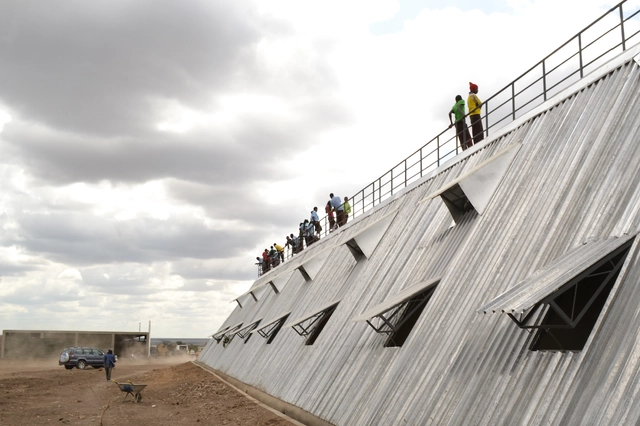
Waterbank Stadium under construction, photo credit: A.Maganga. Image Courtesy of PITCHAfrica
In many African countries, clean water is still a luxury. Wars are fought over it, families are uprooted for it, and entire communities perish without it. The scarcity of freshwater has plagued nations in Africa and around the world for centuries. Now, non-profit group PITCHAfrica is fixing the problem with a novel combination of sport and design. Part of a 10-acre Waterbank Campus comprised of 7 water-harvesting buildings, the soccer (or “futsal”) stadium is capable of hosting up to 1500 people, helping to save, educate and unite communities that are most in need.
Recently completed in Belarus, OFIS arhitekti's Football Stadium Arena Borisov combines modern technology and creative space planning to produce an environment with fine-tuned acoustics, 360 degree views of the field, and lots of public recreational opportunities. The 13,000-seat arena's stretched textile skin lends a distinctive character within its rugged forest setting and public street at its base where it lifts away from the building's core. Beyond the stadium, its 3,628 square-meter site hosts public gyms, a bowling area, restaurants, bars, and shops, as well as offices, press boxes, and training facilities. Check out the video to get an in-depth look inside the arena and learn more about the stadium, here.
Herzog & de Meuron is said to be collaborating with Lifschutz Davidson Sandilands to explore options for expanding the Chelsea Football Club’s Stamford Bridge home stadium in west London. According to a report by the Architects’ Journal, news of the possible expansion first broke last June, after considerations of relocating the stadium were heavily criticized by the public.
The stadium, originally designed by Scottish architect Archibald Leitch and built in 1876, has already undergone several renovations. Chelsea FC hopes to increase its capacity from 41,837 to 60,000, as well as provide a new decking over the railway line on the east and north sides of the building.
More from Chelsea FC regarding the expansion, after the break.
Following our recent news that confirmed Rogers Stirk Harbour + Partners (RSHP) will oversee the design and construction of two new stadiums within Caracas' Hugo Chavez Park, details have emerged regarding the Estadio Nacional de Fútbol de Venezuela. Designed by RSHP, in collaboration with Arup and Schlaich Bergermann und Partners, the project will be the practice’s first ever football stadium.
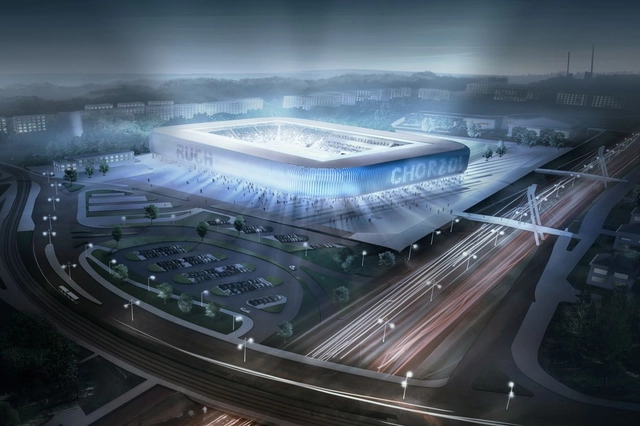
Andrea Maffei Architect'scompetition entry for a new stadium for Ruch Chorzów, one of Poland‘s largest football clubs, offers a capacity for 12,000 and provision for up to 16,000 seats. The design encourages the stadium and its surroundings to act as a new civic point of reference for Chorzów as part of a wider complex of shops and restaurants. The architects' understanding of the movement of people on match days is complimented by the facilities that the new stadium will offer to visitors seven days a week, the design for which will provide Ruch Chorzów with a state-of-the-art football pitch and associated amenities.
The design for a new stadium for Ruch Chorzów, one of Poland's largest football clubs, has been unveiled. The winning proposal, designed by GMT Mysłowice, will have a capacity for 12,000 seats and, although described as not being "the most impressive [design] overall," has been selected for its simple, clean form and "value for money." With ruch meaning 'movement' or 'motion' in Polish, the concept for the design has hinged around "giving passers-by a different perspective from every possible angle as they move along the stadium."
The 2010 World Cup to be held in South Africa is less than one year away. Being perhaps the most important international competition in sports in the world, we would like to start featuring some of the stadiums that will host this magnificient competition.
Soccer City Stadium is located in Johannesburg and it was originally built in 1987. Among other important events, it hosted the first massive speech from Nelson Mandela after his liberation in 1990. However, it was completely renewed for the upcoming World Cup, becoming the stadium where the starting and the final game will be played.
Designed by Boogertman Urban Edge and Partners in partnership with Populous, it will allow for 94,000 spectators to enjoy the best soccer in the world. The design of the stadium was selected from a series of concept designs ranging from acknowledgement of Johannesburg’s disappearing mine dumps; the kgotla (defined by the tree) of the African city state; the African map as a horizontal representation, which included the roof as a desert plane supported on tropical trees set within the mineral wealth of Southern Africa; to a representation of the protea, South Africa’s national flower.
The calabash, or African pot, was selected as being the most recognizable object to represent what would automatically be associated with the African continent and not any other. The calabash, or ‘melting pot of African cultures’, sits on a raised podium, on top of which is located a ‘pit of fire’. Thus the pot sits in a depression, which is the ‘pit of fire’, as if it were being naturally fired.