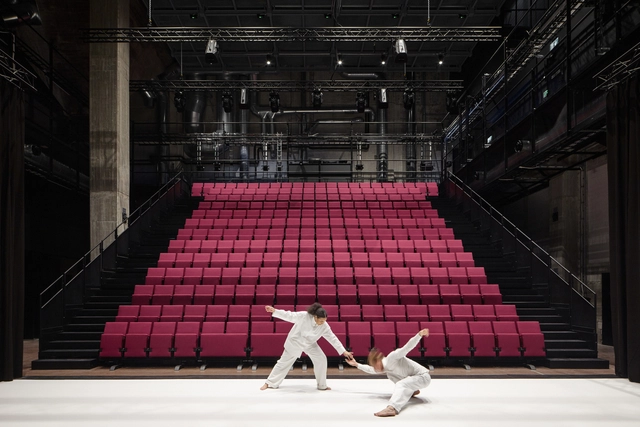
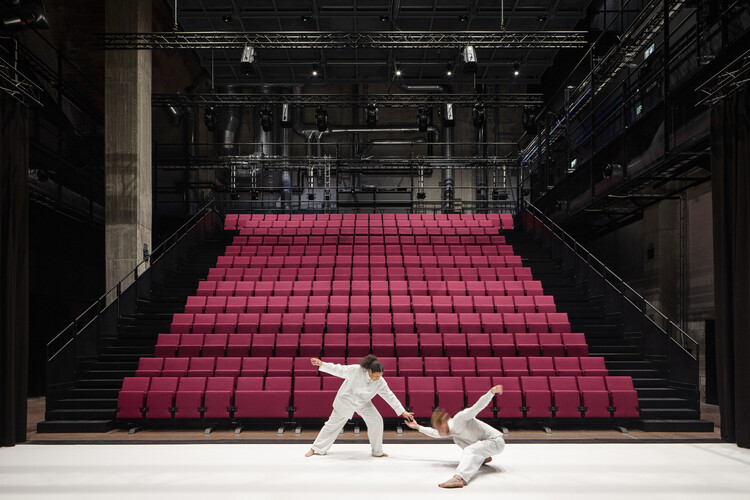
MAD, the architecture studio founded by Ma Yansong, has revealed the designs for Danshuis, a new dance center planned for Rotterdam, the Netherlands. Located on a landmark site in the city's historic docklands, adjacent to the Fenix Museum of Migration, also designed by MAD, the project is expected to open in 2030. The 9,500-square-meter center will transform an Art Deco warehouse dating from 1923 on the south bank of the River Maas. Planned as a center for the production, development, and practice of dance across different styles, Danshuis aims to bring together professional and amateur programs for different ages and levels of experience.
"Dance, dance… otherwise we are lost." This oft-cited phrase by Pina Bausch encapsulates not only the urgency of movement, but its capacity to reveal space itself. In her choreographies, space is never a neutral backdrop, it becomes a partner, an obstacle, a memory. Floors tilt, chairs accumulate, walls oppress or liberate. These are architectural conditions, staged and contested through the body. What Bausch exposes — and what architecture often forgets — is that space is not simply built, it is performed. Her work invites architects to think not only in terms of materials and forms, but of gestures, relations, and rhythms. It suggests that architecture, like dance, is ultimately about how we inhabit, structure, and emotionally charge the spaces we move through.
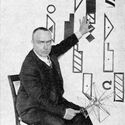
Historically, architecture and dance have operated in parallel, shaping human experience through the body's orientation in space and time. From the choreographed rituals of classical temples to the axial logics of Baroque palaces, built space has always implied movement. The Bauhaus took this further, as Oskar Schlemmer's Triadic Ballet visualized space as a geometric extension of the body. This was not scenery, but spatial thinking made kinetic. In the 20th century, choreographers like William Forsythe and Anne Teresa De Keersmaeker integrated architectural constraints into their scores, while architects such as Steven Holl, Diller Scofidio + Renfro, and Toyo Ito designed buildings that unfold as spatial sequences, inviting movement, drift, and delay.
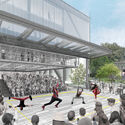
Pina Bausch Center in Wuppertal, Germany. Image Courtesy of Diller Scofidio + Renfro
Diller Scofidio + Renfro has won an international competition to design the new Pina Bausch Zentrum in Wuppertal, Germany. Pina Bausch’s legacy as a dancer and choreographer will be celebrated in the design and revitalization of the Tanztheater Wuppertal, as well as in the creation of a new production center. The building will emerge out of the ethos of Pina Bausch, setting an example for a new generation of leadership in the world of choreography.
Apart from the production stage centers, the design includes an archive of Pina Bausch's enormous artistic legacy, comprising a library, study, and research areas, and a public platform to promote community involvement with many creative and academic disciplines. Various contrasting and flexible spaces that encourage and foster conversation across the project's numerous program components are found throughout the proposed design.
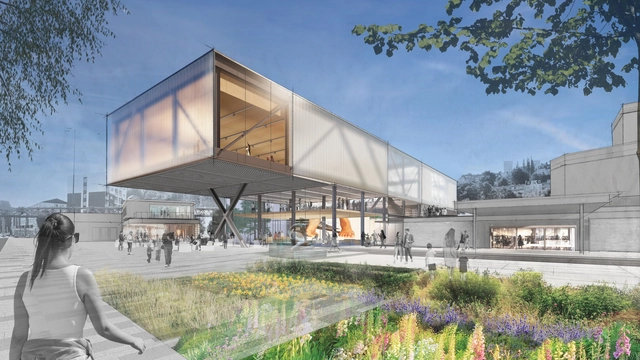
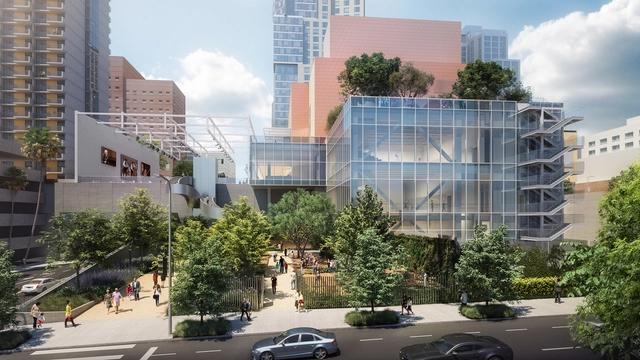
Rendering of the Colburn Center at the Colburn School. View from Hill Street West towards dance school entrance, adjacent park, and stairs leading up to Olive Street and public plaza.. Image Courtesy of Gehry Partners
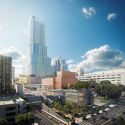
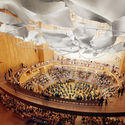
The Colburn School, Los Angeles' renowned school for music and dance, has unveiled architectural designs by Frank Gehry for the Colburn Center, a 100,000 square-foot campus expansion that aims to inspire and promote the region’s young performing artists and organizations. The center will serve as a cultural and civic hub in the heart of Downtown LA through public programs, as well as performance and educational collaborations with local and touring artists.
What do dance and architecture have in common? It's difficult to explain how our experiences of dance are stored in our bodily memory, but central to our recollection of a performance is the architectural space that it inhabited. Although dance may have been the central focus, the site is integral to its experience. Both disciplines are fundamental when exploring the ways we navigate and create cities and urban spaces.
It's no surprise that many choreographers explore both disciplines: dance and architecture. These pieces question how our bodies navigate through built environments. However, it is important to note that this experimentation is not merely contemplative but speaks to the way specific groups of peoples and cultures operate in their surroundings. In the words of the philosopher Marina Garcés: "The body is no longer what is and binds us to a place, but it is the condition for every place. It is the zero point of all the spatialities that we can experience, and at the same time, all the links that constitute us, materially and psychically."
What is a building that is not inhabited? Is it still architecture? Could we say that we live in a daily choreography where our everyday life is in constant movement with the world around us? Different philosophers and theorists have long addressed the issue that architecture is not simply a set of concrete, steel, and glassware ready to protect its users, but rather all the actions it harbors, all the bodies, and set of breaths and movements. This has been reinforced by different theories that approach the body as an actor of place. However, theories of the body in architecture are not as rare as we might believe. From Ergonomics to Le Corbusier's "Modulor," theorist have sought to understand our relationship with architecture.









.jpg?1532465132&format=webp&width=640&height=580)