
-
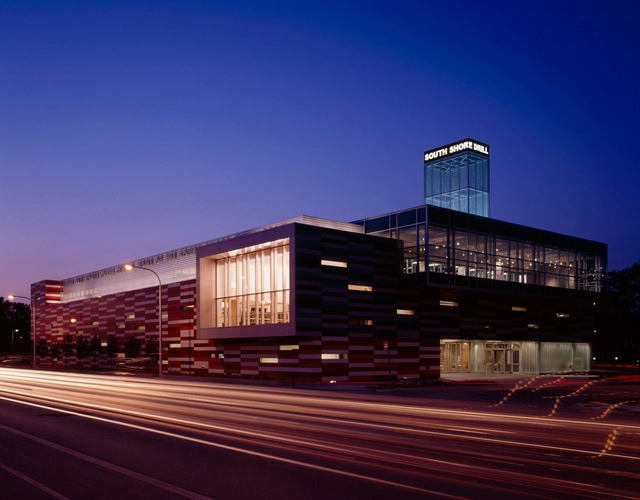
Architects: John Ronan Architects
- Area: 75000 ft²
- Year: 2006



Recently completed by Spirit of Space, the film above displays the cadence of morning rush hour reflecting the rhythm of the Chicago River, but how often do we allow the river to reflect a wandering glance from us? This “glance” aims to bring to light the potential of Chicago’s socially under utilized, aqueous artery.

The Art Institute of Chicago is hosting a retrospective for Bertrand Goldberg, famed architect of Marina City (1959–1967), two cylindrical corncob-shaped commercial/residential towers. The exhibition contains a range of Goldberg’s work; it begins with his work at the Bauhaus and the 1933 Century of Progress Exposition and follows his career into his visionary plans of a postwar America. The exhibition will feature architectural drawings, models, photographs, along with graphic and furniture design.
Follow us after the break for images of Goldberg’s work.


USA Today has put together a list of city neighborhoods which are satiated with activity, areas which offer a “great slice of urban life.” These districts trend from the urban vicinity to its very core, each in itself exemplifying the revitalization of the American city. The list includes regions which have been influenced by deliberate urban revitalization projects, such as High Line Park in Chelsea; while other neighborhoods have experienced an influx of a younger populace which has contributed to its growth, such as Lawrenceville in Pittsburgh.
See the 10 Up and Coming Urban Neighborhoods after the break.

The Ceremony and Dinner will be preceded by a free afternoon Symposium which will feature presentations from all the 2011 winners. Join us to hear from senior representatives of these ground breaking projects, as well as from the two CTBUH Lifetime Achievement award winners who have influenced the tall building profession for decades. More information on the event after the break.


The architecture community recently lost Chicago architect Douglas Garofalo, FAIA. Founder of Garofalo Architects, he was a University of Notre Dame graduate and a professor at the University of Illinois at Chicago, serving as director (2001-2003) and co-founded the alternative design school Archeworks. Garofalo also was known for pioneering the use of computer technology in building design within the United States. His award-winning Korean Presbyterian Church in New York, a collaborative project with Greg Lynn and Michael McInturf, received international attention with its digital media approach and alternative solution to adaptive reuse.

This concrete, clover leaf-shaped structure, which was built in 1975, will likely suffer a fate common to many vacant and disused buildings. After approximately four years of vacancy, this Bertrand Goldberg-designed building will likely be demolished when ownership will revert to Northwestern University this year. Although Goldberg’s organic architectural designs – such as this one – were widely influential, none of his major Chicago works are protected by local landmark designation. Prentice Women’s Hospital was considered groundbreaking for its cutting-edge architecture, advanced engineering, and its progressive design approach to organizing medical departments and services. It received international press coverage and an award from Engineering News Record for its innovative tower and open floor-plate layout that eliminated the need for structural support columns. “You will not find the structural solution to Prentice, which is an exterior shell cantilevered off a core, anywhere else in the world” notes Geoffrey Goldberg, an architect and Bertrand Goldberg’s son. “Prentice was the only one in which this was achieved.”


The Urbana Illinois (140 miles South of Chicago) situated design team, Design With Company, has partnered with Min Chen to develop their latest project, Second Second City, which they have shared with us here at ArchDaily. Additional images of their vision for Chicago’s McCormick Place East and a narrative from the architects can be seen after the break.

Department of Unusual Certainties [DoUC] recently completed a submission to the Network Reset, Rethinking the Chicago Emerald Necklace, competition hosted by Mas Studio and the Chicago Architectural Club. Participants were asked to look at the urban scale and propose a framework for the entire boulevard system as well as provide answers and visualize the interventions at a smaller scale that can directly impact its potential users. Through images, diagrams and drawings the work should express what are the soft or hard, big or small, temporary or permanent interventions that can reactivate and reset the Boulevard System of Chicago. DoUC’s proposal focused on filling Chicago’s Emerald Necklace with a framework of posts, beams, ropes and counterweights - to produce a pick-and-choose- method of program management. Images of their entry and a description can be seen after the jump.

CHANGING ROOM, by Easton + Combs, is a mirage of the intimate in the realm of the public. As the daydream is to daily life, a momentary slippage that can re-qualify the onslaught of a quotidian continuum, so too is the CHANGING ROOM to the urban field.