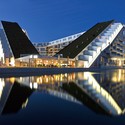
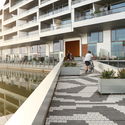
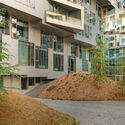
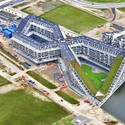
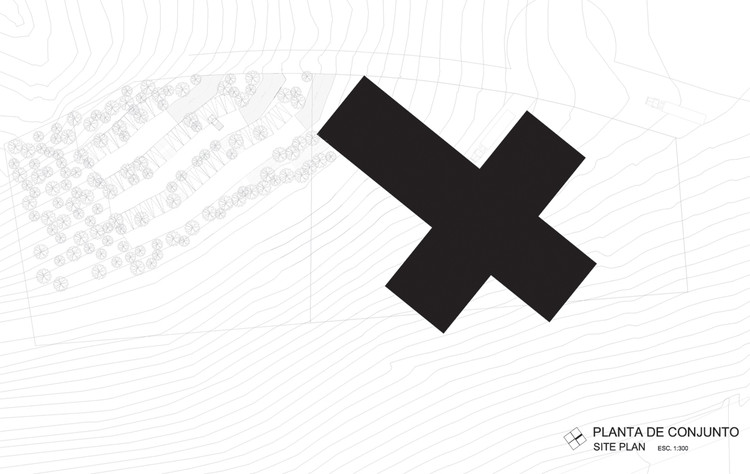
Belgian photographer Julien Lanoo share with us his photoset of House 8, the latests project by danish architects BIG, featured last week here on ArchDaily.
More photographs after the break.


Belgian photographer Julien Lanoo share with us his photoset of House 8, the latests project by danish architects BIG, featured last week here on ArchDaily.
More photographs after the break.
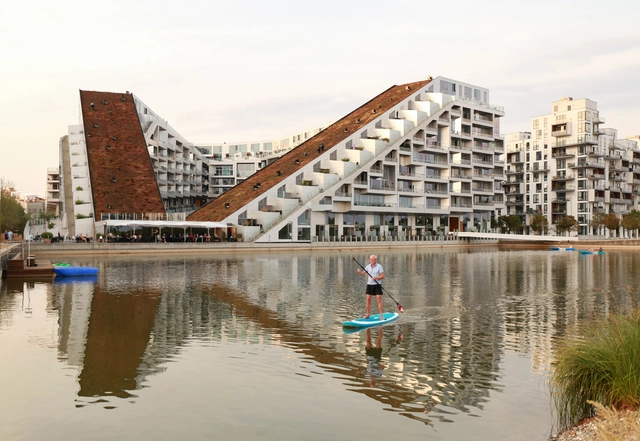
Celebrating its third project with the same development team in the maturing neighborhood of Orestad, the construction of the 61,000 sqm 8 House has come to an end, allowing people to bike all the way from the street up to its 10th level penthouses alongside terraced gardens where the first residents have already moved in. Follow the break and you can find images of 8 House at night, interiors, gardens, and diagrams along with a more detailed project description and quotes from the architects.
You can also check our previous feature on the construction of this amazing project.
Architect: BIG – Bjarke Ingels Group Location: Copenhagen, Denmark Collaboration: Hopfner Partners, MOE & Brodsgaard, KLAR Partner-In-Charge: Bjarke Ingels, Thomas Christoffersen Project Leader: Ole Elkjaer-Larsen, Henrick Poulsen Project Manager: Finn Norkjaer, Henrik Lund Project Team: Dennis Rasmussen, Rune Hansen, Agustin Perez Torres, Annette Jensen, Carolien Schippers, Caroline Vogelius Wiener, Claus Tversted, David Duffus, Hans Larsen, Jan Magasanik, Anders Nissen, Christian Alvarez Gomez, Hjalti Gestsson, Johan Cool, James Duggan Schrader, Jakob Lange, Kirstine Ragnhild, Jakob Monefeldt, Jeppe Marling Kiib, Joost Van Nes, Kasia Brzusnian, Kasper Broendum Larsen, Louise Heboell, Maria Sole Bravo, Ole Nannberg, Pablo Labra, Pernille Uglvig Jessen, Peter Rieff, Peter Voigt Albertsen, Peter Larsson, Rasmus Kragh Bjerregaard, Richard Howis, Soeren Lambertsen, Eduardo Perez, Ondrej Tichy, Sara Sosio, Karsten Hammer Hansen, Christer Nesvik, Soeren Peter Kristensen, Lacin Karaoz, Marcello Cova, Luis Felipe González Delgado, Janghee Yoo, SunMing Lee Client: St. Frederikslund Holding Project Area: 61,000 sqm, 476 residences Project Year: 2010 Photographs: Dragor Luft, Jens Lindhe, Ty Stange, Maria Gonzalez
“(Driver)less is more”, BIG’s proposal for the Audi Urban Future Award was one of the five finalists of the competition won by J. Mayer H. More images and architect’s description after the break.
We’re so happy to share this video BIG passed along to us highlighting their contribution to the 2010 Venice Biennale. Entitled the LOOP City, the exhibition focuses on a new Metro loop that become the catalyst for development for the cross border region as different programs grow around the new stations. The loop will connect areas around the Øresund Strait in a sustainable spine of public transport, energy exchange and electric car infrastructure. The design introduces a new “vein of true urbanity” that will weave it was through the suburbs. This new loop will create a new realm by uniting specific points, yet activating each interstitial segment.
More about the project after the break.

BIG has proven in the past to be a source of innovating projects. Their idea is far beyond the superficial: it´s about improving the city, as you can see on this presentation by Bjarke Ingels for 8 House.
For this project -which will open in October-, BIG has been honored by the Scandinavian Green Roof Association as the Best Green Roof in the Scandinavia for its 1.700 m2 sloping green roof at an award ceremony held at 8 House in Oerestad, Copenhagen.
More information about this award after the break.
We have seen the Danish pavilion on its conceptual stage, during construction, completed and finally opened to the public.

BIG, in collaboration with AKT, Tyréns and Transsolar, just won the competition for the World Village of Women Sports in Malmo, Sweden, a 100.000sqm complex for research, education and training of women’s sports.
Rather than a program organized around a sports arena disconnected from the city, the project becomes a town inside a town, offering rich public spaces as you can see on the renderings.

The central space of the village offers a large area for public gathering, which can host professional football matches, concerts, conferences, exhibitions and flea markets. Around this space we find a series of sloped buildings, which reduce the visual impact of the complex to the adjacent neighborhood.
Between these buildings we find a pedestrian network around the main sports hall which plugs into the surrounding street networks as well as the interior galleries of Kronprinsen, turning it into a complete ecosystem of urban life.
More images and drawings after the break.

BIG is looking for a Project Leader to head up the BIG team responsible for developing the new Presidential Library in Astana, Kazakhstan, which we previoulsy featured in ArchDaily and got many comments from our readers.
The new library, named after the first President of the Republic of Kazakhstan, encompasses an estimated 33.000m2. Being one of the future cornerstones of Kazakh nation-building, and a leading institution that will represent the Kazakh national identity, the library goes beyond a mere architectural challenge.
The new Presidential Library in Astana, Kazakhstan’s new capital since 1997, shall not only accumulate history but also provide a foundation for new futures. It will serve as an intellectual, multifunctional and cultural center with the primary goal to reflect the establishment and development of Kazakhstan, its political history, and the Head of the State’s activities and roles in the development of the country.
Requirements after the break.
Quick video friday, Bjarke Ingels at TED talks. You can download an iPhone/iPod friendly version here.

BIG was recently awarded with the first prize on an open international design competition for Kazakhstan’s new National Library in Astana.
The new building has an area of 33.000 sqm, arranged as a continuous circulation on a Möbius Strip, as the result of 2 interlocking structures: the perfect circle and the public spiral. The sections (see below) clearly show how the horizontal program shifts to a vertical configuration, combining vertical hierarchy, horizontal connectivity and diagonal view lines. The skin, which changes from wall to roof as the strip develops. It sounds a bit complicated, but the sections and diagrams explain this pretty well, and you can get the idea on how the spaces and diagonal views relate on the renderings. In short words, a clear lineal organization (ideal for an archive, library) is mixed with an infinite loop.
“What is a library but an efficient archive of books… and a path for the public to reach them” (Thomas Christoffersen, Project Leader)
This shape also looks forward to become a symbol for the nation: “the circle, the rotunda, the arch and the yurt are merged into the form of a Moebius strip. The clarity of the circle, the courtyard of the rotunda, the gateway of the arch and the soft silhouette of the yurt are combined to create a new national monument appearing local and universal, contemporary and timeless, unique and archetypal at the same time” (Bjarke Ingels).
But once again, BIG diagram´s are way better to explain this than my words. See the diagrams, sections and renderings after the break:
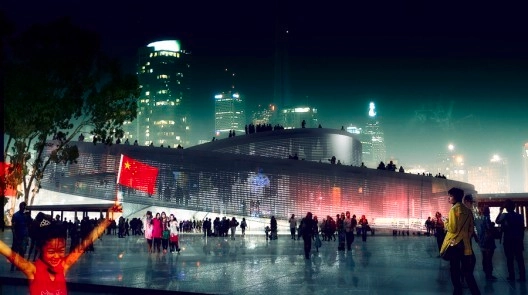
Housing projects, a new City Hall for an Estonian city, a master plan for an island and the Danish Pavillion for Shanghai Expo 2010 are just some of the enormous variety of projects designed by BIG. Check them out on our first Round Up of the week.

Architects: Rojkind Arquitectos + BIG Location: Mexico City, Mexico Client: Patronato Tamayo Constructed Area: 3,500 sqm BIG Architects Partners in Charge: Bjarke Ingels & Andreas Klok Pedersen Project Team: Pauline Lavie, Maxime Enrico, Pål Arnulf Trodahl Rojkind Arquitectos Partner in Charge: Michel Rojkind Project Team: Agustín Pereyra, Monica Orozco, Ma. Fernanda Gómez, Tere Levy, Isaac Smeke, Juan José Barrios, Roberto Gil Will, Beatriz Díaz, Joe Tarr Structural Engineer: Romo y asociados Landscape Design: Entorno taller de paisaje Graphic Design: Ernesto Moncada Images: Glessner Group – Germán Glessner

MAD recently organized a collaborative masterplanning project in South West China. Ten young international architects were invited to take part in an urban experiment, to design a new city centre on a scenic natural site close to the city of Guiyang. The participating architects were: Atelier Manferdini (USA), BIG (DENMARK), Dieguez Fridman (ARGENTINA), EMERGENT/Tom Wiscombe (USA), HouLiang Architecture (CHINA), JDS (DENMARK/BELGIUM), MAD (CHINA), Mass Studies (KOREA), Rojkind Arquitectos (MEXICO), Serie (UK/INDIA), Sou Fujimoto Architects (JAPAN).
Seen on designboom.
Images after the break.

With the exhibition “Yes is more”, the Danish Architecture Centre zooms in on BIG – Bjarke Ingels Group. Using unconventional approaches, humour, and international focus, BIG has contributed to the renewal of the Danish architectural tradition.
Parkour is a sport on which you have to go from one point of the city to another as efficiently and quickly as possible, overcoming any obstacles in your way: walls, fences, trees, etc. This has made Parkour THE urban sport, included in recent pop culture music videos.

Mark Magazine is by far one of my favourite architecture magazines. Their motto “Another architecture” tells us what we´ll find inside: fresh architecture – the main reason we love this magazine so much.
This bimonthly magazine is structured in 5 sections: Noticeboard (a collage of new projects), Cross Section (short articles on new buildings and architectural subjects), Viewpoint (interviews with architects on the rise), Long Section (in depth articles on buildings) and Service Area (new building materials).
On the August/September issue (October one on the mail, more about that soon) we find an amazing house by spanish studio Ensamble, shown on a collage with embossed textures, something that has become a signature on Mark Magazine covers.
In my opinion Bjarke Ingels, founder of BIG, is one of the best architects when it comes to give shape to the interests of an “unspoken” client on public buildings,either representing the values of a country or a culture. All with exceptional syntax and presentation skills.
And BIG‘s latest project (in collaboration with Arup and 2+1), the Danish Pavilion for the Shanghai 2010 Expo, does it again, by taking the best of living in Copenhagen and placing it on China for visitors to experience.

Basically, the pavilion is a big loop on which visitors ride around on one of the 1,500 bikes available at the entrance, a chance to experience the Danish urban way. At the center of the pavilion there’s a big pool with fresh water from Copenhagen’s harbor, on which visitors can even swim.