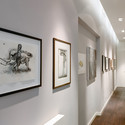
The student team of Ivana Andjelic, Nemanja Kocic and Natalija Usendic has shared with us their proposed solution for the Schindler Award 2011 contest for the Olympic Park in Berlin. Additional images and text are available after the break.
The student team of Ivana Andjelic, Nemanja Kocic and Natalija Usendic has shared with us their proposed solution for the Schindler Award 2011 contest for the Olympic Park in Berlin. Additional images and text are available after the break.

Announced today, the Berlin Neues Museum designed by David Chipperfield is the recipient of this years prestigious EU Prize for Contemporary Architecture – Mies van der Rohe Award. The Neues Museum is the result of blending old and new; the original Museum was designed by Friedrich August Stüler in the mid-19th century. Substantially damaged in the Second World War reconstruction of the Museum began in 2003.
Jury Chair Mohsen Mostafavi, shared the following about the building, “The rebuilding of the Neues Museum is an extraordinary achievement. Rarely have an architect and client succeeded in undertaking a work of such historic importance and complexity; especially one that involves both preservation and new building. The project raises and addresses many aesthetic, ethical, and technical issues. It is an exemplary demonstration of what collaboration can achieve in the context of contemporary European architectural practice.”
Also announced today was the recipient of ‘The Emerging Architect Special Mention’ award, given to Ramon Bosch and Bet Capdeferro for the Collage House in Girona, Spain.
The awards will be presented in a ceremony at the Mies van der Rohe Pavilion in Barcelona on June 20th.
More details about this announcement following the break.
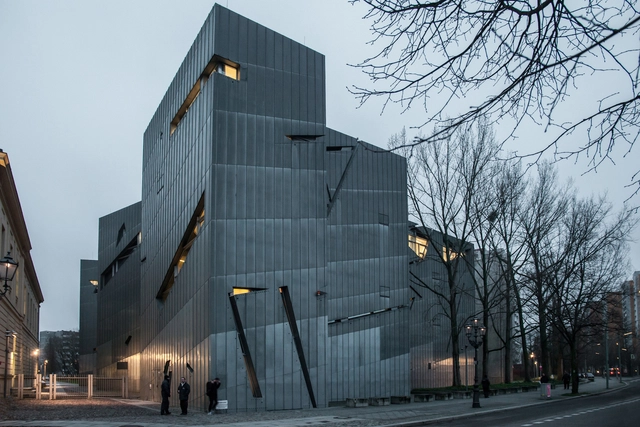
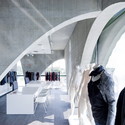
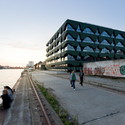
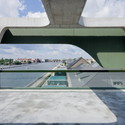
Architects: SAQ Project leader: Drew Seskunas Location: Berlin, Germany Project team: Tibor Bartholomä, Joel Dunmore Florian Lippe, Irene Per Photographs: Brice Dellastrada, Laura Gianetti


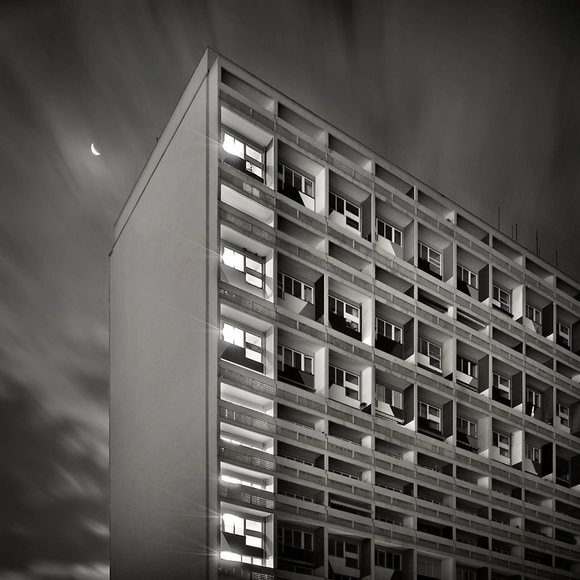
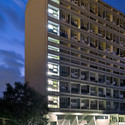
Architects: Hans Scharoun Location: Berlin, Germany Architect: Hans Scharoun References: greatbuildings.com, wikiarquitectura.com Year: 1963 Photographs: Courtesy of Wikimedia Commons, Photographs of Architecture

We see CoCities as a platform for exchange and mutual inspiration. We invite urban planners, designers, technology geeks, environmental experts, public officials, urban gardening enthusiasts and cultural influencers to be part of the conversation. We can only make our cities more livable if we work together to improve them.

ILEK at the University of Stuttgart has shared with us their winning proposal for the “Plus-Energy House with Electromobility” competition run by the German Federal Ministry of Transport. Learn more about this winning design and the ILEK after the break.
“(Driver)less is more”, BIG’s proposal for the Audi Urban Future Award was one of the five finalists of the competition won by J. Mayer H. More images and architect’s description after the break.

No other city has been as enthusiastic as Berlin in experimenting with modes of living. From mass housing to highly individualistic visions of living and extreme communal regimes, Berlin has long pushed the boundaries of what it means to live together. New organisational forms of dwelling, combined with alternative implementation methods, are currently challenging the roles of both architect and local authority in the process of delivering dwellings for the city.

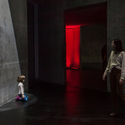
An installation designed by Raurouw (Arnd-Benedikt Willert-Klasing, Filippo Lodi, Jörg Petri, and Kyriakos Chatziparaskevas), a group of young architects experimenting with ideas of a continuously changing atmosphere, has just opened at the Program Gallery in Berlin. Entitled ‘Shock Control Regression Adaptation’, the laser-installation developed by Raurouw transforms the exhibition space into a place of continuously changing atmospheric conditions.
More about the installation, including more images after the break.
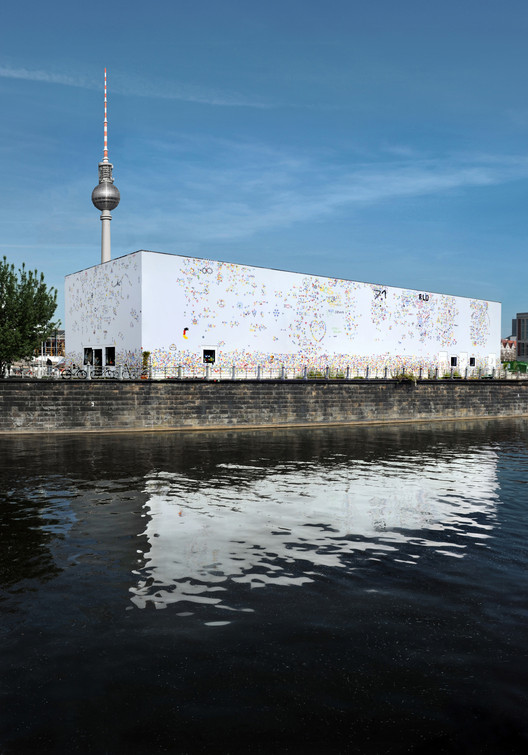
In the center of Berlin, an amazing institution known as the Temporäre Kunsthalle is a great venue for contemporary art as exhibits are housed not only within Adolf Krischanitz’s free plan interior, but also on the exterior. As each new artist brings his own personality to the building’s exterior, the 11 meter high building, which covers a ground surface of 20 by 56.25 meters, becomes the artist’s blank canvas, patiently waiting for its new treatment. The most recent exterior exhibition, autoR by Carsten Nicolai, is the third project to be realized on the façade.
More images and more about the exhibit after the break.

Each year UdK Berlin organizes a small competition among the students for the concept of a Bookshop inside the School. This year’s winning proposal for the shop was designed by Dalia Butvidaite, Leonard Steidle, Johannes Drechsler and the all participating students then helped manufacturing the structure.
Cardboard as the main material was chosen because of its flexibility in shape, stability, cheapness, temporary feeling, lightness, mobility and last but not least its recyclability.

The RE.FLECKS exhibition presents panels J. MAYER H. has derived from data-protection patterns. Developed by chance in print shops around 1900, the patterns were used as an envelope lining to protect the confidential content inside.

The Schindler Award has the goal of improving access and overall mobility for all city dwellers, irrespective of their age, status or physical capabilities. To that end, it challenges young architects to think beyond form, light and materials and to focus on the needs of the people who will eventually inhabit the structures and spaces that they design.