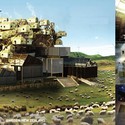
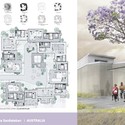
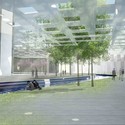
RUA shared with us their second prize winning proposal in the Ideas Competition for the Re-qualification and Redevelopment of the Beach and Seafront of Figueira da Foz and Buarcos. Their proposal is for a light concrete structure that “fly’s” over the dunes allowing for a gradual and controlled re-naturalization of the area between the existing promenade and the waterfront. More images and architects’ description after the break.
The challenge in the competition for the Amstetten School Campus was to combine two existing secondary schools in one location and complement the program with a new music school and an additional gym. With the area being characterized by an extreme heterogeneous development, with a wide range of buildings with various functions and styles, the design by Atelier Thomas Pucher, which won the first prize, is comprised of a compact five-storey cube which rises in the surroundings as a distinctive landmark. Additionally, the building is combined with two lower volumes and three courtyards, within a chessboard formation. More images and architects’ description after the break.
Mecanoo architecten, in cooperation with local partner Cafer Bozkurt Architecture, shared with us their proposal, one of the competition’s three winning proposals, in an international design competition for Yenikapı Transfer Point and Archaeo-Park Area in Istanbul, Turkey. Yenikapı, ‘New Gate’, consists in a railroad and maritime transfer centre that connects Europe with Asia, as well as the inner city with the surrounding megapolis and the rest of the country. More images and architects’ description after the break.
The Aliah Project, a hotel for a green World Cup, designed by Hiperstudio + Arkiz has been awarded as the winner of a competition organized by Aliah, a company which promotes sustainable development through practices and businesses that are profitable with a positive socio-environmental impact. A sustainable luxury hotel complex for the 2014 World Cup, their design serves as a model of sustainable architecture by disseminating innovative concepts that promote a green lifestyle. More images and architects’ description after the break.
gmp Architekten was recently awarded the first prize in the international competition to build the Culture Center in the newly created Changzhou city center. With a total floor area of 365,000 square meters, the building in this city of three million, between Wuxi and Nanjing, is six times the size of the Louvre in Paris. Reflecting elements of Changzhou’s southern Chinese culture and the city’s prominent water features, their design includes a number of museums such as an arts museum, a science and technology museum and a library, together with service facilities supporting the center for culture in the Xinbei district of the city. More images and architects’ description after the break.
The winners of the Global Holcim Awards 2012 were recently announced which asked participants to design a project for a school in Gando, Burkina Faso, a community center in Sao Paulo, Brazil, and a plan for urban renewal in Berlin, Germany. These outstanding sustainable construction projects were selected from 15 finalists by a panel of independent experts led by Enrique Norten. More images and information on the winning designs after the break.
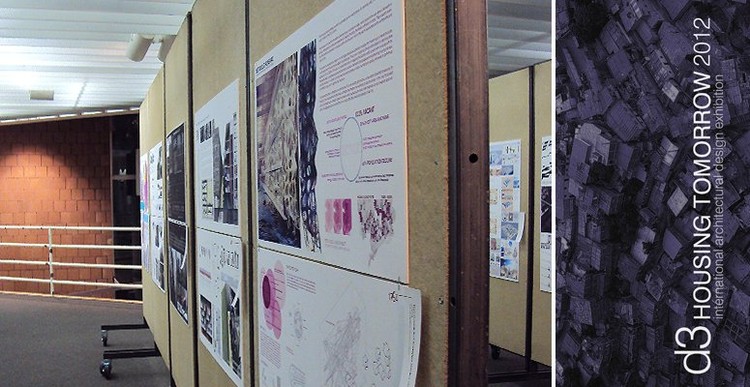
d3 is pleased to announce the winners of the 2012 Housing Tomorrow competition. The annual competition promotes the exploration of contextual, cultural, and life cycle flows that offer new housing strategies for living in the future. Sponsored by New York-based d3, the competition invites architects, designers, engineers, and students to collectively explore innovative approaches to residential urbanism, architecture, interiors, and designed objects.
d3 recognizes innovative strategies that challenge conventional housing typologies with emerging planning strategies, advanced technologies and alternative materials. Competition submissions for 2012 reflect forces of globalization and adaptation, as well as the changing nature of visualization in academia and professional design practice. As an annual competition, d3 Housing Tomorrow seeks to identify and celebrate emerging voices and visionary proposals that connect housing with people, context and ecologies.
Continue after the break to view the three winners and twelve honorable mentions selected by the jury.
Armin Valter and Joel Kopli shared with us their competition winning proposal for the Memorial of Victims of Communism in Estonia. Situated on/in northern coastal limestone cliff near town Paldiski, which was a closed military nuclear submarine base in soviet times, their design attempts to revitalize the place and bring more awareness to people of the region. More images and architects’ description after the break.
A secondary school project in Gando, Burkina Faso, a community center project in São Paulo, Brazil, and an urban renewal plan in Berlin, Germany are the winners of the Global Holcim Awards for 2012. These leading sustainable construction projects were selected from 15 finalist submissions by a jury of independent experts led by Enrique Norten. The finalists were the regional Holcim Awards 2011 winning projects that had been selected from more than 6,000 entries in 146 countries.
All 53 prize-winning projects at the regional level also competed for further prizes based on their contributions to sustainable construction through innovative building materials and construction technologies. The Global Holcim Innovation prizes conferred by a jury of materials and industry experts led by Harry Gugger went to projects in Switzerland, Germany and the United Kingdom.
Continue after the break to view the winning proposals!
Serving Guangzhou, China as a distinctive emblem of China Southern Airlines’ global leadership, the winning proposal by Woods Bagot is a bold reinterpretation of the corporate campus model. A 400-hectare, mixed-use development, the three-precinct master plan integrates business, manufacturing, residential, and cultural amenities within a comprehensive open space network that supports recreational opportunity and bolsters ecological vitality. More images and architects’ description after the break.
Rotterdam-based practice BUBE has shared with us their third-place winning proposal in the Classic Siftung Weimar international competition for the New Bauhaus Museum. Three translucent cubes are clustered together in an effort to maximize open space and reorganize the site with a focus of intensifying the interactions between park and museum visitors. BUBE’s proposal is one of the final four designs still competing. The jury is expected to announce the winning design this summer. More images and architects’ description after the break.
The Mecanoo+ Royal Haskoning design team was recently announced as the winner for the realization of the new Eurojust headquarters in The Hague, Netherlands. This design concept illustrates a strong connection with Eurojust’s neighbouring organisations, the OPCW (Organisation for the Prohibition of Chemical Weapons) and Europol. The atmosphere of soft slopes and grassy vegetation is designed to sit within the lush surroundings of The Hague’s ‘Green Heart’. More images and architects’ description after the break.
The first prize winning proposal for the Museum Nasional Indonesia by Aboday aims to bring back this massive institution to its original role as a public facility. Their design addresses the question of urban context by inserting a new corridor between the existing museum building (A) and building (B) that will maintain an openness to the pedestrian and city park on the Eastern part of the complex. More images and architects’ description after the break.
U.S. Department of Energy has announced the date and location of the 2013 Solar Decathlon. Appearing for the first time outside of Washington D.C., the highly anticipated competition will take place in 2013 from October 3rd through the 13th at the Orange County Great Park in Irvine, California. Launched in 2002, the biennial event will challenge twenty collegiate teams to design, build and operate a solar-powered house that is cost-effective, energy-efficient and attractive. Participants are judged by their ability to blend affordability, consumer appeal and design excellence with optimal energy production and maximum efficiency.
Continue reading after the break for more information and the complete list of the 2013 teams.
eVolo is pleased to announce the winners of the 2012 Skyscraper Competition. Established in 2006, the annual competition recognizes outstanding ideas that redefine skyscraper design through the use of new technologies, materials, programs, aesthetics, and spatial organizations, along with studies on globalization, flexibility, adaptability, and the digital revolution. This is also an investigation on the public and private space and the role of the individual and the collective in the creation of a dynamic and adaptive vertical community. The award seeks to discover young talent, whose ideas will change the way we understand architecture and its relationship with the natural and built environments.
Continue reading to view the 2012 winners and honorable mentions!
Space Group, based out of Oslo, Norway, recently completed the master plan for Lexington, Kentucky’s new Arena, Arts and Entertainment District. Beating out 13 other architectural firms, the 46 acre development will incorporate a basketball arena, convention center, performing arts center, school of the arts, offices, retail shops and housing. A unique aspect that was incorporated was the distinctive compactness of the existing downtown area and its proximity to residential neighborhoods. In order to accommodate predicted future growth, Space Group conceived a strategy that mirrors the footprint of the existing downtown district and projects it along an axis in line with the Rupp Arena. More info after the break.
The first prize in the DesignByMany competition for the Electric Vehicle Charging Station was recently awarded to Arcollab for their Plug + Play proposal. Their design functions as a visual meter of the substantial gap between the production and consumption of energy. This generates a renewed consciousness of energy use in our modern lives. More images and architects’ description after the break.