1. ArchDaily
  2. architecture media

architecture media: The Latest Architecture and News

Error 404: Architectural Memory in the Age of Algorithms

Before the digital turn, architecture's memory was largely tangible. It lived in the weight of drawings, the patina of models, and the thickness of books. To preserve architecture meant to preserve its traces, the documents, sketches, and photographs through which buildings could be remembered long after their material form had changed or disappeared. The modern architectural archive, as it developed in the 20th century, was both a refuge and a device of legitimacy. Institutions such as the Canadian Centre for Architecture, Casa da Arquitectura, or the Deutsches Architekturmuseum were built upon the conviction that to preserve architecture was to preserve its documents.

However, these archives didn't merely store knowledge. They determined what counted as architecture, who belonged to its canon, and how history would be told. To archive is to edit the past — to decide what enters, what is omitted, and how it will be interpreted. The archive, as theorised by Michel Foucault and later by Jacques Derrida, is never neutral; it is an instrument of power, a space that selects and excludes. In architecture, these dynamics are especially evident as they record the visible while silencing what falls outside their categories. The act of collecting has always been, implicitly, an act of judgment.

Error 404: Architectural Memory in the Age of Algorithms - Image 1 of 4Error 404: Architectural Memory in the Age of Algorithms - Image 2 of 4Error 404: Architectural Memory in the Age of Algorithms - Image 3 of 4Error 404: Architectural Memory in the Age of Algorithms - Image 4 of 4Error 404: Architectural Memory in the Age of Algorithms - More Images+ 15

AR Issues: Looking Back on 120 Years of The Architectural Review

Subscriber Access | 
AR Issues: Looking Back on 120 Years of The Architectural Review - Image 2 of 4
Courtesy of The Architectural Review

ArchDaily is continuing our partnership with The Architectural Review, bringing you short introductions to the themes of the magazine’s monthly editions. In this introduction to the December – January 2017 issue—the magazine's celebration of its 120th anniversary—Editor Christine Murray discusses the legacy that comes from more than a century being one of architecture's most respected magazines, and looks forward to the future of the publication. "Looking forward, we are committed to doing things differently – which, paradoxically, is what we’ve always done," she explains.

The archive of The Architectural Review is a great cabinet of curiosities – a cacophony of voices, styles, illustrations and photographs, Outrages and Delights, personalities and proclivities, polemics, failures and fetishes. In creating this anniversary edition celebrating 120 years of criticism, we wanted to capture the diversity and eccentricity of this ongoing architectural conversation. As such, the archive content is organized not chronologically, but in perennial themes that have echoed and evolved across the decades, from technology to education – forces that have shaped the profession.

Why 2015's Most Important Design In Architecture Isn't A Building, But A New York Times Article

Subscriber Access | 

Looking towards the uppermost floors of the new Whitney Museum of American Art, thick clouds roll diagonally across the sky behind. Reflected in the ample window of the museum’s main gallery they dash in a different direction, while the building’s white facade flashes light and dark in response to the changing light conditions. Superimposed over this scene, bold all-caps lettering pronounces the title of an article: the simple but dramatic “A New Whitney.”

This is the sight that greeted readers of Michael Kimmelman’s review of the Whitney in The New York Times last Sunday. Scroll down just a little, and the first thing you encounter is a list of credits: Jeremy Ashkenas and Alicia Desantis produced the article; graphics were contributed by Mika Gröndahl, Yuliya Parshina-Kottas and Graham Roberts; and videos by Damon Winter (the editor behind the entire endeavor, Mary Suh, is not mentioned).

Before even reading the article’s opening words, one thing is clear: this is not your average building review. As a matter of fact, it might even be the most important article in recent architectural memory.

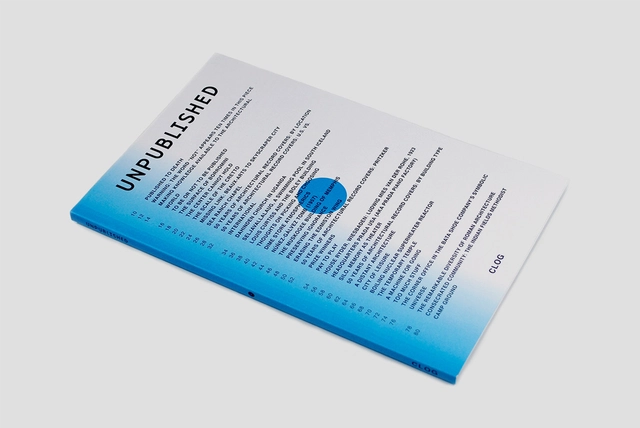
Unpublished / CLOG

Subscriber Access | 

Each edition of CLOG poses a particular challenge to the reader: by showcasing such a variety of distinct view points, teasing out the central, connective themes is far from an easy task. It requires analysis, thought, and most of all time - which is, of course, entirely the point. CLOG seeks to “slow things down” so that the greater issues of architectural discourse are mulled over and explored.

The latest CLOG, however, Unpublished, has two central points that quickly, easily emerge. Pick up CLOG: Unpublished if you want to learn two things: (1) about how and why certain publications choose the architecture they publish (ArchDaily included); or (2) about works that have, for their geographical location or problematic nature, been forgotten from the “idealized narratives” of architecture