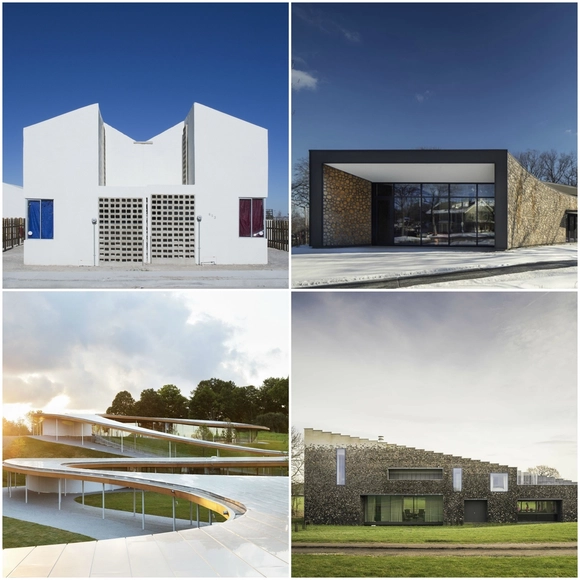
The work of an architect and urban planner can take on many forms thanks to the diverse curricular composition of most graduate courses, with subjects that deal with designing in different scales and contexts. From great urban plans to home renovations, and the metropolis to furniture design, these branches deal with different objects, however, all in common are the use of drawing and models as a tool for representation.
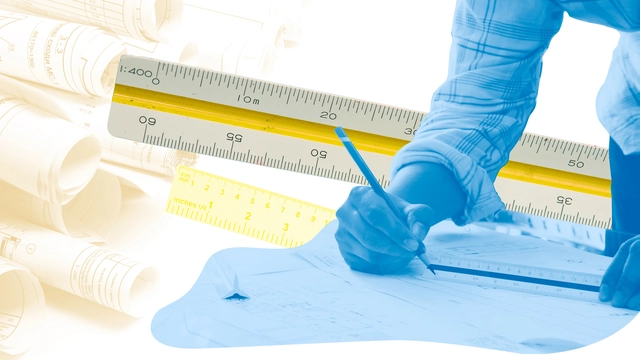
Whatever the project may be, drawing is the way to represent reality, ideas, speculations, and conceptions. Scale, a factor that establishes the level of reading one must make of these representations, determines the link between the real world and the dimensions of the drawing or model. For instance, the scale 1:1 is also known as “full size.”
At ArchDaily en Español, we recognize the need to maintain constant contact with architecture students, who will be responsible for designing and building the cities of the future. For this reason, we periodically open a call for applications to join our editorial team through our internship program.
If you currently reside in Argentina, this could be your opportunity to contribute local content to the world's most visited architecture platform, which inspires and informs hundreds of thousands of architects around the globe. If you are interested, please read on.
"True love is a span, extending infinitely, An immense monolith, our architecture." - Gilberto Gil, Drão
Just over two years ago, the Casa da Arquitectura - Portuguese Centre for Architecture began a major effort to assemble a collection of significant works from the last 90 years of Brazilian architectural history. In addition to expanding the institution's already impressive archive—which includes, among other items, hundreds of original scale models by Souto de Moura—this collection of more than eight thousand documents of Brazilian architecture will form the core of the exhibitionInfinito Vão, curated by Guilherme Wisnik and Fernando Serapião.
As marketing shifts away from its earlier, more traditional format, it’s almost unthinkable that a company solely try to reach potential clients though conventional ads. And if we’re talking about reaching architects, this is even more unimaginable.
As we’ve seen in previous articles, in addition to valuing price and quality, architects chose the products they will work with based on the technical information that they can obtain from the manufacturer. It’s of vital importance for them to understand the installation process and the product’s performance over time. In addition, they need to be able to access and reference other works of architecture that have used the same material.
https://www.archdaily.com/898592/how-to-generate-content-thats-interesting-for-architectsPola Mora
Presenting a project in a clear and convincing manner can be a major challenge—even a torment for many students. When you add high doses of caffeine, sleep deprivation, and a jury ready to evaluate your work, we can all agree that, once the moment arrives, it is impossible not to tremble inside (at best) and outside (in most cases).
For the architect, there is perhaps no greater frustration than realizing--at the end of the construction process--that the quality of the materials selected to complete the project, or the way in which said materials were installed, compromise the overall vision of the finished architecture. So it makes sense that architects are becoming more actively involved in the construction process; they understand that it can make a difference regarding their competition. Building materials manufacturers should really take advantage of the detailed-driven architect’s involvement in order to generate a productive relationship that begins way before construction starts. Manufacturers have a great role to play in the creative process.
https://www.archdaily.com/895479/the-relationship-between-architects-and-building-materials-and-productsPola Mora
In April 2018, the inaugural edition of the Provincia Festival was held, aiming to create an open forum for dialogue and the discussion of civic interest topics, with an emphasis on responsible engagement in regional architectural development.
The festival took place in the city of Tuxtla Gutiérrez in Chiapas, México—a region currently lacking high-quality urban spaces, planning, and a clear vision regarding the impact of architectural projects. Meanwhile, there is a constant drain of local talent, driven by a combination of factors that foster the belief that professional success can only be achieved through large-scale projects in major metropolises. We want to reaffirm the idea that architecture is everywhere, and that the true success of the profession lies in serving everyone, regardless of their gender, social background, or economic status.
From ceramic tiles and metal sheets for roofs to wooden decks and floating cement tiles for roofing, roofing materials not only contribute to the drainage and protect the lower layers from solar radiation and wear, but also have an important aesthetic function.
Currently, when choosing the roof covering, you can find a wide variety of materials and dimensions, each with specific characteristics, determined by the type of roofing, the location of the project, and its future maintenance.
Review a catalog of options to incorporate creatively into your designs, below.
We spoke with Griselda Balian and Gastón Noriega, members of the Argentine architecture studio BAAG —Buenos Aires Arquitectura Grupal— a team that, through its understanding of the value of collective work, aims to make an exploratory contribution to the discipline.
Over the past three weeks, we received a total of 230,000 votes from our readers to select the winners of the ArchDaily 2018 Building of the Year Awards in China. With a readership composed largely of industry professionals, voters selected the three most exemplary projects from more than 300 Chinese works published on ArchDaily.cn in 2017. As a peer-voted accolade, this recognition carries significant weight.
https://www.archdaily.com/1114625/2018-archdaily-china-building-of-the-year-awards-winners-announcedJoanna Wong
Architecture is well-known as one of the more expensive professions to study given the high costs for supplies. The fast-paced rhythm of traditional studio courses requires students to present their design ideas using drawings, diagrams, renderings, and collages—usually plotted onto paper—adding to the already high cost of creating physical models. The price tag for studying and practicing architecture is a cost that the entire profession has assumed, for better or worse.
If you aren't one of the lucky few residing in a country or state in which education is free, or in which there are significant financial aid support systems, the constant extra cost of building models and printing presentation materials has a big impact. In the best case (and only in cases in which the family is in the fortunate position to do so) parents supplement the extra money need; but in many cases, students must work while studying. What else can you do when you're expected to produce a final project or thesis that can total hundreds or even thousands of dollars to produce?
Founded in 1996 by Buenos Aires-born Martin Rein-Cano, TOPOTEK 1 has quickly developed a reputation as a multidisciplinary landscape architecture firm, focussing on the re-contextualization of objects and spaces and the interdisciplinary approaches to design, framed within contemporary cultural and societal discourse.
The award-winning Berlin-based firm has completed a range of public spaces, from sports complexes and gardens to public squares and international installations. Significant projects include the green rooftop Railway Cover in Munich, Zurich’s hybrid Heerenschürli Sports Complex and the German Embassy in Warsaw. The firm has also recently completed the Schöningen Spears Research and Recreation Centre near Hannover, working with contrasting typologies of the open meadow and the dense forest on a historic site.
https://www.archdaily.com/871052/topotek-1-s-martin-rein-cano-on-superkilens-translation-of-cultural-objectsOsman Bari
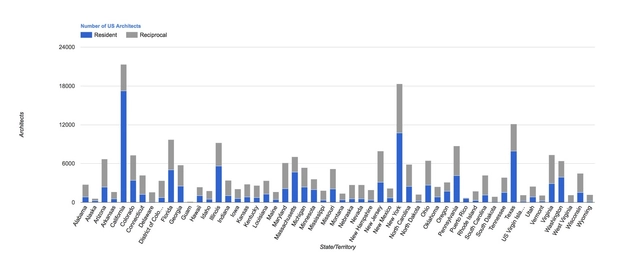
As architects around the country gather for the 2017 AIA Convention in Orlando, the National Council of Architectural Registration Boards (NCARB) has decided to share some initial results from their 2016 nationwide Survey of Architectural Registration, specifically, the number of architects licensed in each state.
The data tracks both the number of resident licenses and reciprocal licenses (licenses for a particular state held by a resident of another state). The 2016 survey found that the number of architects working in the US has held steady, and that architects are working across state lines more than ever before. While the total number architects dropped slightly from the previous year (0.4 percent) to 109,748, the number out-of-state licenses grew a full 3 percent to 126,554.
A feature Instagram users have spent years longing for is finally here: Zoom. Just released today, the update to the iOS app finally will allow you to pinch to zoom in on photos and videos, just like you can in most photo viewing apps (no more screenshotting necessary!). This means you can now get a closer look at the architectural details of your favorite buildings on Instagram, from doorways to moldings to joints. Though be warned, just because you can make it bigger doesn’t mean it will necessarily be clearer - Instagram still will only support images 1080 pixels wide.
On this day twenty-five years ago Tim Berners-Lee launched the “World Wide Web” protocol at CERN in Switzerland, ushering in the age of the Internet. Over the last two decades this global information network has rapidly evolved, increasingly influencing how architecture is conceived, produced, discussed and ultimately implemented in real space.
https://www.archdaily.com/793914/internet-25-years-old-why-we-are-celebrating-today-why-all-architects-should-tooAD Editorial Team
This edition of Section D, Monocle 24's weekly review of design, architecture and craft turns its editorial gaze back to their "own turf" to consider ways in which publications cover design and architecture, both in print and online. The episode asks whether "traditional magazines are as influential as they used to be," and whether or not "clicks and online-only articles can actually pay the bills?" In search of answers, Monocle's Henry-Rees Sheridan talks to ArchDaily's co-founder and Editor-in-Chief, David Basulto, along with European Editor-at-Large James Taylor-Foster, about the origins of the platform – and more.
https://www.archdaily.com/786281/monocle-24-asks-how-do-you-cover-architecture-and-design-archdaily-david-basulto-james-taylor-fosterAD Editorial Team
Eleven women are being considered for the Moira Gemmill Prize for Emerging Architecture prize for their "use of innovative architecture to effect positive social change." Read on to see them all.

.jpg?1540844392&format=webp&width=230&height=230&crop=true)




_17.41.00_1.jpg?1526683290&format=webp&width=640&height=580)




.gif?1472762798)