We will be publishing Nikos Salingaros’ book, Unified Architectural Theory, in a series of installments, making it digitally, freely available for students and architects around the world. In the following chapter, Salingaros continues his discussion of Christopher Alexander's “Mirror of the Self” test introduced in Chapter 9A, and revealing how it can be used to provide all-important feedback to enable evidence-based design. If you missed them, make sure to read the previous installments here.
Evidence-based design is now fast becoming a standard tool used in school design. (See Peter C. Lippman: “Evidence-Based Design of Elementary and Secondary Schools”, 2010). And yet its current application, while laudable, is missing the other key components necessary for adaptive design: Biophilia, Intelligence in the environment (two topics discussed in this book), and Pattern Language. All of these have to work together to give optimal design results.
Evidence-based design permits an architect to evaluate a design, and variations of that design, to see if they contribute to human wellbeing. This makes possible informed choices that push and guide a design towards a more adaptive final form. We know the result is going to be more adaptive since we check each intermediate stage of an evolving design.
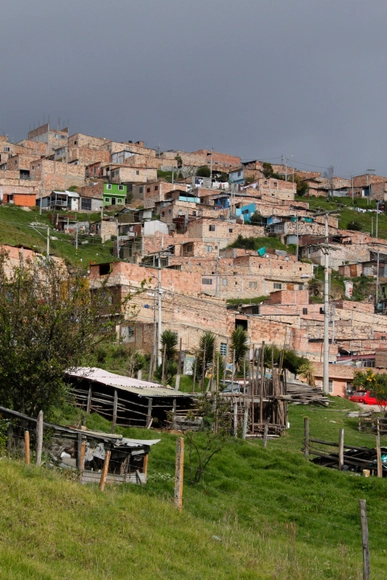
Perched behind the fog that conceals Bogotá’s mountains is William Oquendo’s house. It is a labyrinth of doors and windows, wherein a bedroom opens into the kitchen and a bathroom vents out into the living room.
Five thousand 5,000 kilometers away in Rio de Janeiro, Gilson Fumaça lives on the terrace level of a three-story house built by his grandfather, his father, and now himself. It’s sturdy; made out of brick and mortar on the ground floor, concrete on the second, and a haphazard combination of zinc roof tiles and loose bricks on the third. The last is Gilson’s contribution, which he will improve as his income level rises.
On the other side of the world in Bombay (Mumbai since 1995), houses encroach on the railway tracks, built and rebuilt after innumerable demolition efforts. “The physical landscape of the city is in perpetual motion,” Suketu Mehta observes in ‘Maximum City.’ Shacks are built out of bamboo sticks and plastic bags; families live on sidewalks and under flyovers in precarious homes constructed with their hands. And while Dharavi—reportedly the largest slum in Asia—has better quality housing, running water, electricity and secure land tenure, this is not the case for most of the new migrants into the city.