Construction alone accounts for more than 30% of the world’s greenhouse gas emissions and must now be reinvented to meet the ecological, economic and societal challenges of doing better with less, reducing its environmental footprint, limit the consumption of natural resources; build more responsibly and sustainably.
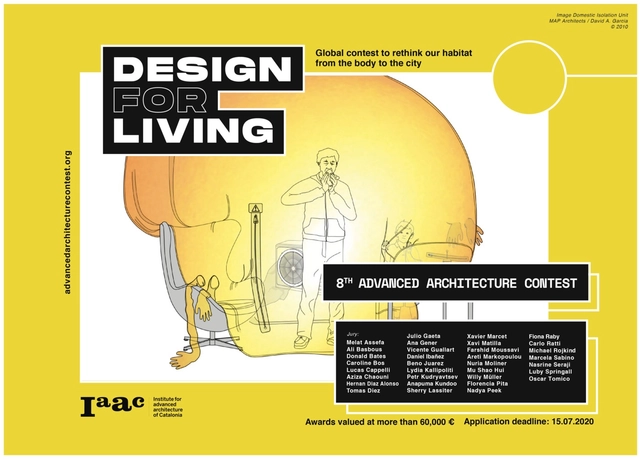
The Institute for Advanced Architecture of Catalonia (IAAC) calls its 8th Advanced Architecture Contest as a global reflection to rethink human habitats, at a time when the fight for life and climate allows us to consider how we would like to live in the coming decades.
The Intimate City hosts Dining in the Urban, a design competition that offers the opportunity to explore domestic rituals in Skopje's public realm. The brief uses the knowledge gained from domestic rituals to expose the current social and physical forms, unveiling the boundaries between the public, communal, and private within the city. Aiming to reveal social and physical latency the brief is an experiment that acknowledges form as a social commitment in order to mediate the tension in the city.
CANactions School launches the Call for Papers for CANactions Magazine Edition 02 'ЗЕМЛЯ І THE LAND'. It is meant to explore "LAND" and its inhabitants to collect and share with the world the most actual and relevant portrait of contemporary post-socialist states countryside.
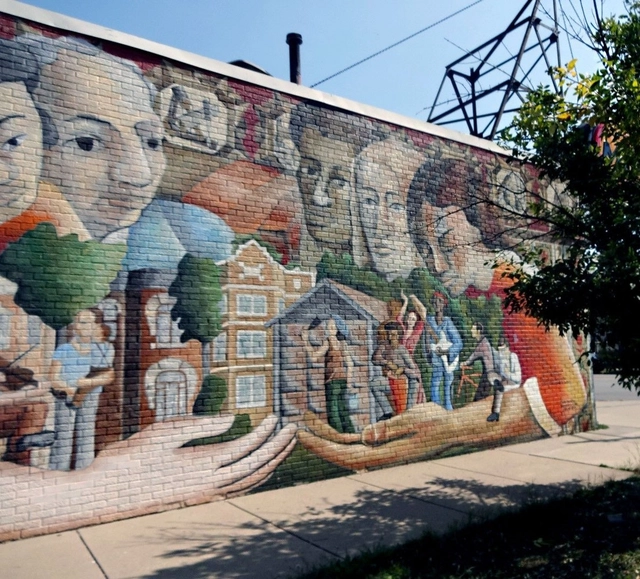
Due to the Great Chicago Fire of 1871, Chicago’s public art legacy is younger than Boston’s or New York City’s. Its vast collection of public art, however, is star-studded, widely varied, endlessly interesting—and still growing. CAC docent Ed McDevitt leads this engaging introduction to some of Chicago’s greatest public art treasures.
The recent COVID-19 pandemic has had a significant effect on higher education institutions and in particular delivery of design and architectural education. The co-presence of educators and students and creating affordances for physical and material spatial experiences, as well as collaborative work, has long been at the heart of architectural education and its studio culture. This issue aims to capture the imminent changes that this pandemic promises and provide a platform for sharing pedagogic experiences, practices and perspectives for the future of architectural education.
Contribute to the society as architectural designers during COVID-19 isolation period.
We are launching this special ISO[NATION] competition to raise funds and to save lives during the outbreak of pandemic COVID-19. A small donation will be required to enter this competition and they will be donated towards the World Health Organization COVID-19 Solidarity Response Fund.
The aesthetics of care environments carry huge potential to induce wellbeing, enhance the quality of life and, thereby, affect the healing and rehabilitation of patients and residents. This book applies experimental Q methodology – a qualitative method for systematically analysing human subjectivity – in search of a new approach to evaluating care environments.
LOOP Design Awards launches the first edition of its prize in 2020!
LOOP is an open platform to creativity and talent, where all the designers may showcase their best projects, giving them great visibility around the world. We want to celebrate and honor diversity with remarkable projects globally.
Quelle Architecture has recently launched a participatory study open to all on the impact of the containment we are experiencing. This study would be a collection of ideas, drawings, texts, models..., making it possible to show how everyone imagines their future home or the ideal dwelling in which to live through their confinement. To do this, we propose two models that can be used: a building or a housing unit. All proposals are welcome, from the most utopian to the most realistic.
How has the quest for Utopia shaped American cities? Join urban planner and professor Alex Krieger as he explores the dreams and ideals that have long influenced our urban settlements, as told in his new book, “City on a Hill.”
EU-wide, open architectural competition for “Campus of Religions” launched in Vienna.
A joint major project of eight religious communities in Vienna’s aspern Seestadt, one of Europe’s largest urban development areas
The ”Campus of the Religions”, an interfaith center and international model project, will play a special role in Vienna’s social life. The competition launched on April 17th aims at finding architectural solutions for the buildings for worship/religious services of the eight participating communities, for the University College of Christian Churches for Teacher Education KPH, shared and open spaces. The Campus construction site covers approx. 10,000 m² near aspern’s lakeside.
The spread of the new Coronavirus SARS-CoV-2 is forcing to change rapidly our lives, and this pandemic scenario won’t last for a little time. Gideon Lichfield in his article in the MIT Technology Review state that this situation will probably last for 18 months. Many scientists, moreover, are convinced that this is just the first of many pandemics that we will face in the next future.
The space that hosts the project is currently a 9 holes golf course. Our wish is to turn it into a verdant, fragrant garden where rosemary and thyme give golfers and non-golfers alike an opportunity to nourish their body and mind. Creating this mesmerizing atmosphere will be made possible by planting one million rosemarie and thyme bushes around the golf area.
The 47th Nisshin Kogyo Architectural Design Competition
“Play” meaning in various ways, including playing like an infant, having fun with friends, indulging in drinks or gambling, taking breaks between work and study, having the leeway to things, seeking beauty in literature and art isolated from the secular world, and giving space to machinery part connection. In any case, it is like a source to life, an act full of humanity contrary to pursuing functionality and rationality.





![#mOOO3 Iso[nation]: Home Office (Fundraising For Covid-19 Response Fund) - Featured Image](https://snoopy.archdaily.com/images/archdaily/media/images/5ea6/a470/b357/653a/fd00/00ca/slideshow/open-uri20200427-28383-q8brb0.jpg?1587979362&format=webp&width=640&height=580)