1. ArchDaily
  2. Theory and History

Theory and History: The Latest Architecture and News

Subscriber Access

The End of Critique: Baubles on Pedestals

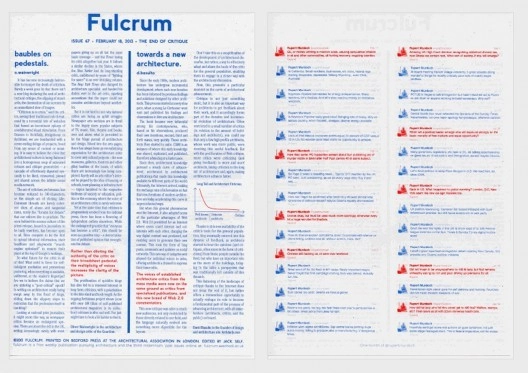
The following article by Oliver “Olly” Wainwright (Architecture and design critic at The Guardian) was featured on Fulcrum #67 “The End of Critique”, which also included an article by ArchDaily's co-founder and Editor-in-Chief, David Basulto.

Baubles on Pedestals

It has become increasingly fashionable to trumpet the death of criticism. Barely a week goes by that there isn’t a new blog declaring the end of architectural critique, the slipping of standards, the domination of our screens by an unmediated slew of images.

“Criticism is in crisis,” wail the critics, seeing their traditional role threatened by a torrential tide of websites that funnel an incontinent splurge of unadulterated visual stimulation. From Dezeen to ArchDaily, Designboom to Architizer, we are bombarded with a never-ending deluge of projects, freed from any sense of context or meaning. It is easy to believe the cries that architectural culture is being flattened into a homogenous soup of saturated colours and oblique geometries – a cascade of effortlessly digested eye-candy to be liked, retweeted, pinned and shared across the infinite social media network.

Subscriber Access

The End of Critique: Towards a New Architecture

The End of Critique: Towards a New Architecture - Image 1 of 4
Fulcrum #67

The following article was featured on Fulcrum #67 "The End of Critique" and includes texts by Oliver "Olly" Wainwright (Architecture critic at The Guardian) and me, David Basulto (Founder and Editor in Chief of ArchDaily). Thanks to Jack Self for the invitation and for his thorough editing.

Towards a new architecture

Since the early 1900s, modern architecture has undergone incremental development, where each new iteration has been informed by previous findings and solutions designed by other architects. This process started at a very slow pace, when a young Le Corbusier went east and published his findings and observations in Vers une Architecture.

The book became very influential among his contemporaries, who, based on his observations, produced their own iterations, second, third and forth waves, very quickly. These architects then started to unite. CIAM is an instance of where this early knowledge was shared, replicated, and published, therefore advancing at a faster pace.

Since then, architectural knowledge pursued a steady curve of advancement, accelerated by architectural publications that made this knowledge available to different parts of the world. Ultimately, the Internet arrived, making the exchange rate of information so fast that new iterations of modern architecture are today accelerating this curve in unprecedented ways.

Subscriber Access

TEDx: Fracture-Critical Design / Tom Fisher

Thomas Fisher, Professor in the School of Architecture and Dean of the College of Design at the University of Minnesota, discusses the subject matter of his most recent book, Designing To Avoid Disaster: The Nature of Fracture-Critical Design.

Subscriber Access

Video: Wang Shu, “Geometry and Narrative of Natural Form”

Founder of Amateur Architecture Studio and Head of Architecture at the China Academy of Art, Wang Shu was the first Chinese architect to hold Harvards Graduate School of Design (GSD) Kenzo Tange professorship. The Harvard lecture honors architect Kenzo Tange by bringing distinguished architects from around the globe to the GSD.

Subscriber Access

Video: Culture of Craft / AIA Committee On Design

The experts at studio/216 have shared with us the Culture of Craft – a pilot for an AIA Committee On Design (COD) series about The Value of Design. The non-profit AIA committee spent this past year discussing this topic, hosting two conferences in Seattle and Japan. In this film, architects Tom Kundig FAIA, Bob Hull FAIA, Annie Han, Prentis Hale and Roy McMakin discuss the value of craft and design in theory and in practice.

Subscriber Access

Bernhard Leitner: Sound Spaces

Bernhard Leitner: Sound Spaces - Image 49 of 4
© Bernhard Leitner

“I can hear with my knee better than with my calves.” This statement made by Bernhard Leitner, which initially seems absurd, can be explained in light of an interest that he still pursues today with unbroken passion and meticulousness: the study of the relationship between sound, space, and body. Since the late 1960s, Bernhard Leitner has been working in the realm between architecture, sculpture, and music, conceiving of sounds as constructive material, as architectural elements that allow a space to emerge. Sounds move with various speeds through a space, they rise and fall, resonate back and forth, and bridge dynamic, constantly changing spatial bodies within the static limits of the architectural framework. Idiosyncratic spaces emerge that cannot be fixed visually and are impossible to survey from the outside, audible spaces that can be felt with the entire body. Leitner speaks of “corporeal” hearing, whereby acoustic perception not only takes place by way of the ears, but through the entire body, and each part of the body can hear differently.

- George Kargl, Fine Arts Vienna

Bernhard Leitner: Sound Spaces - Image 50 of 4Bernhard Leitner: Sound Spaces - Image 51 of 4Bernhard Leitner: Sound Spaces - Image 52 of 4Bernhard Leitner: Sound Spaces - Image 53 of 4Bernhard Leitner: Sound Spaces - More Images+ 98

Subscriber Access

Paolo Soleri's Bridge Design Collection: Connecting Metaphor

Paolo Soleri's Bridge Design Collection: Connecting Metaphor   - Image 21 of 4
© Cosanti Foundation

“Of all things that are man-made, bridges are, with dams, the most “structural,” single-minded, and imposing. As connectors at a breaking point, they have a heroic force that is aided by a challenging structuralism. As a strand of continuity in a non-continuum, the bridge is full of implied meanings. It is the opposite of devisiveness, separation, isolation, irretrievability, loss, segregation, abandonment. To bridge is as cogent in the psychic realm as it is in the physical world. The bridge is a symbol of confidence and trust. It is a communications medium as much as a connector.”

-Paolo Soleri, 1970, from “The Sketchbooks of Paolo Soleri”, published by MIT Press, 1971

Subscriber Access

Video: Ole Bouman, "Broadcasting Architecture"

In this earnest and insightful video, NAi director Ole Bouman lectures on our shared need to “celebrate architecture’s glory.” The lecture was recorded in June 2011 at the International Architecture Festival (“FESTARCH“).

Subscriber Access

The Decaying Dutch Harbor Bunkers

The Decaying Dutch Harbor Bunkers  - Featured Image
© Tom Doyle

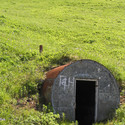
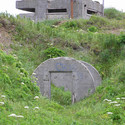
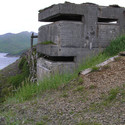
Set against a backdrop typically reserved for postcards, the decaying bunkers of the Aleutian Islands Campaign serve to memorialize a little-known chapter of WWII lore. Read more about these distinctive relics after the break.

The Decaying Dutch Harbor Bunkers  - Image 4 of 4The Decaying Dutch Harbor Bunkers  - Image 6 of 4The Decaying Dutch Harbor Bunkers  - Image 1 of 4The Decaying Dutch Harbor Bunkers  - Image 8 of 4The Decaying Dutch Harbor Bunkers  - More Images+ 5

Subscriber Access

Venice: City in Peril

Venice: City in Peril - Image 7 of 4
Photo by Tambako the Jaguar - http://www.flickr.com/photos/tambako/. Used under Creative Commons

Venice is commonly regarded as one of the wonders of the world, attracting over 17 million tourists each year. However, the city of Venice faces ongoing problems that threaten its ability to stay above water. The city’s flooding issues are notorious around the world. Every year water surges through its legendary labyrinth of streets wreaking havoc on architectural gems such as the Palazzo San Marco. With its architecture under threat, and dwindling population as many young people flock to the mainland, it is appropriate to think of Venice as a dying relic.

Subscriber Access

O’ Mighty Green / STAR strategies + architecture

O’ Mighty Green / STAR strategies + architecture - Image 2 of 4
Sustainable Cenotaph for Isaac Newton – Boullée, 1784: © STAR strategies + architecture, 2011

The Rotterdam based design team STAR strategies + architecture has shared with us their recent project, O’ Mighty Green, a critical piece about Green – washing and especially about the abuse of “Green” in architecture. Additional images and text can be seen after the break.

Subscriber Access

Mercier House, Lausanne

Mercier House, Lausanne - Image 3 of 4

Architects: Francis Isoz Location: Rue du Grand Chêne 8, Lausanne, Switzerland Project Year: 1898-1900 Client: Jean-Jacques Mercier