Learning doesn't have to formal, or expensive. As education becomes increasingly commodified the world over, here are four courses from the Massachusetts Institute of Technology (MIT) exploring architecture and landscape, urbanism, photography, and the production of space that are—significantly—free of charge and available to all.
https://www.archdaily.com/881570/4-mit-architecture-courses-you-can-take-online-video-lectures-includedAD Editorial Team
Two large-scale US cultural projects have, this week, announced major updates relating to the renovation of existing buildings – and both involve, to a greater and lesser extent, American business magnate, media mogul, and philanthropist David Geffen.
This article was originally published on the blog of the Chicago Architecture Biennial, the largest platform for contemporary architecture in North America. The 2017 Biennial, entitled Make New History, will be free and open to the public between September 16, 2017 and January 6, 2018.
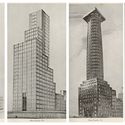
The Tribune Tower has stood at the heart of Chicago’s cultural heritage for almost a hundred years. Like the spire of a secular cathedral, it still symbolizes the rise of the “city of big shoulders” and its defining role in the American Century. But the building is more than a Chicago icon. The story of its origin has proved to be one of the most enduringly influential narratives in 20th Century architecture, key to understanding the skylines of cities all over the world.
On the ground floor of the Chicago Cultural Center, Labyrinth—a cluster of installations and exhibitions occupying a warren of rooms as part the 2017 Chicago Architecture Biennial—serves as the visitor's introduction to participants' responses to the theme, Make New History. In this short film, architects including Jürgen Mayer H., Freek Persyn (51N4E) and Philip F. Huan (Archi-Union) present their projects and reflect on their work, process, and involvement in North America's largest architectural event.
https://www.archdaily.com/880467/a-labyrinth-of-projects-at-2017-chicago-architecture-biennial-demonstrate-novel-approaches-to-design-and-citiesAD Editorial Team
"We are at a moment of great cultural transition," Jorge Otero-Pailos argues. "The kinds of objects that we look to to provide some sort of continuity in that transformation is often times architecture, [...] one of the most stable objects in culture." This short film, in which an number of participants of the 2017 Chicago Architecture Biennial reflect on their work and those of others, tackles the theme conceived by artistic directors Sharon Johnston and Mark Lee: Make New History.
https://www.archdaily.com/880402/how-architects-in-chicago-architecture-biennial-2017-are-making-new-historyAD Editorial Team
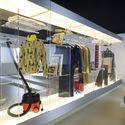
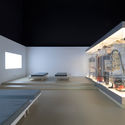
Their challenge was in considering the forms and ways that their selection "might extrapolate out from the cropped photographic frame into a spatial and lifestyle construction across a larger, horizontal site" – in this case, a field of plinths, the size and positioning of which is a direct reference to the footprint of Mies van der Rohe's 1947 plan for the IIT Campus in Chicago.
https://www.archdaily.com/880306/in-horizontal-city-24-architects-reconsider-architectural-interiors-at-2017-chicago-architecture-biennialAD Editorial Team
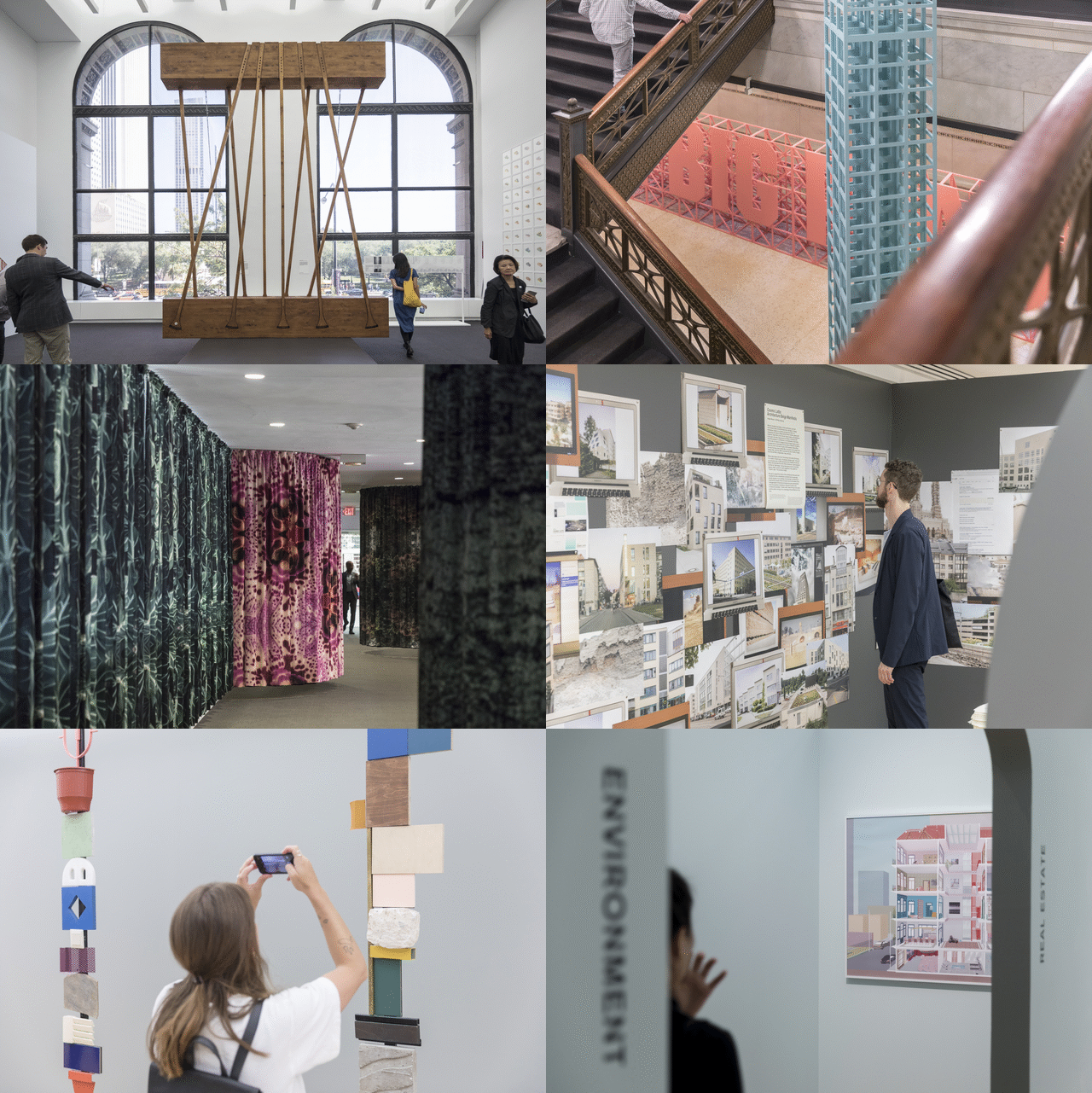
With the 2017 Chicago Architecture Biennial in full swing and open to the public until January 7, 2017, we've scoured the galleries, halls and corridors of the Chicago Cultural Center to bring you our favorite fifteen installations. Documented through the lens of Laurian Ghinitoiu and assembled by our Editorial Team on location, this selection intends to shed light on the breadth, scope and preoccupations of Make New History– the largest architecture event in North America.
Understanding the trace of history is more important than ever. Maybe now it's a good time to take stock and reevaluate to see what architecture could do better, and there are certain issues that other disciplines address better than architecture itself.
https://www.archdaily.com/879750/curators-johnston-marklee-introduce-the-2017-chicago-architecture-biennial-make-new-historyAD Editorial Team
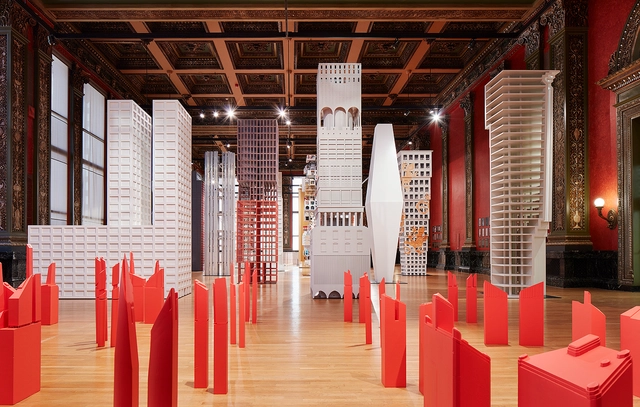
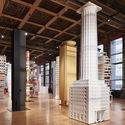
In a large-scale, central installation at the 2017 Chicago Architecture Biennial, the likes of 6a architects, Barozzi Veiga, Kéré Architecture, MOS, OFFICE KGDVS, and Sergison Bates—among others—have designed and constructed sixteen five meter-tall contemporary iterations of the renowned 1922 Chicago Tribune Tower design contest.
https://www.archdaily.com/879715/in-vertical-city-16-contemporary-architects-reinterpret-the-tribune-tower-at-2017-chicago-architecture-biennialAD Editorial Team
Today SO-IL, in collaboration with Ana Prvački, debuted L’air pour air on the occasion of the press preview of the second edition of the Chicago Architecture Biennial. The performance explores the art of performing behind a filter in an age where many cities suffer from the environmental impact of human habitation. Described as "part installation and part musical performance," the creators have drawn inspiration from abundant plant life and the interconnectedness of people and nature.
https://www.archdaily.com/879646/so-il-with-ana-prvacki-debut-musical-spatial-performance-at-2017-chicago-architecture-biennialAD Editorial Team
Ahead of the official launch of the Steve Jobs Theater, a 1000-capacity auditorium at the heart of the new Apple Campus in Cupertino, California, new details about its design and construction have been revealed. According to Bloomberg, the entrance to the venue stands beneath “a silver disc,” whose supporting—and structural—glazed panels lend it the appearance of floating 20 feet above ground.
https://www.archdaily.com/879278/apples-steve-jobs-theater-set-to-take-center-stage-ahead-of-new-product-launchAD Editorial Team
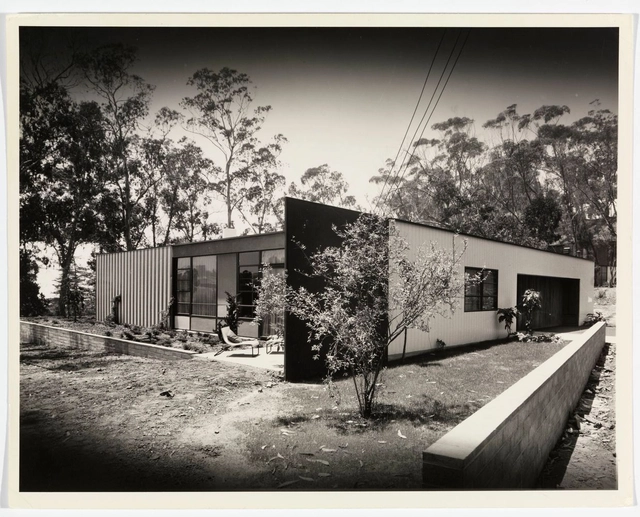
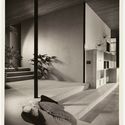
Nestled in the verdant seaside hills of the Pacific Palisades in southern California, the Entenza House is the ninth of the famous Case Study Houses built between 1945 and 1962. With a vast, open-plan living room that connects to the backyard through floor-to-ceiling glass sliding doors, the house brings its natural surroundings into a metal Modernist box, allowing the two to coexist as one harmonious space.
Like its peers in the Case Study Program, the house was designed not only to serve as a comfortable and functional residence, but to showcase how modular steel construction could be used to create low-cost housing for a society still recovering from the the Second World War. The man responsible for initiating the program was John Entenza, Editor of the magazine Arts and Architecture. The result was a series of minimalist homes that employed steel frames and open plans to reflect the more casual and independent way of life that had arisen in the automotive age.[1]
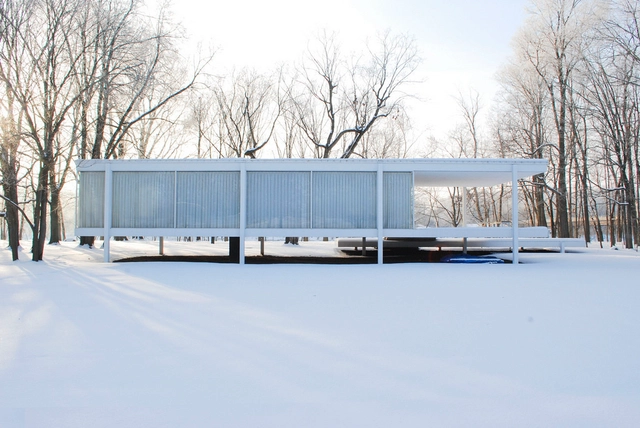
Farnsworth House. Image Courtesy of Flickr CC user Jonathan Rieke. (Licensed under CC BY-NC 2.0)
The Chicago Architecture Biennial and it's artistic directors, Johnston Marklee, have revealed a collection of Special Projects designed to harness the curatorial vision of the event—entitled Make New History—and bring it to a number of significant landmarks in the city and in it's surrounding area. Featuring a SO-IL and Ana Prvački collaboration, a Francois Perrin installation, a new performance artwork by Gerard & Kelly at the Farnsworth House, photographs by James Welling, and films by Gerard & Kelly, the projects will inhabit some Chicago's greatest "architectural gems."
https://www.archdaily.com/876117/chicago-architecture-biennial-special-projects-to-inhabit-a-series-of-architectural-landmarksAD Editorial Team
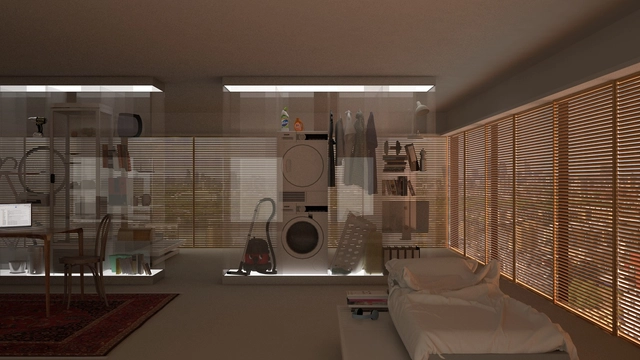
Interior design by REAL Foundation for Common Stock: Sharing as Luxury, the fourth tower in the Derivative Architecture series. Image Courtesy of Real Foundation
The Chicago Architecture Biennial is the largest platform for contemporary architecture in North America, and the blog invites designers and other contributors to express their perspectives in a range of formats. The 2017 exhibition, entitled Make New History, will be free and open to the public between September 16, 2017 and January 6, 2018.
Chicago Architecture Biennial (CAB): We want to start by noting that REAL foundation, which stands for "Real Estate Architecture Laboratory," is not a typical design practice. You design spaces, but you also make books, exhibitions, a magazine, and tools for advocacy. Why?
Jack Self (JS): The REAL foundation is an unusual model for an architectural firm. We're a normal architectural practice, but we are governed by a very strict set of conditions that allow us to pursue certain political and economic ideologies. We see the social role of the architect, as well as the structure of the architectural firm, as a subject for design as much as buildings.
New footage from drone videographer Duncan Sinfield reveals that finishing touches are being applied to one of the Apple Campus's more important outward-facing buildings, and perhaps its most 'public' – the "Steve Jobs Theater". Designed and constructed using similar elements to the nearby office 'ring'—including large convex glazed panels and precise, rounded cladding panels—the theater's main function will be to host the company's world-renowned keynote addresses, in which they present new products.
https://www.archdaily.com/874648/new-drone-footage-captures-finishing-touches-being-applied-to-apples-steve-jobs-theaterAD Editorial Team
In the tenth episode of GSAPP Conversations, Jorge Otero-Pailos (Director of the Historic Preservation Program at Columbia GSAPP) speaks with Francine Houben, founder and creative director of the Dutch practice Mecanoo. Recorded before the school's annual Paul S. Byard Memorial Lecture, their conversation centers on her practice's work to renovate and redevelop the Martin Luther King Jr. Memorial Library in Washington D.C., Mies van der Rohe's last building and only library project.
https://www.archdaily.com/874332/francine-houben-mecanoo-on-washington-dc-central-library-a-balancing-act-between-mies-van-der-rohe-martin-luther-king-jrAD Editorial Team
This article was originally published on the blog of the Chicago Architecture Biennial, the largest platform for contemporary architecture in North America. The blog invites designers, writers and other contributors to independently express their perspectives on the Biennial across a range of formats. The 2017 Biennial, entitled Make New History, will be free and open to the public between September 16, 2017 and January 6, 2018.
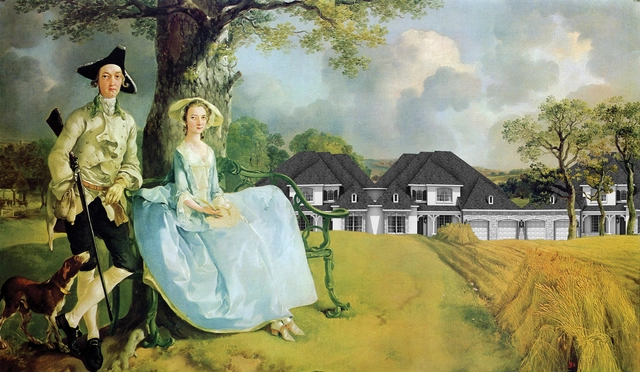
Some works of architectural writing can be taken at face value as stark manifestos for a new aesthetic. Keith Krumwiede’s Atlas of Another America is, instead, a constantly unfurling satire that offers layers upon layers of artfully imagined social commentary. Like McMansion Hell, my own long-form satirical project, Krumwiede’s “architectural fiction" sends up American ideas about economics, politics, and culture by picking apart our outrageous suburban housing types. The project will be on display at the Chicago Architecture Biennial this fall, delivering a sardonic vision of American architecture that comes out of academic theory, but has a potent message for anyone who has spent time in suburbia.