1. ArchDaily
  2. Architecture Essays

Architecture Essays: The Latest Architecture and News

From Facades to Floor Plates & Form: The Evolution of Herzog & de Meuron

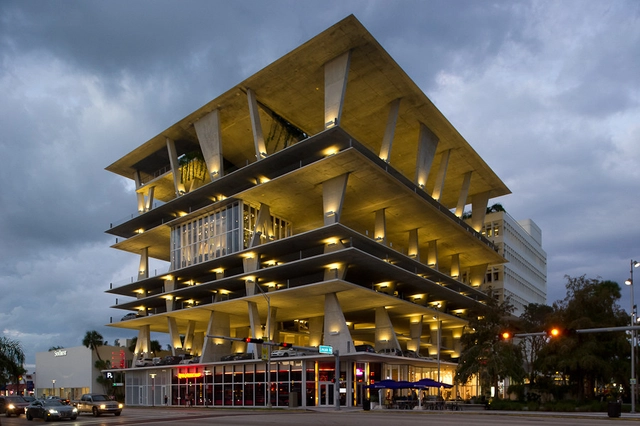
The following is an essay that originally appeared in Australian Design Review as "Beyond the Wall, the Floor." In it, Michael Holt and Marissa Looby describe the evolution of Herzog and de Meuron's work. Using numerous examples of recent projects (such as VitraHaus and 56 Leonard Street), they point out that Herzog and de Meuron have, increasingly, relied on the floor slabs of their buildings to suggest the building’s shape. By removing the façade’s prominence in favor of a more suggestive way of creating mass, they have turned their original design signature on its head.

Simple adjustments, slight alterations, subtle illusions. These are not tagline descriptions of the 1111 Lincoln Road, Miami Beach project, or a synopsis for a body of work. Instead they operate as retroactively projecting the course of professional development in the works of Swiss architects Herzog & de Meuron. The practice is known, from its earliest built projects, as a firm who produced artistically driven facade treatments where the vertical plane — the ‘nominal façade’ — would define form through the visually stimulating surface or skin. As the practice has evolved, it is argued here, they have crafted a new strategy: the horizontal plane as vertical facade generator.

In its progression the practice has deviated from facade ornamentation and fabrication towards the removal of the facade altogether; allowing for the floor plate — as a visual element — to operate as inadvertent facade and thus doubling its structural and visual importance. The placing of floor plates becomes the force creating the form – the ‘inverted structural skin’The stripped back architectural form does not remove the facade, but removes the idea of a facade, paradoxically creating a building mass almost by default.

The Indicator: Where the Migrant Workers Are

Subscriber Access | 

Zaha Hadid’s unfortunate comments in response to worker deaths on construction sites for the 2022 World Cup has made Qatar the eye of a storm that has been raging globally for decades. But it’s not just about Qatar. This has been an issue for as long as there have been construction sites and for as long as poor people have swarmed to them for a chance at a better life.

Construction booms and migrant construction workers have always been two sides of the same equation, both dependent on the other, and, by the twisted logic of the global economy, both are the reason for the other’s existence. No migrant labor pool = no global city = no fantastic architecture, or something to this effect. 

The migrant workers are the silent collaborators in global architecture, the invisible, faceless, “untouchables” who make the cost-effective construction of these buildings possible.

Hadid's Response to Worker Deaths: Tone-Deaf But True

This article, by Martin Pedersen, originally appeared on Metropolis Magazine as "Governments, Not Architects, Should Shoulder Responsibility for Worker Deaths, Says Hadid."

Zaha Hadid set off a mini-shitstorm [the other day] when she declared that architects have “nothing to do with the workers” who have died on construction sites in Qatar, site of the World Cup in 2022. The Guardian had reported that nearly 900 workers had died in the past two years building the infrastructure required for the massive event. One of the projects under construction is Hadid’s Al-Wakrah stadium (above), a swoopy, curvilinear 40,000 seat facility that some critics likened to a vagina when the scheme was unveiled to the public. “It’s not my duty as an architect to look at it,” Hadid said, on the worker deaths. “I cannot do anything about it because I have no power to do anything about it. I think it’s a problem anywhere in the world. But, as I said, I think there are discrepancies all over the world.”

Her tone-deaf comments elicited a firestorm of predictable outrage, but I’d contend they had a near-truth about them. As I see it, Hadid had four possible courses of action, all of them limited in scope.