Archifest is back in October, as a bigger, better and more inclusive celebration of great design. With over 100 events spread out across the island and online, the month-long Architecture Festival - organised by the Singapore Institute of Architects (SIA) - promises to have something for everyone, appealing both to architecture enthusiasts, and to the general public.
Architecture performs through bodies. Its conceptualization entails choreographing bodily movements. Drawings are spatial scripts, to which bodies perform in conformity, transgression, re-appropriation, or indifference. Performances can be corporeal or phenomenological, planned or spontaneous, everyday or a singularity. They charge architecture with vibrant energies disrupting the exigencies and politics of built spaces. The 10th issue of Room One Thousand, “Body + Performance,” seeks for performance to expand and challenge our understanding of architecture and its impact. Performance can be understood as an object, phenomenon, commodity, or metaphor. The convergence of architecture and performance captures the corporeality, tactility, and sensuality of a space. How can architecture be read through the lens of performance? Who is the performer, the building or the body? What are the design implications of highlighting the agency and plurality of bodies? What happens when architectural practice shifts from performance to production? How can performance be a methodology in design?
A unique Charrette-style competition bringing together architects, designers and innovative solution providers (students and young professionals) to create a concept to re-generate a former industrial area into a sustainable Net Zero community.
Theme: The Person-Space Continuum Venue: Hybrid of Virtual and Offline events Date: 24 - 30 October 2021 Registration Link: https://forms.gle/H7PHXXRGtST3A5KL8
As with every year, the anchor highlight of Singapore's Archifest will be its returning Annual Conference. Set to take place virtually on Zoom over three days between Oct 12 and 14 October 2021, the conference will bring together globally acclaimed voices in the industry.
KLEO Art Residences. Photo by Lee Bey. Courtesy of JGMA.
While COVID-19 has driven us indoors and online, Chicago architects have still been bringing their visions to life around town. In this special edition of our Current Projects series, we spotlight exciting new works from the past year. This program is part of Open House Chicago 2021.
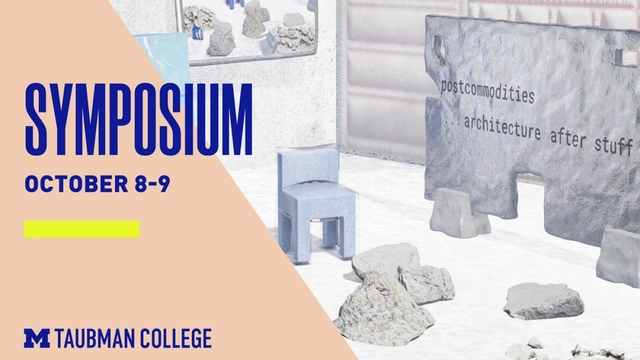
One person’s wishlist is already another person’s problem. Prime Day is cruel and you can’t afford the bag your culture is printed on. This persistent materialism is contributing to social inequity and climate crisis alike and from quarries to distribution centers to construction methods, architecture is implicated at all scales of this material overproduction.
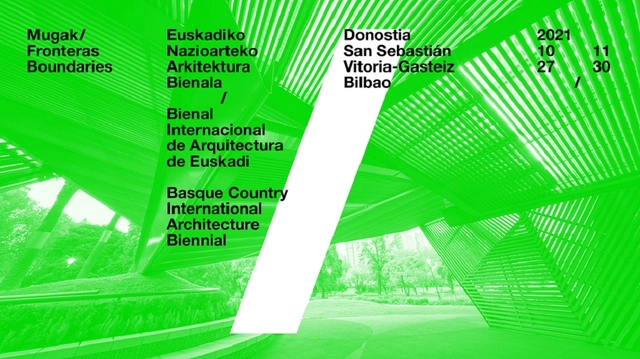
The most significant architecture event in northern Spain will take place in November: the Mugak International Architecture Biennial of the Basque Country will fill the three Basque capitals with architecture, featuring over fifty exhibitions, lectures, screenings, and workshops.
Cities face enormous challenges: The energy transition, climate adaptation and, the enormous challenge to build houses for growing populations. As more and more people live in cities, we consider how architecture and landscape design can be adapted to their needs.
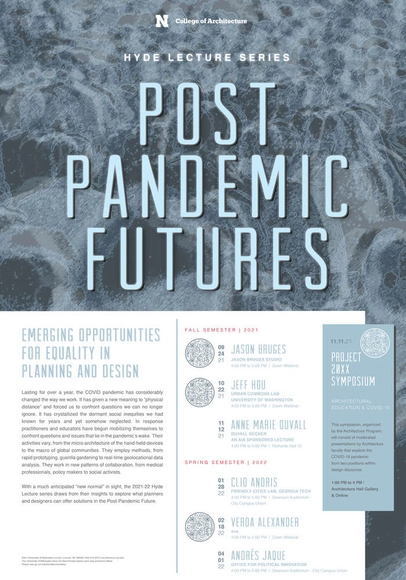
Lasting for over a year, the COVID pandemic has considerably changed the way we work. It has given a new meaning to “physical distance” and forced us to confront questions we can no longer ignore. It has crystallized the dormant social inequities we had known for years and yet somehow neglected. In response practitioners and educators have begun mobilizing themselves to confront questions and issues that lie in the pandemic’s wake. Their activities vary, from the micro architecture of the hand-held devices to the macro of global communities. They employ methods, from rapid prototyping, guerilla gardening to real time geolocational data analysis. They work in new patterns of collaboration, from medical professionals, policy makers to social activists.
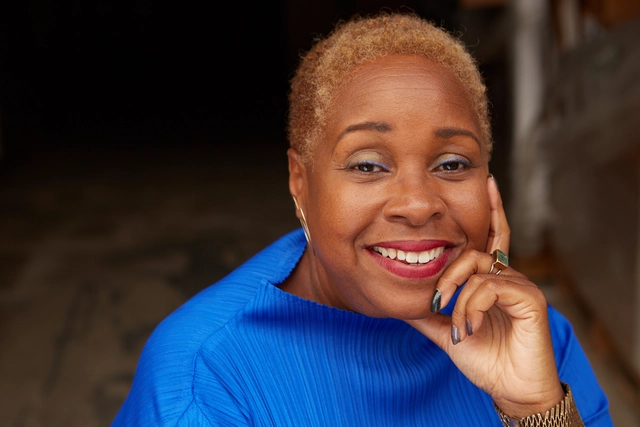
Celebrate the ground-breaking work and accomplishments of Mabel O. Wilson, the Nancy and George E. Rupp Professor of Architecture, Planning, and Preservation at Columbia University. Wilson is the 23rd recipient of the National Building Museum's annual Vincent Scully Prize. An architect, scholar, researcher, artist, writer, and curator, Wilson's work focuses on Black culture and history and the ways they intersect with the built environment. In a conversation with Steven Nelson, Dean of the Center for Advanced Study in the Visual Arts at the National Gallery of Art, Wilson will discuss her career and ongoing work to expand the narrative of African American contributions to the built environment.
The exhibition OASIS opened at the Estonian Museum of Architecture in Tallinn brings together different projects of designers/artists/architects who created contemporary micro-climates for survival in a hostile environment.
Independence Library Apartments By John Ronan Architects
Join the Chicago Architecture Center as we celebrate 25 years of the Driehaus Foundation Award, which encourages quality design in Chicago’s neighborhoods. Our panel discussion will explore the impact of the award and the unique and inspiring partnerships it has fostered. This program is part of Open House Chicago 2021.
Archifest is back in October, as a bigger, better and more inclusive celebration of great design. With over 100 events spread out across the island and online, the month-long Architecture Festival - organised by the Singapore Institute of Architects (SIA) - promises to have something for everyone, appealing both to architecture enthusiasts, and to the general public.
As part of the curatorial cycle "Preparing the cohabitation of plants, animals and people," barco galería invites you to tune into the series of conversations accompanying the installation "A Thicket and a Palm at a Street," conceived in collaboration with the Berlin-based practice Something Fantastic. The series consists of four meetings that expand on the questions raised by the installation, connecting them to broader issues.