From social, racial, economic inequity to virtual, immersive environments, the COVID-19 pandemic is reshaping trends and pushing societies to discuss how we will live together in the future.
In this context, architecture has been navigating through sequential changes over the last decades with the rise and latter consolidation of new technologies, tools, formats, topics, scales, and interdisciplinary approaches, along with the emergence of the Internet that led towards a disruptive decentralization of the architecture production and discussion. Architects and designers from all over the world are embracing these challenges by pondering their roles and exploring their own practical approaches.
Escola da Cidade’s open courses are short-term and cover a diverse range of topics. They are intended for those interested in expanding dialogues on subjects such as history, anthropology, technology, economics, photography, literature, design, and music, among others, through cross-disciplinary perspectives on architecture and the city.
In recent months, we have witnessed one of the crises that has most profoundly challenged our "essence"—our ways of living, working, communicating, socializing, and even relating to one another. These issues, which transcend the health emergency and the pandemic, have prompted us to reflect on topics related to the environment, sustainability, the efficiency of segregating activities, the frantic mobility to which we had become accustomed, the need for flexible spaces in homes and cities, and the nature of public spaces when social distancing is mandatory.
Architecture performs through bodies. Its conceptualization entails choreographing bodily movements. Drawings are spatial scripts, to which bodies perform in conformity, transgression, re-appropriation, or indifference. Performances can be corporeal or phenomenological, planned or spontaneous, everyday or a singularity. They charge architecture with vibrant energies disrupting the exigencies and politics of built spaces. The 10th issue of Room One Thousand, “Body + Performance,” seeks for performance to expand and challenge our understanding of architecture and its impact. Performance can be understood as an object, phenomenon, commodity, or metaphor. The convergence of architecture and performance captures the corporeality, tactility, and sensuality of a space. How can architecture be read through the lens of performance? Who is the performer, the building or the body? What are the design implications of highlighting the agency and plurality of bodies? What happens when architectural practice shifts from performance to production? How can performance be a methodology in design?
1. Armin Linke, Lake Assal, extraction of salt, Djibouti, Africa, 2012. Courtesy Armin Linke and Vistamare / Vistamarestudio, Pescara / Milano.
Sophia Journal is currently accepting submissions on the theme of its third thematic cycle “Landscapes of Care”, addressing contemporary photography and visual practices that focus on how architecture understood in a wide sense can help to heal a broken planet. The concept of “Landscapes of Care” has increasingly been adopted by diverse areas of study, from health geography to the arts and architecture. It allows us to understand architecture, city and territory as living and inclusive organisms, constituted by multifaceted landscapes with complex social and organisational spatialities which embody the difference and the other, the strange, the unfamiliar, the indigenous, the human and the non-human. Our aim is to explore the ways in which the image can be used as a meaningful instrument of research about the multifaceted complex socioeconomic, political, historical, technical and ecological dimensions of architecture, city and territory that testify, question or emerge from those relationships of care.
As part of a collaboration agreement between the company Cerámica Santiago and the UDD Faculty of Architecture, the 2021 Brick Week will take place throughout October. The event aims to position brick—and ceramic derivatives—as a valuable resource for both architectural design and construction.
mOOO calls on architects live in every continent to submit successful and unsuccessful stories of their ventures in a video format, to fire up young architects to create their unique careers and realise the full potential of an architect’s skill set.
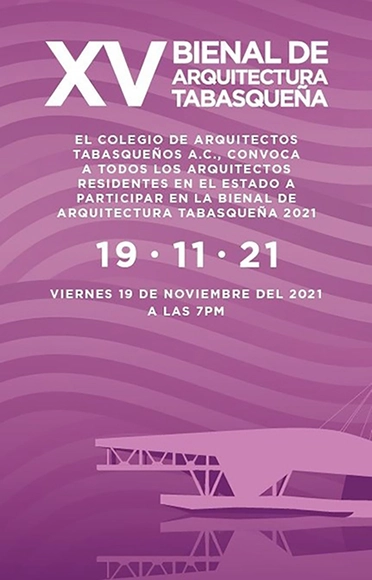
Identify the best architectural works by architects in the state of Tabasco, as well as publications, research, and theses. Recognize their authors. Disseminate the most relevant works to allow, through analysis and critique, a reflection on responsible contemporary architecture with sustainable solutions.
11th Urban Design Meeting “Towards the realization of urban agendas. Cases of urgency”. READU, University of La Serena and PuntoColectivo.
The Academic Network of Urban Design, the Department of Architecture at the University of La Serena, and Punto Colectivo invite project submissions—from both professional practice and academic workshops—that demonstrate how the broad goals of urban agendas (Sustainable Development Goals, Habitat III, etc.) can be translated into concrete urban design interventions for cases requiring urgent action.
4th Ciudades Cómo Vamos Forum - Apply by October 3rd
The Ciudades Cómo Vamos Forum is a space for discovery and discussion regarding the present and future of cities, promoted by Lima Cómo Vamos. Its objective is to share approaches, evidence, and proposals concerning the country's cities, and to facilitate the dissemination of multi-stakeholder efforts aimed at improving urban areas in Peru.
Fundación Tejido Urbano, a research space focused on urban habitat issues that aims to combat housing problems in the city and raise social awareness, has launched its second open call for research on urbanism, housing, and new forms of habitat in the Buenos Aires Metropolitan Area (AMBA).
From October 4th to 31st, all those interested in sustainable urbanization are invited to participate in the UN's global campaign on sustainable urban development: How to overcome the climate crisis?
4th Ciudades Cómo Vamos Forum - Submit your workshop, project, or research by September 19th
Be part of the 4th Ciudades Cómo Vamos Forum! The Forum is a space for discovery and discussion regarding the present and future of cities, promoted by Lima Cómo Vamos. It aims to share approaches, evidence, and proposals concerning the country's cities, and serves as a platform to highlight the multi-stakeholder efforts being made to improve urban areas in Peru.
Participate and secure a fee waiver for the 2022 selection process.
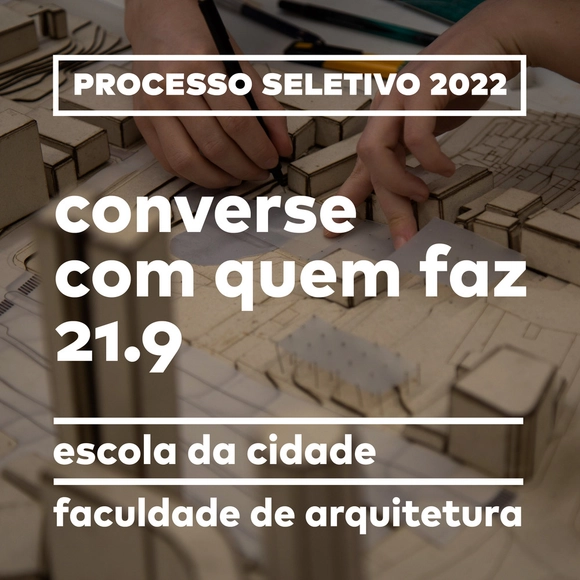
On September 21 at 6:00 PM, Escola da Cidade is hosting a conversation between alumni, current members of the school (students, faculty, or coordinators), and prospective students interested in our undergraduate program in Architecture and Urbanism. This free, online event will explore various perspectives on education and career paths in the field. Participants will receive a full application fee waiver for the 2022 admissions process.
In an endeavor to further a dialogue around design and our built environment, we are introducing "Design Dialogue" as an ongoing feature on our website at: https://www.arcdeck.net/. This would be a collection of essays, images, sketches, renderings, thoughts or even architectural photography along with author's commentary.
The São Paulo State Government, through the Secretariat of Culture and Creative Economy, presents the exhibition “Artacho Jurado in the City’s Design” at the Galeria da Cidade. The exhibition, which focuses on the self-taught architect who designed and built landmarks of modern São Paulo such as the Bretagne, Cinderela, and Louvre buildings, opens to the public on Saturday, September 4—the date marking the 114th anniversary of his birth. In accordance with COVID-19 safety protocols, visitation is limited to a maximum capacity of 10 people. Those interested in scheduling a visit may do so via email at: artachonacidade@gmail.com