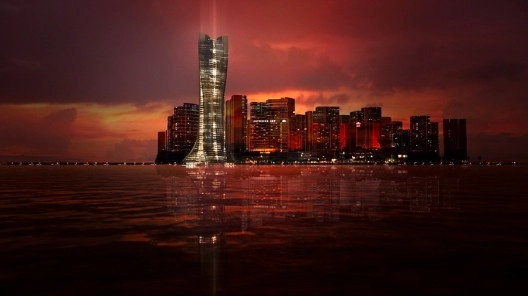
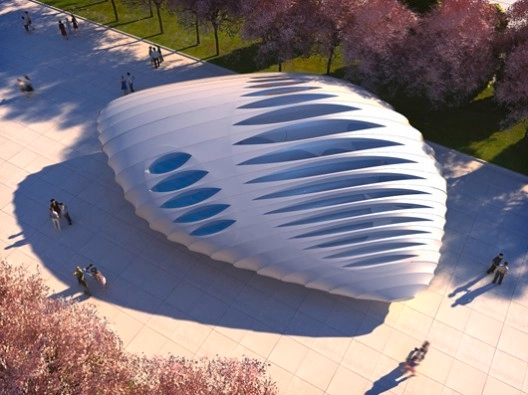
The Macau Pavilion at Shanghai World Expo 2010 will take the shape of a jade rabbit lantern. Designed by Chinese firm Carlos Marreiros Architects the pavilion will be wrapped with a double-layer glass membrane and feature fluorescent screens on its outer walls. Balloons will serve as the head and tail of the ‘rabbit’, which can be moved up and down to attract visitors.
The building will be constructed with recyclable materials and consists of solar power panels and rain collection systems. The design was inspired by rabbit lanterns popular during the mid-autumn festival in south China in ancient times.
Probably the most impressive thing for someone who visits for the first time cities like New York, Shanghai or Dubai is the ridiculous size of it’s buildings. So to finish this week of Round Up, we bring you previously featured skyscraper on ArchDaily.
The Smithsonian’s Cooper-Hewitt, National Design Museum will celebrate outstanding achievement in design this fall with its 10th annual National Design Awards program. Today, Cooper-Hewitt Director Paul Warwick Thompson announced the winners and finalists of the 2009 National Design Awards, which recognize excellence across a variety of disciplines.
Among several categories, some of the winners are:
French architect Dominique Perrault has been selected to design the new city center of Bulgaria’s capital Sofia. The city center will be built in the next ten years and will house various state institutions. The center will be located along Sofia’s main boulevard “Tsarigradsko Shosse”. The vision of Bulgarian prime minister Sergei Stanishev and his brother – architect Georgii Stanishev – is to gather ministries and state agencies in the new “Sofia city”, relocated from the current center of Sofia.
Perrault was selected among six practices, all of them world architectural design leaders including Zaha Hadid, Norman Foster, and Massimiliano Fuksas. Two Bulgarian firms also participated in the final stages of the contest.
Seen at Bustler. More images of Perrault, Foster and Hadid’s proposals after the break.
The fractional ownership super-yacht company YachtPlus launched its first yacht – The Ocean Emerald – in La Spezia, Italy on April 25 in the presence of Norman Foster.
This contemporary 41 metre yacht has been designed with a strong emphasis on space and light and has five suites for up to 12 guests, who will be looked after by a permanent, highly trained crew of seven. The internal planning of the yacht offers total flexibility to respond to the diverse requirements of the owners and their guests and keen attention has been paid to design and detail ranging from the internal (2,790sqft) and external (2,495sqft) areas to cutlery, crockery, fabrics and crew uniforms. All furnishings and fittings are provided by the Italian manufacturer Cassina and kitchen and galley equipment by Schiffini.
Ocean Emerald will be the first of four identical Foster + Partners designed super-yachts to be launched by the company over the next two years. The second yacht, Ocean Pearl will enter service in the autumn 2009 and the third, Ocean Sapphire in the early part of 2010. The fourth yacht, as yet unnamed, is scheduled to launch in the latter part of 2010.
More information here. More images, after the break.
Amsterdam City Council recently held ‘The Silo Competition’ which involved the adaptive and reuse design for two former sewage treatment silos in the city’s Zeeburg district.
For the competition NL Architects proposed silos dedicated to climbing, sports and culture. In their design the existing structures were extended to the maximum height to benefit from the views.
The cultural silo consists of two theaters with dressing rooms and rehearsal spaces, spaces for workshops, exhibition spaces, music studios and a space for hair design. A bridge connects the silos at the height of the original roof level and office spaces will be positioned on top. The top level will be dedicated to a restaurant with 360 views and a roof terrace.
Norwegian architecture firm Snøhetta has won the Mies van der Rohe architecture award for the Norwegian National Opera and Ballet in Oslo (previously featured on AD), the Mies van der Rohe Foundation announced Wednesday in Barcelona.
Today, we show you Francois Blanciak Architect’s proposal. As a cultural reference to a taiwanese aboriginal construction technique using slabstone heaps, the project similarly piles up 4 slabstones (3 containing theaters, 1containing administrative spaces) in a cairn-like structure. In order to emphasize the public nature of the building, it is elevated on top of a wide upper plaza, upon a plinth that liberates the movement of pedestrians on the ground level.
Zaha Hadid has been awarded on several ocations, including the Pritzker Prize, becoming the first woman to win the prize. So to start this week of Round Up, we bring you previously featured projects of Zaha Hadid (and an interview).
The Goethe-Institut New York marks the opening of its downtown events space with Reinventing Goethe, an ongoing series of lectures and performances by emerging and internationally acclaimed artists, architects and designers.
The Goethe-Institut New York presents What Is Green Architecture?, a series of conversations, lectures, and events exploring the cutting-edge developments in the field and their impact on contemporary life as well as implications for the future. The series continues with a talk by noted architect Prof. Manfred Hegger, followed by a discussion moderated by Matthias Hollwich.
Prince Charles is against the modern design with glass and steel used by architects in the Chelsea district, and wants them to use a more traditional design using stones and bricks. The Sunday Times also said that Prince Charles showed his concern to Qatar’s royal family, owner of the site.
Urban Age Public Debate Series presents “Architecture as Investment, New Forms of Social Equity”, with ELEMENTAL‘s Executive Director Alejandro Aravena.
The glass tower by Eric Owen Moss Architects is encouraging the re-development of South Central Los Angeles with this project. The building has been in planning since the nineties but was stalled for some years until it was re-designed in 2006 as a single tower.
A rail line installed nearby spurred the redesign. The structure is part of the redevelopment of South Central LA, an area plagued with poverty and violence for many years. The project was originally conceived of with a structural strategy, consisting of curvilinear ribbons wrapping two main volumes.
The new design remains very similar with the same ribbon theme, but as a single volume. as the area’s only high-rise, office tenants will enjoy wide, open views of the city. a train stop sits directly outside the building, but car parking was also a main concern for the architects. The aforementioned ribbon scheme provides the building’s structure, making each floor completely open. The ribbons are made from steel tubes filled with concrete. Each floor was the same flexible plan but comes in three distinct heights of 13, 16 and 24 feet, to offer further flexibility.
The Faculty of Architecture, Building and Planning at the University of Melbourne, in association with the University’s Property and Campus Services department, is seeking to appoint an architect or architectural team to design a new building for the Faculty, to be located on the Melbourne University Parkville Campus. The process of appointment will be via a limited competition to be held in 2009. Architects and architectural teams who wish to be considered for selection into the competition are invited to submit an expression of interest.
Choosing the main material for your house may be quite a problem. Wood? Steel? Or stone? So to finish this week’s Round Up, we bring you previoulsy featured stone houses on ArchDaily.
The Mohawk Group, along with Interior Design Magazine and IIDA, is hosting a number of FREE workshops designed to help displaced designers and architects get back to the drawing board and back to work.