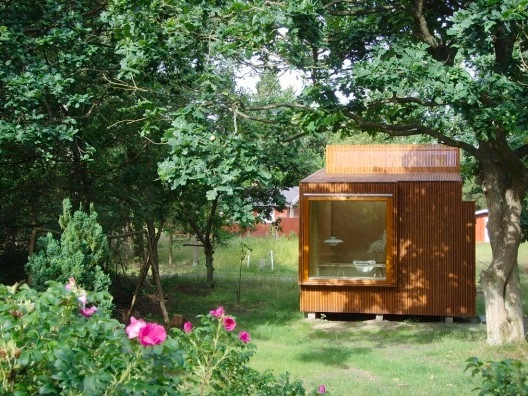
Dorte Mandrup Arkitekter is a Denmark-based architecture firm with a tremendous variety in their projects. From a day care centre, to a summerhouse, a water tower, and a sports centre, we bring you previously featured projects by Dorte Mandrup.


Dorte Mandrup Arkitekter is a Denmark-based architecture firm with a tremendous variety in their projects. From a day care centre, to a summerhouse, a water tower, and a sports centre, we bring you previously featured projects by Dorte Mandrup.
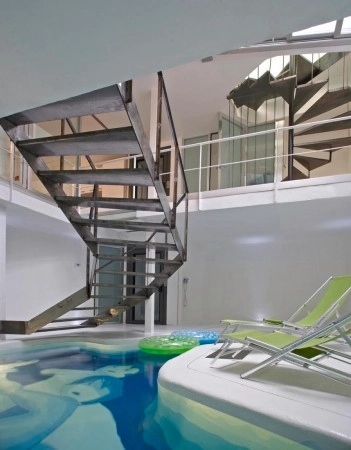
I guess there’s nothing better to sit back and relax after a long week than a pool. Fun and refreshing, pool houses are just great. So now, we bring you our Round Up of previously featured pool houses on ArchDaily.
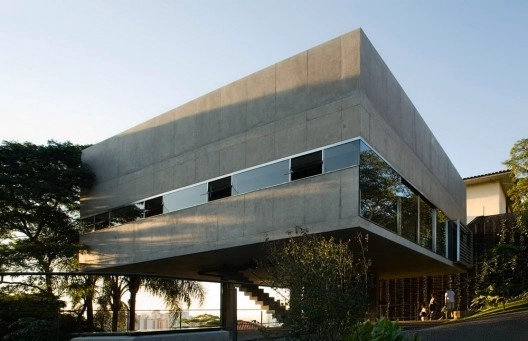
Last week we featured a Round Up of houses from the United States. So for you to start comparing different architecture at different places, we bring you our first Round Up of previously featured houses from Latin America.

Adam Kalkin’s Push Button House 1 demonstrates how industrial products can repurposed as architectural elements, or as entire homes. The Push Button House was originally displayed at Art Basel Miami in 2005, and uses a standard shipping container as the structure of a home.
Kalkin’s concept uses hydraulic power to lift and lower the sides of the shipping container, vastly expanding the usable living space. His design incorporates bedrooms, a bathroom, kitchenette, and living area. Though not actually viable for use as a home, Kalkin’s Push Button House is one of many shipping container concepts that utilize an object that might otherwise lie dormant.
Seen at SwipeLife. More images after the break.
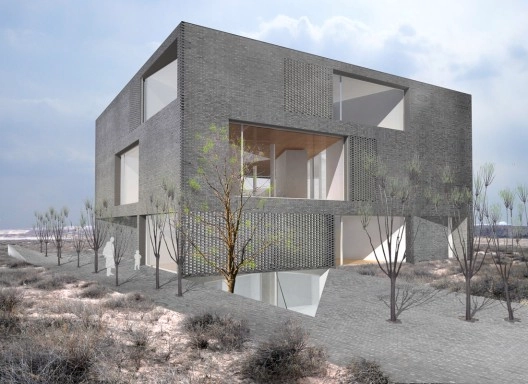
ORDOS 100 is a development in Inner Mongolia that you might have heard of. It consist of one hundred 1000sqm villas designed by 100 hip architects in 100 days, selected by Herzog & de Meuron over a master plan developed and curated by Ai Wei Wei (FAKE Design). So now we bring you our first Round Up of the first ORDOS project’s featured on ArchDaily.

Romses Architects has designed “Harvest Green Project-02′ as a part of Vancouver ‘The 2030 Challenge’. Harvest Green Project is rooted in a concept that challenges the status quo of how energy and food is produced, delivered and sustained in our city, neighbourhoods, and individual single-family homes.
Taking cues from the citys eco-density charter, and in particular, it’s new laneway housing initiatives, the Harvest Green Project proposes to overlay a new ‘green energy and food web’ across the numerous residential neighborhoods and laneways within the city as these communities address future increased densification. The city’s laneways will be transformed into green energy and food conduits, or ‘green streets’, where energy and food is ‘harvested’ via proposed micro laneway live-work homes.
Seen at designboom. More images after the break.

Guedes was part of the legendary Team 10, often referred to as “Team X”, a group of architects and other invited participants who assembled starting in July 1953 at the 9th Congress of CIAM and created a schism within CIAM by challenging its doctrinare approach to urbanism.

Snøhetta create a unified vision for Gambia’s higher level educational institutions with the new University of Gambia. The new university will relocate and unite three of Gambia’s existing formal institutions and one university in a single campus for 15,000 students. In addition to designing with the educational experience in mind, Snøhetta also want the project to set new environmental standards.
Part of this plan involves a solar park for generating energy, a waste management centre and locally done water harvesting. Because the masterplan for the university was previously undeveloped, there was no infrastructure, allowing the architects to re-invent the established western conventions. Snøhetta worked to develop a campus based on Gambian traditions in architecture and culture.
Seen at designboom. More images after the break.

The Pavilion will initially appear as part of Tent London’s exhibit at the London Design Festival 2009 before taking up residence at The Lightbox as an annual summer pavilion and gallery space. The structure is to be engineered and constructed by Facit and funded by the Lightbox Museum’s £100,000 Art Fund Prize 2008.
More images and architect’s description after the break.
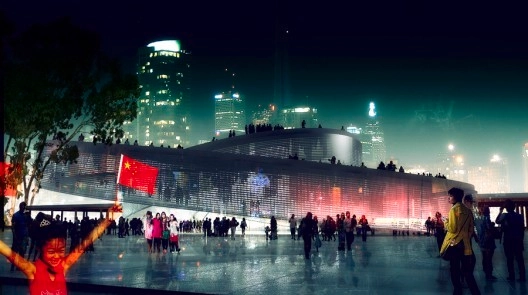
The Shanghai 2010 World Expo will without a doubt be a huge event. Countries from all around the world will show what they have to offer in gigantic pavillions built specially for the occasion. So we bring your our first Round Up of previously featured Shanghai Pavillions on ArchDaily.

Eric Owen Moss Architects designed a parking structure and retail space in Culver City, California. Located in the “Conjunctive Points” development, the new structure will serve local residents and business with a new parking garage and 50,000 square feet of retail and restaurant space.
The area is a growing hub that is in need of additional parking space (a necessity in the city of Los Angeles). The project will provide an additional 800 spaces below its three story retail space. The structure will feature an open courtyard that is covered with an installation that features 196 glass tubes suspended above at various lengths.
Seen at designboom. More images after the break.

The Biotope converts the remains of an old water purification plant in an ecological mixed use development. Conceived as an ecological education centre, the Biotope will be the home for eco-related institutes like IUCN (International Union for Conservation of Nature), for several schools of Amsterdam, for residential spaces and for sport facilities.
More info and images after the break.

Rafael López de Heredia Tondonia Winery is one of the oldest and more famous winery in the Spanish region of La Rioja. To celebrate their 125th anniversary they decided to rehabilitate a very old store that the winery founder took to Brussel’s World Fair in 1910 and had been disassembled ever since.
In 2002 current owners (direct descendants of the founder), discovered how beautiful the old store was and decided to built an exterior volume to house the old store. This would become the future wine store and a place where visitors could taste the great wines they produce. This pavillion is only part of all the project that will include three more tasting rooms and a cleaning room. More images and architect’s description after the break.

Here’s Francois Blanciak Architects proposal for the TyssenKrupp Elevator Award to develop an iconic tall emblem structure for Zaabeel Park in Dubai.
This is one of the 926 proposals submitted for the competition.
Seen at designboom. More images and architect’s description after the break.

The prize winners of the re-Growth House competition were recently announced. The competition, organised on behalf of the people of Victoria that lost their homes in the Black Saturday bushfires, sought inspirational design ideas that can offer a way, for residents who have lost their homes to the bushfires, to re-build.
The first stage of the competition attracted 36 entries that were assessed anonymously, with seven shortlisted. The panel included Adam Kalkin, Marcus Trimble, Dan Honey, Peter Johns and Stoney and Jacqueline Black a family that lost their home in the fires and are now living in the re-Growth Pod.
Images and architect’s description of the four winning proposals, after the break.
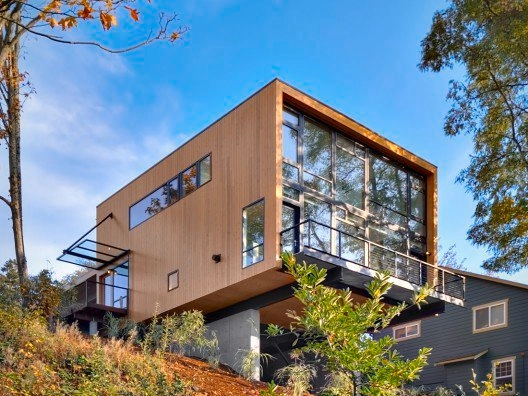
Architecture can tell us a lot about the places in which the projects are located. So to start comparing different architecture in different countries, we bring you previously featured houses in USA. Next week, houses in Latin America.

“Panelion” was selected as an exception entry and will be exhibited at The Lightbox London.
More images and architect’s description, after the break.

The second cycle of the Holcim Awards competition has reached its pinnacle: the top sustainable construction projects out of thousands of submissions from all continents have been selected. THOLChe four winning entries are a river remediation scheme in Morocco, a greenfield university campus in Vietnam, a rural planning strategy in China, and a shelter for day laborers in the USA. A series of prize-handovers will be held at the site of each project to celebrate the winners and their highly-acclaimed examples of sustainable construction.
Almost 5,000 sustainable construction projects and visions from 121 countries entered the five regional Holcim Awards competitions in 2008. Winners of the Gold, Silver and Bronze Awards in each region automatically qualified for the Global Holcim Awards competition in 2009. The global jury was headed by Charles Correa (architect, India) and included Peter Head (structural engineer, UK), Enrique Norten (architect, Mexico/USA), Saskia Sassen (sociologist, USA), Hans-Rudolf Schalcher (civil engineer, Switzerland), and Rolf Soiron (economist, Switzerland).
More images and description of the winning projects, after the break.